EU, India successfully conclude major trade deal: New Delhi
EU, India successfully conclude major trade deal: New Delhi/node/2630720/world
EU, India successfully conclude major trade deal: New Delhi
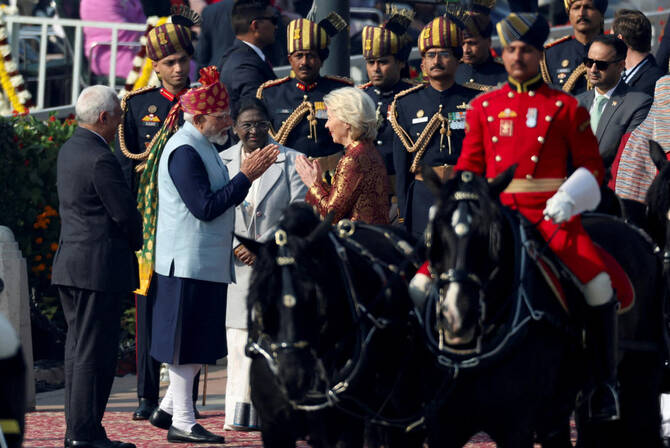
India's Prime Minister Narendra Modi greets European Commission President Ursula von der Leyen as she arrives to attend the Republic Day parade in New Delhi on Monday. (Reuters)
EU, India successfully conclude major trade deal: New Delhi
Indian government officials say the pact, which was two decades in the making, will be unveiled Tuesday
European Commission President Ursula von der Leyen and European Council president Antonio Costa appear as guests of honor at India’s Republic Day parade
Updated 26 January 2026
AFP
NEW DELHI: India and the European Union have finalized a massive free trade deal, Indian government officials said on Monday, about two decades after negotiations were first launched.
Facing challenges from China and the United States, Brussels and New Delhi have sought closer ties, producing a pact that is to be unveiled in the Indian capital on Tuesday.
Feted Monday as guests of honor at India’s Republic Day parade, European Commission President Ursula von der Leyen and European Council president Antonio Costa are to meet Indian Prime Minister Narendra Modi for a summit.
“Official level negotiations are being concluded and both sides are all set to announce the successful conclusion” of talks at the Tuesday summit, Indian commerce secretary Rajesh Agrawal told AFP.
The EU has eyed India — the world’s most populous nation — as an important market for the future, while New Delhi sees the European bloc as an important source of much-needed technology and investment to rapidly upscale its infrastructure and create millions of new jobs.
’Mother of all deals’
Bilateral trade in goods reached 120 billion euros ($139 billion) in 2024, an increase of nearly 90 percent over the past decade, according to EU figures, with a further 60 billion euros ($69 billion) in trade in services.
India’s Commerce Minister Piyush Goyal has described the new pact as “the mother of all deals.”
“Final negotiations have been focused and fruitful, and we are now very optimistic that we will land this historic trade deal,” an EU official said Monday speaking on condition of anonymity.
Under the agreement, India is expected to ease market access for key European products, including cars and wine, in return for easier exports of textiles and pharmaceuticals, among other things.
“The EU stands to gain the highest level of access ever granted to a trade partner in the traditionally protected Indian market,” von der Leyen said on Sunday, adding that she expected exports to India to double.
“We will gain a significant competitive advantage in key industrial and agri-good sectors.”
Talks went down to the wire on Monday, focusing on a few sticking points, including the impact of the EU’s carbon border tax on steel, according to sources familiar with the discussions.
The accord comes as both Brussels and New Delhi have sought to open up new markets in the face of US tariffs and Chinese export controls.
India and the EU were also expected to conclude an accord to facilitate movement for seasonal workers, students, researchers and highly skilled professionals, and a security and defense pact.
“India and Europe have made a clear choice. The choice of strategic partnership, dialogue and openness,” von der Leyen wrote on social media. “We are showing a fractured world that another way is possible.”
New Delhi, which has relied on Moscow for key military hardware for decades, has tried to cut its dependence on Russia in recent years by diversifying imports and pushing its own domestic manufacturing base.
Europe is doing the same with regard to the United States.
Jesse Jackson, civil rights leader and US presidential hopeful dies at 84, family says
Updated 5 min 35 sec ago
* Jackson was inspirational orator and civil rights champion
* He sought 1984 and 1988 Democratic presidential nomination
Washington: Charismatic US civil rights leader Jesse Jackson, an eloquent Baptist minister raised in the segregated South who became a close associate of Martin Luther King Jr and twice ran for the Democratic presidential nomination, has died at age 84, his family said in a statement on Tuesday. “Our father was a servant leader — not only to our family, but to the oppressed, the voiceless, and the overlooked around the world,” the Jackson family said. Jackson, an inspirational orator and long-time Chicagoan, was diagnosed with Parkinson’s disease in 2017. The media-savvy Jackson advocated for the rights of Black Americans and other marginalized communities dating back to the turbulent civil rights movement of the 1960s spearheaded by his mentor King, a Baptist minister and towering social activist. Jackson weathered a spate of controversies but remained America’s preeminent civil rights figure for decades. He ran for the Democratic presidential nomination in 1984 and 1988, attracting Black voters and many white liberals in mounting unexpectedly strong campaigns but fell short of becoming the first Black major party White House nominee. Ultimately, he never held elective office. Jackson founded the Chicago-based civil rights groups Operation PUSH and the National Rainbow Coalition and served as Democratic President Bill Clinton’s special envoy to Africa in the 1990s. Jackson also was instrumental in securing the release of a number of Americans and others held overseas in places including Syria, Cuba, Iraq and Serbia.
MESMERIZING ORATORY Jackson pursued his political ambitions in the 1980s, relying on his mesmerizing oratory. It was not until fellow Chicagoan Barack Obama’s election as president in 2008 that a Black candidate came as close to securing a major party presidential nomination as Jackson. In 1984, Jackson won 3.3 million votes in Democratic nominating contests, about 18 percent of those cast, and finished third behind eventual nominee Walter Mondale and Gary Hart in the race for the right to face Republican incumbent Ronald Reagan. His candidacy lost momentum after it became public that Jackson had privately called Jewish people “Hymies” and New York “Hymietown.” In 1988, Jackson was a more polished and mainstream candidate, coming in a close second in the Democratic race to face Republican George H.W. Bush. Jackson gave eventual Democratic nominee Michael Dukakis a run for his money, winning 11 state primaries and caucuses, including several in the South, and amassing 6.8 million votes in nominating contests, or 29 percent. Jackson cast himself as a barrier-breaker for people of color, the impoverished and the powerless. He electrified the 1988 Democratic convention with a speech telling his life story and calling on Americans to find common ground. “America is not a blanket woven from one thread, one color, one cloth,” Jackson told the delegates in Atlanta. “Wherever you are tonight, you can make it. Hold your head high, stick your chest out. You can make it. It gets dark sometimes, but the morning comes. Don’t you surrender. Suffering breeds character, character breeds faith. In the end, faith will not disappoint,” Jackson added. Jackson announced in 2017 at age 76 that he had been diagnosed with Parkinson’s disease, a movement disorder marked by trembling, stiffness and poor balance and coordination, after experiencing symptoms for three years.
SOUTHERN ROOTS Born on Oct. 8, 1941, in Greenville, South Carolina, his mother was a 16-year-old high school student and his father was a 33-year-old married man who lived next door. His mother later married another man who adopted Jackson. He grew up amid the Jim Crow era in the United States, the often brutally enforced web of racist laws and practices born in the South to subjugate Black Americans. Jackson earned a football scholarship at the University of Illinois, but transferred to a historically Black college because he said he experienced discrimination. He began his civil rights activism while a student at North Carolina Agricultural & Technical College, and was arrested when he sought to enter a “whites-only” public library in South Carolina. He attended Chicago Theological Seminary and was ordained a Baptist minister in 1968 despite failing to graduate. Jackson became a lieutenant to civil rights leader Martin Luther King Jr and sometimes traveled with him. On the day King was assassinated by a white man named James Earl Ray on the balcony of the Lorraine Motel in Memphis, Jackson was just a floor below. Jackson infuriated some of King’s other associates when he told reporters he had cradled the dying King in his arms and was the last person to whom King spoke, an account they disputed. King, who headed the Southern Christian Leadership Conference, had installed the energetic Jackson in a leadership role to help create economic opportunities in Black communities. Jackson later broke with King’s successor at the SCLC, Ralph Abernathy, and set up his own civil rights organization in Chicago, Operation PUSH, in the early 1970s. In 1984, Jackson founded the National Rainbow Coalition, whose broader civil rights mission also included women’s rights and gay rights, and the two organizations merged in 1996. He stepped down as the president of Rainbow-PUSH Coalition in 2023 after more than five decades of leadership and activism. He met his wife, Jacqueline Brown, during college. They married in 1962 and had five children. His son Jesse Jackson Jr. was elected to the US House of Representatives but resigned and served prison time on a fraud conviction. Jackson also had a daughter out of wedlock in 1999 with a woman who worked at his civil rights groups, which became a scandal. Jackson was known for personal diplomacy. After he secured the 1984 release by Syria of US naval aviator Robert Goodman Jr., President Ronald Reagan invited Jackson to the White House and expressed gratitude for the “mission of mercy.” Jackson met in 1990 with Iraqi leader Saddam Hussein to gain the release of hundreds of Americans and others after Iraq’s invasion of Kuwait. He won the 1984 release of dozens of Cuban and American prisoners from Cuban jails and the release of three US airmen held in Serbia in 1999. He hosted a weekly show on CNN from 1992 to 2000, pressed corporations for Black economic empowerment, and received the highest US civilian honor, the Presidential Medal of Freedom from Clinton in 2000. Jackson continued his activism later in life, condemning the police killing of George Floyd and other Black Americans in 2020 amid the global racial justice movement.