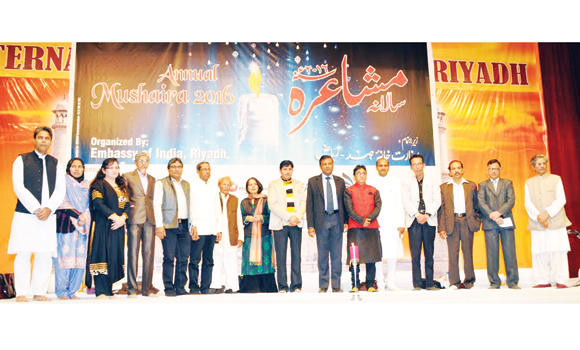
RIYADH: A number of Urdu poets regaled about 2,000 non-resident Indians (NRIs) at a poetry evening (mushaira) organized by the Indian Embassy at the International Indian School-Riyadh (IISR) at the weekend.
The literary event was inaugurated by Hemant Kotalwar, charge d’affaires at the Indian Embassy, while Hifzur Rahman, embassy spokesman, delivered the welcome address.
Presided over by Tarannum Riyaz, fiction writer, critic, poet, columnist and a novelist, the mushaira was moderated by Shakeel Jamali.
He recited couplets that charged the atmosphere. One of his fine couplet that received massive appreciation was: “Hamara Haq Daba Rakha Hai Jisne/Woh Banda Haj Pe Jana Chahta Hai” (A dishonest person who is refusing to return my due is preparing to go on Haj.)
Shakeel Aazmi, a poet turned Bollywood lyricist, recited his popular couplets amid massive appreciation.
Hina Taimoori mesmerized the audience with her popular couplets and melodious voice.
Her couplet that received massive appreciation was: “Khoii Huii Si Rahti Hai Har Waqt Ab Hina/Ye Haal Ho Gaya Hai Tujhey Dekhney ke Baad (I find myself lost quite often from the moment I saw you).
Nusrat Mehdi regaled the audience with her couplets, one of which was: “Main Kya Karun Key Teri Anaa Ko Miley Sakoon/Gir Jaaon, Toot Jaaon, Bikhar Jaaon, Kya Karun?” (What should I do to satisfy your self respect? Should I destroy myself?).
Aalam Khursheed recited couplets with reference to unequal distribution of resources and irregularities in the system: “Zaroor Khot Hai Taqseem Key Tareeqon Mein/ Kaheen Chiragh Bahut Hai Kaheen Chiragh Nahi.”
Another attraction was Mukhtar Yusufi, whose entertaining comic poetry sent the audience into bursts of laughter.
The other poets at the mushaira included Akhtar Gwaliori, Nadeem Siddiqui, Malikzadah Javed, Afzal Manglori, Mehshar Afridi, Aqeel Nomani and Sohail Lakhnavi.


Indian poets regale Urdu lovers in Riyadh
Indian poets regale Urdu lovers in Riyadh

Carved by time: Saudi Arabia’s hidden geotourism gem of Razan
- Long before modern engineering, the geology of Razan functioned as effective natural infrastructure, sustaining life in an arid environment
- This utility made Razan a strategic landmark, playing a vital role in the ancient Yemeni Hajj Road
AL-LITH: Sixty kilometers north of Al-Lith governorate in the Kingdom's west, rising above the shifting sands and valleys of the Makkah region, lies a place where the earth itself tells a story. This is Razan, a geological wonder where history is not written in ink, but etched into the stone by the patient hands of wind, water, and time.
Perched atop a high rocky mass and flanked by valleys to the northwest and southeast, Razan stands in natural isolation. This geographic solitude has acted as a guardian, preserving a landscape that feels almost otherworldly — a pristine stage set by nature over millennia.
The place is defined by its striking rock formations: dense clusters of stone, stepped ridges that resemble ancient staircases, and natural ceilings sculpted by the relentless flow of seasonal torrents.
The visual impact is one of dramatic contrast — the heaviness of solid rock balanced against open, airy spaces carved by erosion. Fine channels and intricate flow patterns mark the stone, serving as fossilized evidence of the water that once rushed through these corridors, shaping the land into a rugged work of art.

Nature’s infrastructure
But Razan is more than just a scenic marvel; for centuries, it served as a lifeline. The same forces that sculpted the cliffs also hollowed out natural rock basins. These geological depressions acted as seasonal reservoirs, catching rainwater and supplementing nearby wells. Long before modern engineering, the geology of Razan functioned as effective natural infrastructure, sustaining life in an arid environment.
This utility made Razan a strategic landmark, playing a vital role in the ancient Yemeni Hajj Road. The sturdy, elevated terrain provided a natural pathway for pilgrims, offering stability and protection on their spiritual journey toward Makkah.
Today, Razan stands at the intersection of heritage and opportunity. No longer just a passage for pilgrims, it is emerging as a valuable asset for geotourism. Its unique topography offers a visual feast for travelers and a treasure trove for scientists studying geological history.
As Saudi Arabia moves toward the goals of Vision 2030, sites like Razan are finding new purpose. By transforming this geological narrative into a tourism destination, the region aims to preserve its natural heritage while breathing new life into the local economy.


