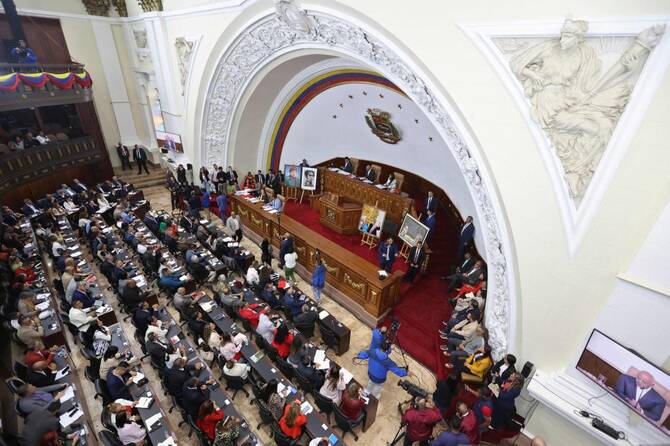
CARACAS: Venezuela’s legislature on Thursday advanced an amnesty bill proposed by acting President Delcy Rodríguez that could lead to the release of hundreds of opposition leaders, journalists and human rights activists detained for political reasons.
Such an amnesty is a central demand of the country’s opposition and human rights organizations with backing from the United States. But the contents of the bill have not been released publicly, and rights groups have so far reacted with cautious optimism — and with demands for more information.
The bill, introduced just weeks after the US military captured then-President Nicolás Maduro, still requires a second debate that has yet to be scheduled. Once approved, it must be signed by Rodríguez before it can go into effect.
In announcing the bill late last month, Rodríguez told a gathering of justices, magistrates, ministers, military brass and other government leaders that the ruling party-controlled National Assembly would take up the legislation with urgency.
“May this law serve to heal the wounds left by the political confrontation fueled by violence and extremism,” she said in a pre-taped televised event. “May it serve to redirect justice in our country, and may it serve to redirect coexistence among Venezuelans.”
Rights groups, fearing some political detainees will be excluded, want more details about the requirements for amnesty before any final vote.
The Venezuelan Program for Education-Action in Human Rights, or PROVEA, issued a statement emphasizing that the bill must be made public urgently due to its potential impact on victims’ rights and broader Venezuelan society.
Based on what is known so far about the legislation, the amnesty would cover a broad timeline, spanning the administration of the late Hugo Chávez from 1999 to 2013 and that of his political heir, Maduro, until this year. It would exclude people convicted of murder, drug trafficking, and serious human rights violations, reports indicate.


Venezuela advances amnesty bill that could lead to mass release of political prisoners
https://arab.news/zanhr
Venezuela advances amnesty bill that could lead to mass release of political prisoners

- Such an amnesty is a central demand of the country’s opposition and human rights organizations with backing from the United States


US immigration agents’ training ‘broken’: whistleblower
- The fatal shooting of two American citizens in Minneapolis in January reignited accusations that agents enforcing Trump’s militarized immigration operation are inexperienced
WASHINGTON: A former US immigration official said Monday that training for federal agents was “deficient, defective and broken,” adding to pressure on President Donald Trump’s sweeping crackdown.
Ryan Schwank resigned this month from his job teaching law at the US Immigration and Customs Enforcement (ICE) training academy in Glynco, Georgia, after he said he was instructed to teach new recruits to violate the US Constitution.
The fatal shooting of two American citizens in Minneapolis in January reignited accusations that agents enforcing Trump’s militarized immigration operation are inexperienced, undertrained and operating outside law enforcement norms.
The administration scaled back the deployment after the killings of Renee Good and Alex Pretti in broad daylight by officers sparked mass protests and widespread outrage.
Schwank told a forum hosted by congressional Democrats on Monday that he “received secretive orders to teach new cadets to violate the Constitution by entering homes without a judicial warrant.”
“Never in my career had I received such a blatantly unlawful order,” he said.
He said that ICE cut 240 hours from its 584-hour training program, curtailing subjects such as the US Constitution, lawful arrest, fire arms, the use of force and the limits of officers’ authority.
“The legally required training program at the ICE academy is deficient, defective and broken,” he said.
As a consequence, poorly trained, inexperienced armed officers were being sent to places like Minneapolis “with minimal supervision,” he said.
The lawyer’s comments coincide with the release of dozens of pages of internal ICE documents by Senate Democrats that suggest the Trump administration cut corners on training, the New York Times reported.
Schwank said he resigned on February 13 after more than four years working for ICE, and that he felt duty-bound to report inadequacies with the new training program.


