The feeling of safety and security overwhelms not only the visitors to Makkah, but seems also to percolate to the pigeons that fly around the Grand Mosque.
They confidently walk in the courtyards of the mosque in a scene that competes with the most famous pigeon squares around the world.
Once the pilgrim approaches the Grand Mosque, he faces flocks of pigeons flying and wandering around the mosque and its minarets. As the pilgrims step into the mosque, pigeons seem to welcome them.
The spectacle of the pigeons roaming around the Kaaba and worshippers without fear soothes the eyes. The pigeons have become one of Makkah’s famous sights.
Pictures of the mosque’s pigeons taken by pilgrims circulate through social media sites and frequently figure in exhibitions and photography competitions.
Pigeons of Al-Hema, as they are called by the residents of Makkah, have created many stories and good memories shared by visitors. These lovely birds have lived along the sidewalks, streets and the roofs of buildings waiting for the pilgrims’ pouches full of feed. Pilgrims feed the pigeons asking for reward from Allah. They have become part of every pilgrim’s story that he shares in his country and thus circulating around the world.
The pigeons roam the sky of Makkah and land confidently among pilgrims who feed them as part of the tradition of people of Makkah.
Abdul Razzak Muhammad, a Makkah native, said: “Pigeons and pilgrims have shared food and love. We have stories with pigeons in which they have consumed our food and water. After every dawn prayer, I go to the roof of the house to give them food and water. I love to look at them, meditate and listen to their sounds. I became familiar with them.”
Muhammad added: “We have never feared pigeons since our childhood. We have got used to them through our parents who encouraged us to love pigeons by serving food and water outside our house, the sidewalks or the square.”
The 80-year-old man said that he noticed how the pilgrims are surprised by the pigeons’ lifestyle and the way they coexist with the people of Makkah.
The Grand Mosque’s pigeons, gray-colored with shades of green, are protected by a law that prohibits their killing, Anyone who kills a pigeon is fined.
They have become the highlight of the pilgrimage experience that is engraved in the memory of the pilgrims during these blessed days of the year. Flocks of pigeons land and walk in confidence among the people performing their prayers. This does not happen with other types of birds that live outside Makkah.
Visitors of to the Grand Mosque make sure they scatter bird feed in the Haram’s courtyard where the pigeons come to pick it up. Usually, the pigeons build their nests in holes of the old Rawasheen. The pigeons have become a familiar sight of Makkah in which the pilgrims witness their flocks circle the Holy Kaaba, and the squares and minarets of the Grand Mosque.
Haram’s pigeons enjoy a breathtaking beauty and a safety that they are envied for. There are tales aplenty about the pigeons. There are various tales about the origin and the source of these pigeons. Some believe them to be the descendants of two white doves that lived at the entrance of Thor cave during the migration of Prophet Muhammad (peace be upon him) with his companion Abu Bakr (may Allah be pleased with him) to Madinah. Others have speculated that they originally came from Europe.


![]()
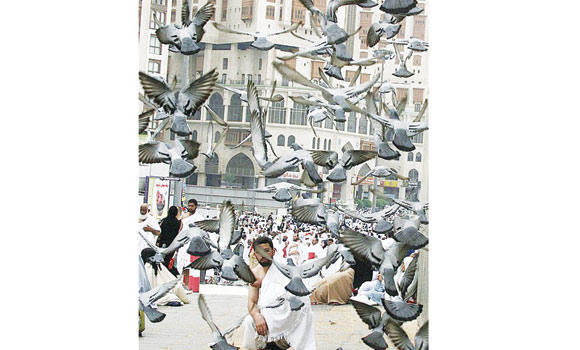
Pigeons of Grand Mosque spreading peace
Pigeons of Grand Mosque spreading peace
Latest updates


© 2026 SAUDI RESEARCH & PUBLISHING COMPANY, All Rights Reserved And subject to Terms of Use Agreement.