- Purpose-built structures offer greater control over habitat design
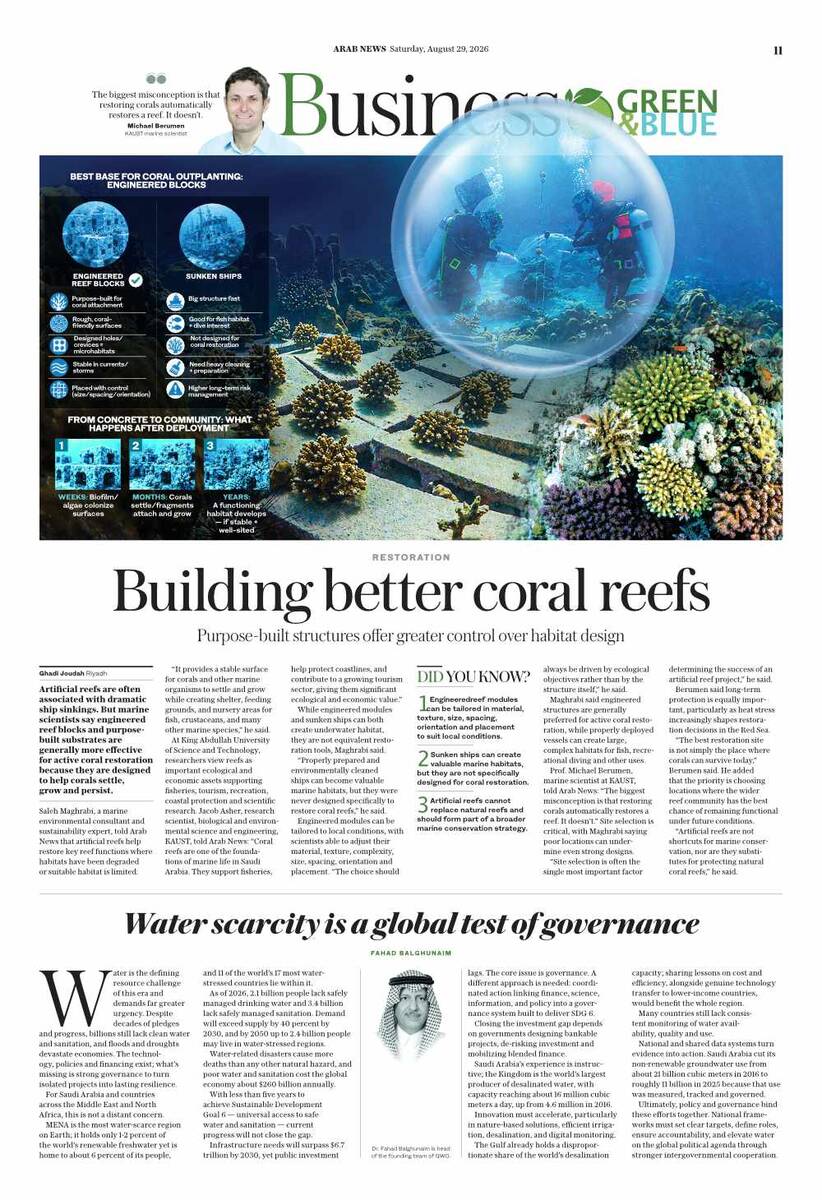
RIYADH: Artificial reefs are often associated with dramatic ship sinkings. But for active coral restoration, marine scientists say the most effective tools are often far less theatrical: engineered reef blocks and purpose-built substrates designed to help corals settle, grow and persist.
Saleh Maghrabi, a marine environmental consultant and sustainability expert, told Arab News that artificial reefs are designed to restore key reef functions in areas where habitats have been degraded or suitable habitat is limited.
“It provides a stable surface for corals and other marine organisms to settle and grow while creating shelter, feeding grounds, and nursery areas for fish, crustaceans, and many other marine species,” he said.
At King Abdullah University of Science and Technology, researchers view reefs as both ecological assets and economic infrastructure for Saudi Arabia. They support fisheries, tourism, recreation, coastal protection and scientific discovery — benefits closely tied to Vision 2030 and coastal development plans in the Red Sea and Arabian Gulf.
Jacob Asher, research scientist in biological and environmental science and engineering at KAUST, told Arab News: “Coral reefs are one of the foundations of marine life in Saudi Arabia. They support fisheries, help protect coastlines, and contribute to a growing tourism sector, giving them significant ecological and economic value.”
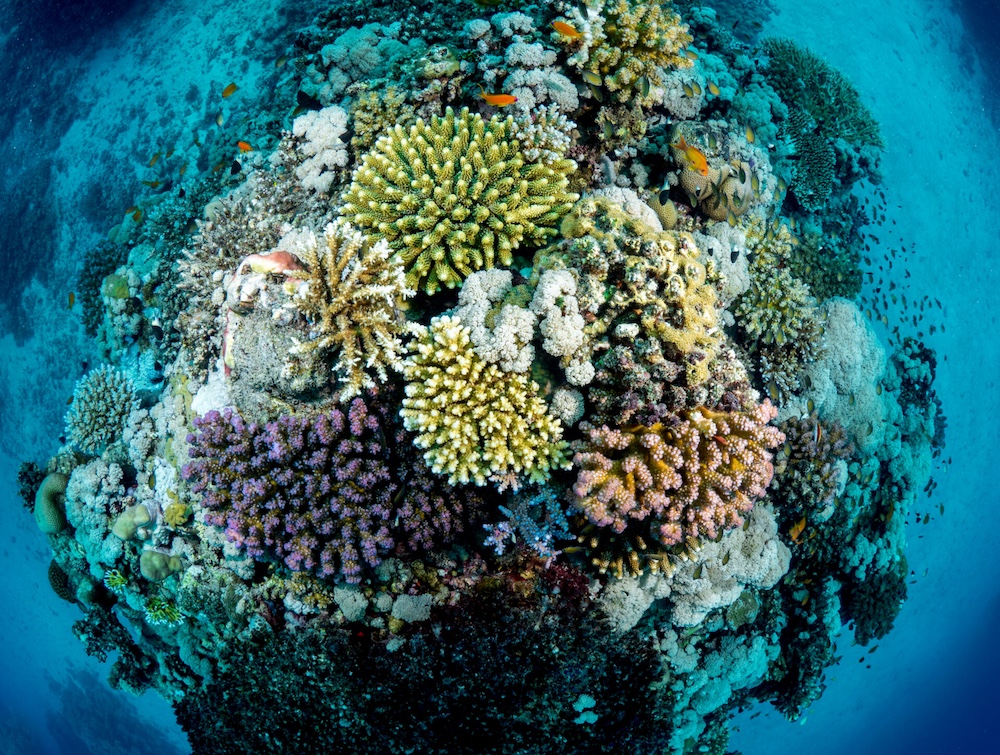
Asher said some Red Sea corals exhibit unusual heat tolerance, although prolonged thermal stress remains a global challenge.
While engineered modules and sunken ships can both add underwater habitat, Maghrabi said they are not equivalent tools, particularly when the objective is active coral restoration. Such restoration depends on suitable attachment surfaces, ecological performance and long-term outcomes rather than simply adding underwater structure.
“Properly prepared and environmentally cleaned ships can become valuable marine habitats, but they were never designed specifically to restore coral reefs,” he said.
Engineered reef modules, by contrast, are purpose-built. Their material, texture, complexity and geometry can be tailored to local conditions and restoration objectives, including their size, spacing, orientation and placement.
Maghrabi said engineered reef modules and deliberately sunk ships should not be treated as competing solutions, because they can serve different ecological purposes depending on the objective.
“The choice should always be driven by ecological objectives rather than by the structure itself,” he said.
Engineered structures are generally preferred when active coral restoration is the priority, Maghrabi said. Cleaned and properly deployed vessels, meanwhile, can be valuable when the objective is to create large, structurally complex habitats that attract fish, support recreational diving or relieve visitor pressure on natural reefs.
Beyond simply adding structure
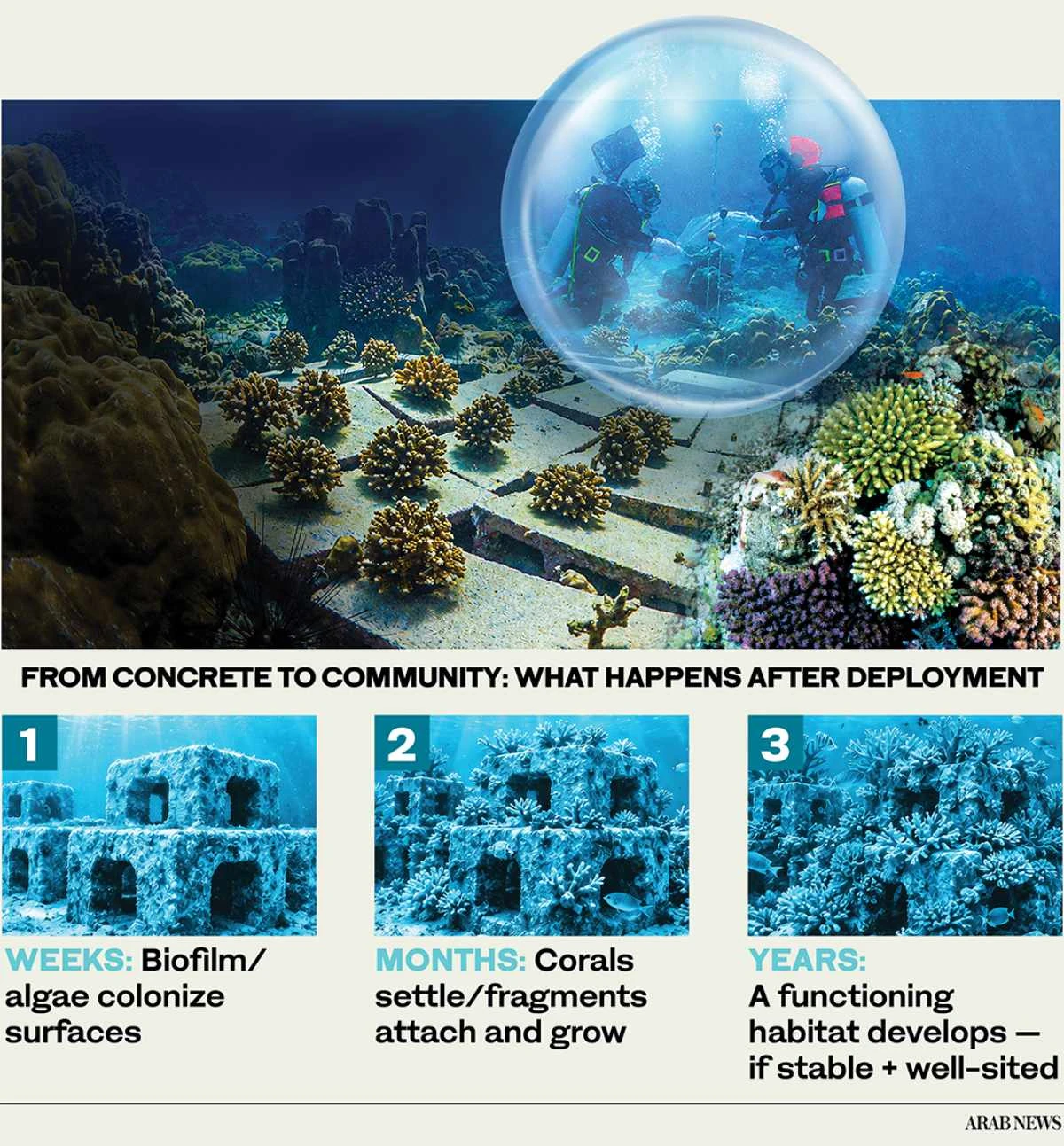
Active coral restoration can involve collecting coral fragments or larvae, growing corals in land-based or ocean nurseries, selecting suitable restoration sites, attaching or outplanting corals onto natural or engineered substrates, and monitoring survival, growth, reproduction and ecological function over time, according to KAUST researchers.
Asher said simply placing a structure underwater can attract marine life quickly. The greater test, however, is whether the site gradually develops the functions of a natural reef — a process that can take many years.
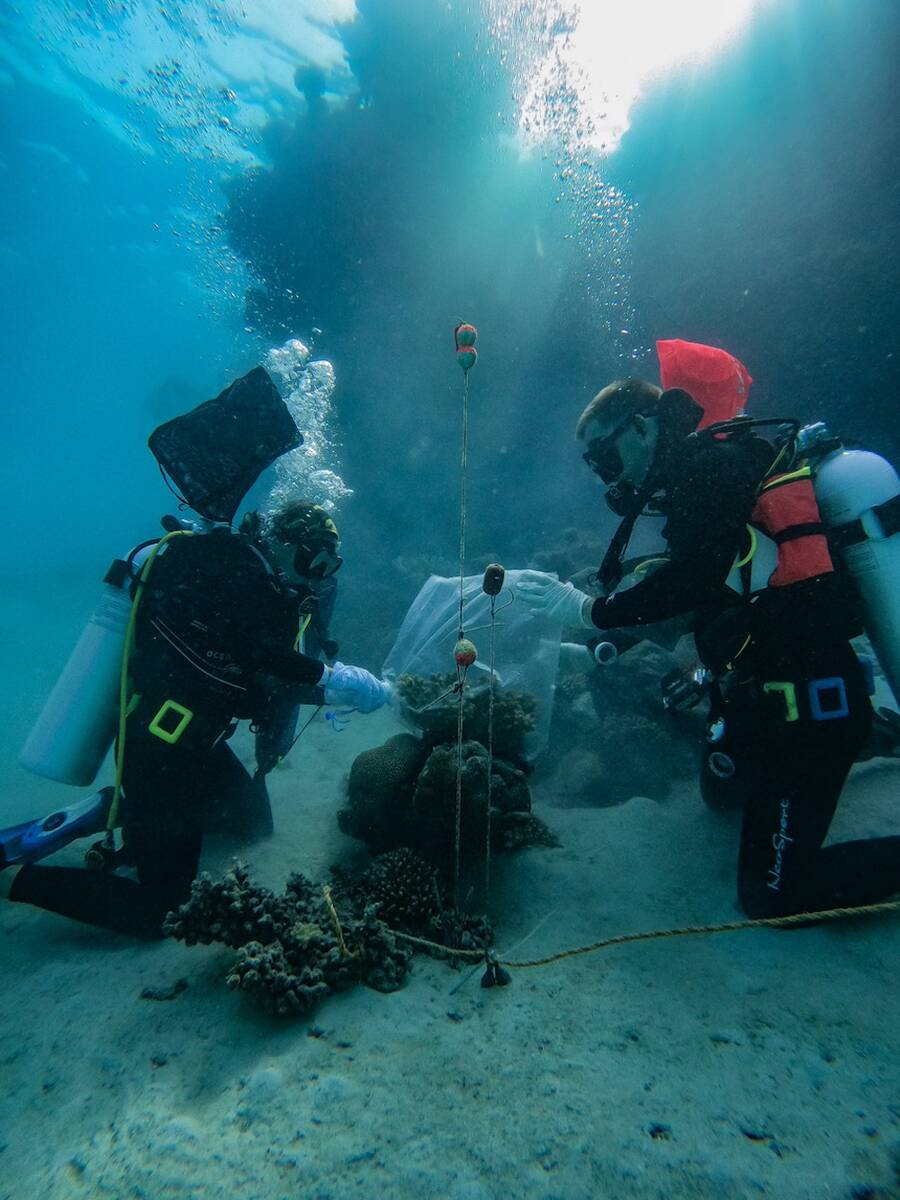
“Design has a lot to do with it: structural complexity shapes what fishes and other organisms can use a site, and stability determines whether it persists at all. Different designs perform differently, and understanding those differences is a large part of the work. What they are not is a substitute for natural reefs,” he said.
Maghrabi said structural complexity is also important in supporting marine communities, as built-in features can provide refuge and habitat for different species and life stages.
“Cavities, ledges, overhangs, and crevices create refuge for juvenile fish, shelter for invertebrates, and habitats for species with different ecological requirements,” he said.
KAUST scientists emphasize that restoration success should be measured by ecosystem recovery rather than simply coral survival or the rapid arrival of fish. Reefs depend on complex interactions among corals, fish, invertebrates, microbes and environmental conditions.
Michael Berumen, a professor of marine science at KAUST's Biological and Environmental Science and Engineering Division, told Arab News: “The biggest misconception is that restoring corals automatically restores a reef. It doesn’t.”
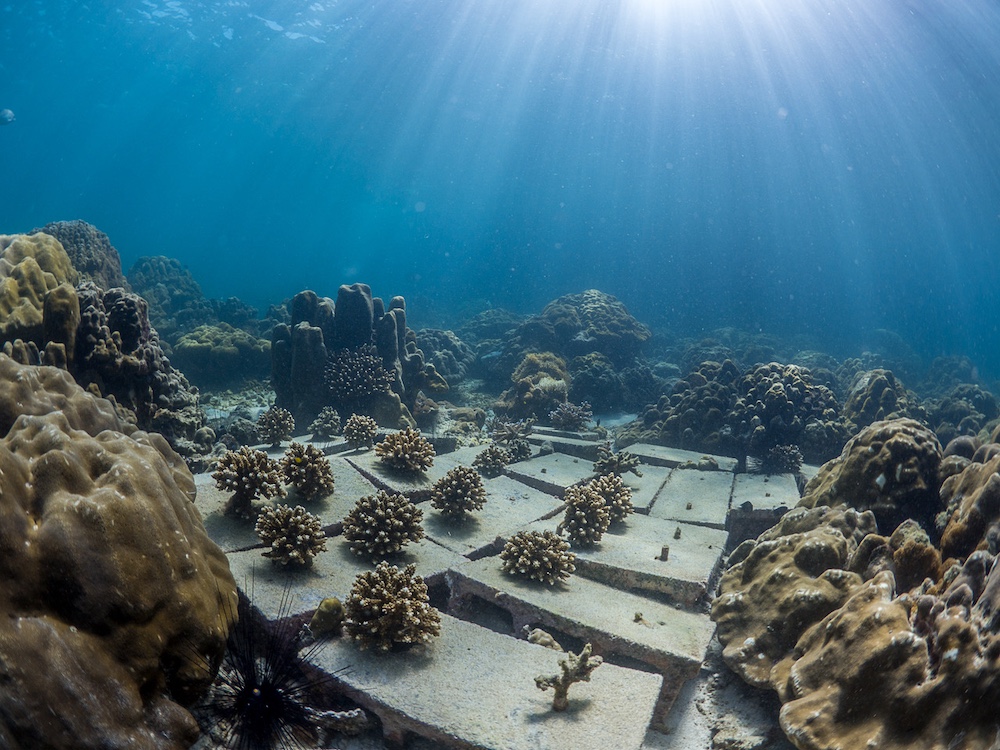
Berumen said a healthy reef is an entire ecosystem, meaning successful restoration requires rebuilding ecological functions rather than simply increasing coral cover.
The importance of location
Maghrabi said site selection is often decisive, with even strong designs likely to underperform if deployed in unsuitable locations, particularly where sedimentation, poor water quality or damage to sensitive habitats is a risk.
“Site selection is often the single most important factor determining the success of an artificial reef project,” he said.
Berumen said: “If forced to choose, I would emphasize site selection combined with long-term protection. Even the best materials and healthiest coral fragments are unlikely to succeed if they are placed in an environment with poor water quality, excessive sedimentation, repeated physical disturbance, chronic fishing impacts, or temperatures beyond their tolerance.”
Heat stress is increasingly shaping site selection in the Red Sea, Berumen said, while long-term monitoring remains essential.
“The best restoration site is not simply the place where corals can survive today,” Berumen said. He added that the priority is choosing locations where the wider reef community has the best chance of remaining functional under future conditions.
The broader lesson, he said, is that artificial reefs should complement — not replace — conservation of natural reefs.
“Artificial reefs are not shortcuts for marine conservation, nor are they substitutes for protecting natural coral reefs,” he said.
They are tools that require careful planning, scientific assessment, sound engineering, long-term monitoring and adaptive management, and must sit within a broader conservation approach centered on protecting natural coral reefs.