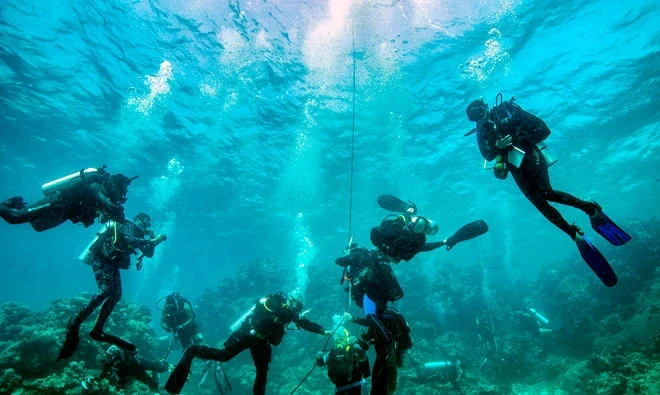
- In patches where the seabed was free of waste, marine life was already reclaiming its place among the marina’s waters.
JEDDAH: When divers descended to the Jeddah Marina seabed, they expected to find years of accumulated waste.
They did.
What surprised them was what they found beneath the debris.
In patches where the seabed was free of waste, marine life was already reclaiming its place among the marina’s waters.
“We found soft and hard corals growing and fish living there. We even came across the largest boxfish any of us have ever seen as divers, living in the marina as its natural home,” said Abdurrahman Al-Haddad, regional manager of SSI Arabia and general manager of Al-Haddad Scuba.
“It is the debris, not the location, that has been holding marine life back.”
The discovery came during the Al-Bahr Bahrek (The Sea Is Yours) initiative, a large-scale cleanup effort that removed tonnes of waste from the marina seabed.
Organized by Jeddah Transport Company under the patronage of Jeddah Gov. Prince Saud bin Abdullah bin Jalawi, the operation brought together hundreds of volunteers, including 165 divers from 11 diving centers.
Over 64 hours of fieldwork and more than 300 dives, teams recovered plastic, tires, metal, concrete, ropes and abandoned fishing nets from the seafloor.
Among the more unusual finds were shopping trolleys, household toilet seats, steel chains, boat furniture and fragments of old piers. Divers also removed a 40-meter section of fiberglass hull from a sunken vessel, the largest object recovered during the operation.
Much of the waste appeared to have accumulated over many years.
“The worst area was the middle of the marina between the floating pontoons, where we found piles of tires, drink bottles, concrete and metal. Some pieces were half buried in the sand and covered in marine growth, so you could tell they had been sitting there for years,” said Tasabih Altagany, chief operating officer of Hulul Inma Albiya Almustadamah Company, which sponsored the initiative.
To minimize environmental disturbance, all waste was removed manually.
“Our role was full environmental supervision on the ground, from Sept. 18 to Oct. 17. We made sure everything was done by hand and only solid waste was removed, with no digging or dredging, so we didn’t stir up the sediment or damage what’s left of the marine life down there,” Altagany said.
Of the 9.3 tonnes collected, about 6.1 tonnes consisted of plastic, with roughly two-thirds of all recovered material sent for recycling rather than to landfill.
The operation also provided a snapshot of life beneath the water’s surface.
According to divers, areas free of discarded waste supported coral growth and fish populations, suggesting the marina’s ecosystem retains a strong capacity for recovery if protected from further pollution.
The cleanup itself posed significant logistical challenges. Between 30 and 70 divers worked underwater at a time while marina operations continued around them. Boat traffic had to be restricted in designated areas, and specialized lifting bags were used to raise objects weighing up to 700 kg.
One encouraging finding was the absence of visible oil contamination, which divers said bodes well for future restoration efforts.
For Altagany, however, removing decades of debris is only the beginning.
“Our recommendation is to make it a yearly thing, with a cleanup and inspection dives every year so waste gets removed before it piles up again and gets buried in the sand.”
She also called for preventive measures, including additional waste bins, clearer signage and environmental requirements for marina users.
Speaking at the initiative’s closing ceremony, Jeddah Transport CEO Eng. Yousef Al-Sayegh said: “Protecting the sea is a shared responsibility that requires the combined efforts of government entities, the private sector, specialized organizations and the community.”
For the divers who spent weeks pulling debris from the seabed, the lasting takeaway may be simpler: Despite years of neglect, the marina still showed clear signs of life — a reminder of how quickly nature can respond when given the chance.