- Dr. Abdulaziz Sager says failed negotiations and Iranian-backed Houthi attacks make military victory a priority before renewed talks
- The Gulf Research Center chairman urges allies to share intelligence, provide military support and take a firm stance against Tehran
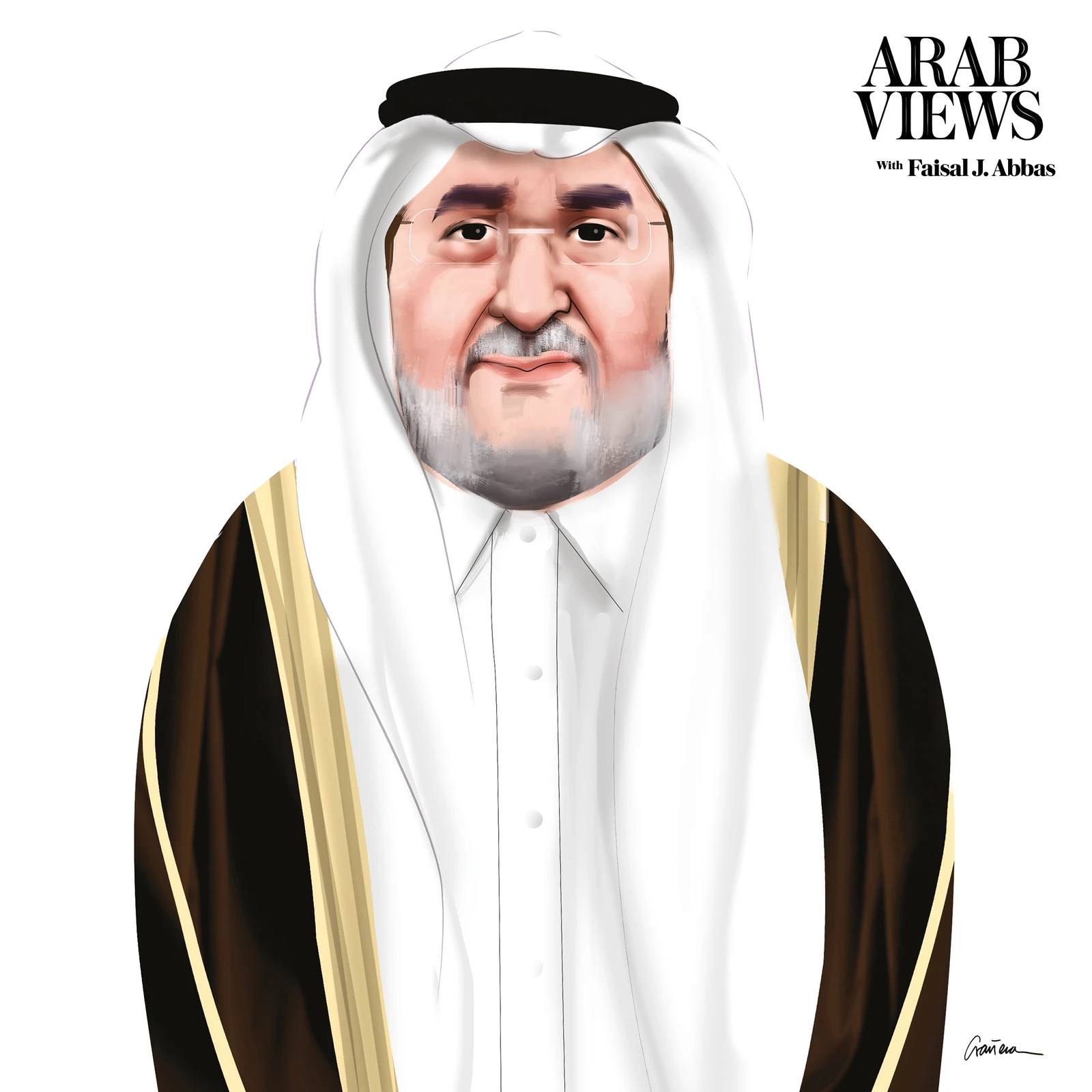
RIYADH: Saudi Arabia should not expect political negotiations with Yemen’s Houthi militia to deliver a solution, as previous attempts at dialogue have failed to change the group’s behavior, according to Dr. Abdulaziz Sager, chairman of the Gulf Research Center.
Appearing on the Arab News program “Arab Views” in Riyadh, Sager said the two attacks on King Khalid International Airport on October 10 and 11 had sent a clear signal that further talks were unlikely to work.
“The Riyadh airport attack was a sad story,” Sager told Arab News Editor-in-Chief Faisal J. Abbas.
“We are so sorry for those whom they lost their life and those who were injured, but at the same time, it sent a clear signal to Saudi Arabia that having a political discussion with such people on negotiation is not going to work.
“We have seen it in Kuwait, in Stockholm and Muscat. The Saudi team that went to Sanaa, they’re not going to respect the neighborhood and country and then reach a political solution.”
Sager said the Houthis were being directed and supported by Tehran, and had concluded that previous negotiations had brought them insufficient gains.
“But at the same time, the Houthis are being instructed, supported, directed by Iran,” he said.
He argued that the group had misunderstood the US position and was escalating attacks to strengthen its position at the negotiating table.
“They realize three things,” he said, explaining that the Houthis believed earlier efforts had yielded little, had misunderstood the US position and wanted to strengthen their negotiating position through attacks on critical infrastructure.
“And number three, they want to create a new activity, at least to bring them into a negotiation position by doing such an attack on a pipeline, on a critical oil facility, on an airport, on Makkah and Madinah, trying to escalate to bring the situation to a negotiation.”
But what, in Sager’s view, are the Houthis actually seeking to achieve, and why are their demands unacceptable to Saudi Arabia?
He said the group wanted Riyadh to stop supporting Yemen’s internationally recognized government and to pay charges it had no obligation to pay.
“They want us to stop supporting the only legitimate government which is recognized by the United Nations. They want us to pay for duties that we’re not supposed to pay for,” he said.
For Sager, disengagement would risk legitimizing the Houthis’ actions and deepening Yemen’s division.
“Disengagement. I think that’s wrong. Totally. I disagree with such a policy, because disengagement would mean it will legitimize what they are doing. It will push the separation in the country and it will create another somalization.”
He said Yemen’s 1,450-kilometer border with Saudi Arabia made the conflict a direct national security concern, arguing that Riyadh could not allow a regional power to expand its influence along the Kingdom’s frontier.
“We cannot allow aggression. We cannot allow using any dimension as a means of expansionism to the neighborhood and to the border of Saudi Arabia,” he said.
Sager said the Houthis would not voluntarily stop attacking critical infrastructure, arguing that the recent assaults on Riyadh airport, which killed 14 people, including pilgrims, demonstrated the threat posed to civilians.
He rejected the movement’s claim to be “Ansar Allah,” meaning “Supporters of God.”
“They are not Ansar Allah. They are the enemy of Allah and the people,” he said. “This is why they kill innocent people. This is why they use their missiles to attack Makkah and Madinah. This is why they attack a critical facility.”
The attacks have also raised questions about Saudi Arabia’s ability to intercept incoming missiles and drones. Sager said no air defense system could guarantee protection against every threat, particularly across a country as large as the Kingdom.
Asked about Saudi Arabia’s interception rate, he replied: “More than 92 percent.”
He described that as a strong performance and said it should be considered alongside the challenges faced by other countries, including Israel, despite its extensive US-backed defenses.
“Israel is a much smaller country, with the THAAD system, with the dome system, with every air defense system supported by the US, the presence of the US there, and the commitment of the US to defend them,” he said.
“Yet the Houthis, they were able to penetrate. And the Iranians, they were able to penetrate that air defense system. So there is no 100 percent guarantee.”
Sager said it was important to understand that the Houthis possessed more than the light weapons commonly associated with armed militias. Their capabilities included inexpensive drones, cruise missiles and medium- and long-range ballistic missiles, he said.
“They now have a small drone with a minimal cost,” he said.
“And they have cruise missiles and the other missiles, which is an Iranian production.”
He argued that the Houthis’ possession of medium- and long-range missiles distinguished them from other non-state armed groups and pointed to support from outside Yemen.
“When we talk about violent non-state actors, when we talk about militia, we need to mention that this is the only militia in the world that possesses a medium- and long-range missile, because there is a link to an outside country,” he said.
Sager attributed the movement of weapons into Yemen to Iranian support, describing methods he said had been used to evade sanctions and international monitoring.
“It was the Iranian Revolutionary Guard who used its best expertise dealing with sanctions and how to switch off the engine and signals from ships, how to keep it floating in international waters, how to get a small boat to deliver it to the coast of Yemen where the other side have received it, and also maybe using some smuggling through a land borders,” he said.
Against that backdrop, Iran’s offer to mediate between Saudi Arabia and the Houthis appears unusual. Sager said Saudi Arabia should not accept an offer from a country he considers responsible for sustaining the threat.
“Iran is the cause of the problem. How can I accept their mediation? What we need from Iran is hands off of Yemen, not to interfere in Arab affairs,” he said.
He argued that Tehran’s involvement in regional affairs extended beyond Yemen, citing maritime and energy security, support for armed groups and what he described as expansionist policies.
“So I don’t think we need their mediation. We can deal with the Yemenis. We have direct access with that one. We understand them better.”
Sager said Saudi Arabia had previously offered to meet Houthi representatives directly in Muscat at the beginning of July, but the proposed meeting did not take place after disagreements over who would represent the group.
He argued that the immediate priority should be military victory, with negotiations following only after the Houthis’ capabilities had been weakened.
“Honestly, I don’t think we should leave it at this moment open. I think at this moment, we need to have a military victory over the Houthi, destroying their storage and their military capability,” he said.
Negotiations could then address prisoners of war and outstanding issues from previous agreements, including those associated with Stockholm and Kuwait. Sager’s position, therefore, was not to rule out all future talks, but to put military action ahead of renewed political engagement.
Sager said Saudi Arabia needed sustained political, military and intelligence cooperation from international partners. He outlined three priorities — a firm political position, a shared understanding of the threat and practical assistance when requested.
“We need their firm political position, number one. We need them to understand the threat and what it represents, not only for Saudi Arabia, but for global security,” he said.
“And third, we need, when we require something, such as ammunition or sharing of intelligence, sharing of knowhow, sometimes an exercise, we need that.”
He said intelligence-sharing was particularly important, as earlier warning of missile launches could give Saudi forces more time to prepare an interception.
Sager acknowledged that cooperation with Washington had increased, but said the US faced competing commitments and was reluctant to open another military front. The approaching midterm elections were another factor, he added.
“I think now I can see a lot more sharing. But at the same time, don’t blame the US that much,” he said.
Nevertheless, he identified uncertainty over American policy as the region’s biggest political risk.
“Today, if you ask me, the biggest political risk I can see is the US’ unpredictability,” he said.
Sager outlined two possible scenarios for the US confrontation with Iran. The first was intensified military action aimed at securing Washington’s stated objectives, including zero uranium enrichment, reopening the Strait of Hormuz and a commitment from Tehran not to attack Gulf countries.
The alternative, he said, was for Washington to withdraw and leave regional countries facing greater Iranian influence.
“The second scenario will be the US will say, okay, hands off, I will withdraw,” he said.
Sager considered that the more dangerous outcome, warning that a US withdrawal could give Iran greater scope to dominate Gulf waters and threaten international security.
“I think that’s the worst scenario, in my opinion. Because if that happened, that means you are going gradually to give Iran the ability to impose hegemony in the Gulf waters because of their type of policy and aggression,” he said.
“Again, you create a global disturbance.”
He argued that disruption to the Strait of Hormuz would affect economies dependent on Gulf energy supplies, while instability could undermine international trade and shipping.
Washington’s credibility was also at stake, he said, if a global power could not contain threats to maritime routes.
Sager welcomed efforts to expand Saudi Arabia’s security partnerships, saying the Makkah Pact between Saudi Arabia, Pakistan and Turkiye was progressing faster than he had expected.
“I think it’s moving faster than what I thought,” he said, noting that the parties had agreed on a secretary-general and a location for the coalition.
He added that the pact did not require Turkish or Pakistani troops to be deployed in Yemen and that they would not be necessary.
Sager also highlighted Egypt’s strategic interests in the Red Sea and the wider region, pointing to Egyptian workers in Saudi Arabia and losses to Egyptian revenues from the Suez Canal.
“Egypt is part and parcel of the Arab national security and also for Saudi Arabia and the rest of the Gulf countries. We cannot exclude that,” he said.
Greece had also contributed to Saudi defense, with personnel operating Patriot air defense systems at Yanbu. Sager said the systems had helped intercept attempted Houthi attacks on critical facilities, and indicated that Greece had spare defense capacity available to support Saudi Arabia. France had also offered an air defense system, he added.
“We are so thankful to them for their contribution to Saudi security and sending the troops and also the system, which was extremely useful.”