- Though textiles contribute 60% to exports, millers say they don't get adequate facilitation from government
- Textile sector gearing up to close at $20 billion in June 2022 compared to $15.4 billion in June 2021
KARACHI: As Pakistan battles a ballooning trade deficit, the country's textile millers expect to hit the $20 billion export mark by the end of the fiscal year but call for the government provide low cost and smooth supplies of power and natural gas to ensure that Karachi, the country's financial hub, does not turn into a "graveyard of industries."
Pakistan’s trade deficit has ballooned to $43.3 billion, or 57.8 percent, during the current fiscal year from July 2001 to May 2022. The country’s exports increased by 27.7 percent to $28.8 billion while imports surged to a record level of $72.2 billion with a growth of 44.28 percent, according to data released by Pakistan Bureau of Statistic (PBS).
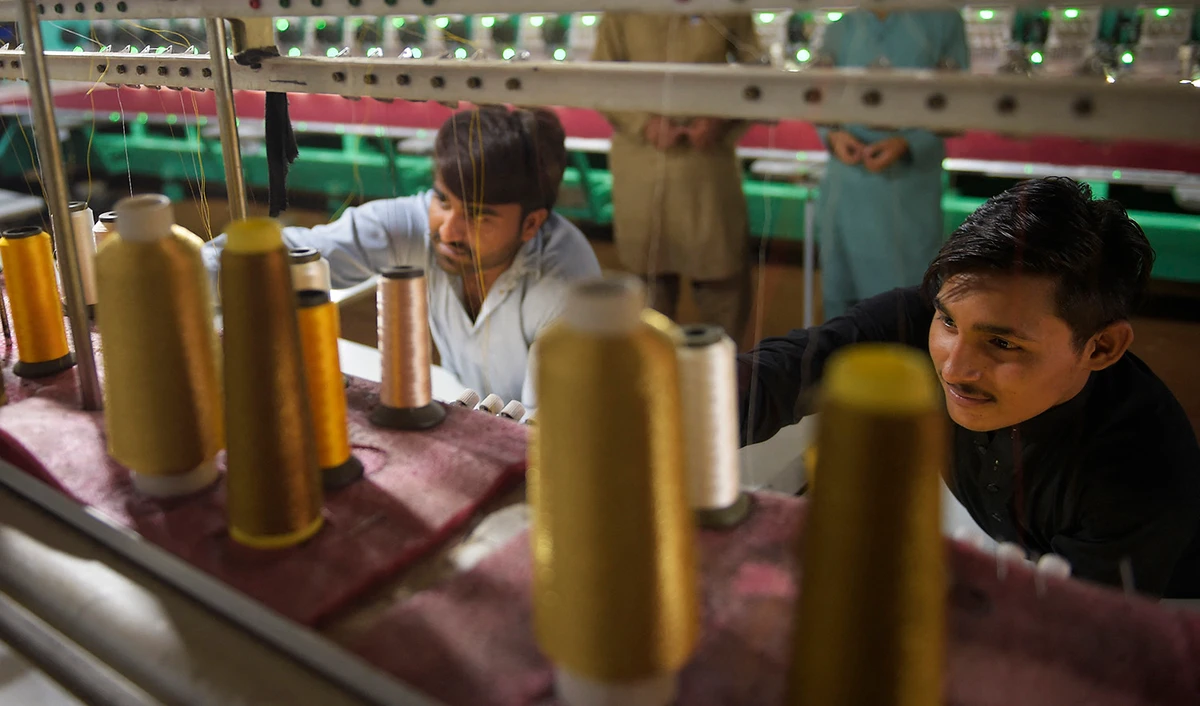
Though the textile sector contributes around 60 percent to overall exports from Pakistan, millers say they have yet to get necessary facilitation from the government.
“Textiles is the only sector that continues to grow and bring foreign exchange to the country, gearing up to close at $20 billion in June 2022 compared to $15.4 billion in June 2021,” the All Pakistan Textile Mills Association (APTMA) said in a statement this week.
“The tragedy is that even with a 59% increase of textile exports in May 2022, $1.69 billion, over May 2021, exports are not being given their due importance. Gas/RLNG (Re-Gasified Liquefied Natural Gas) is being continuously supplied to non-export industries – ceramics, glassware, steel etc. and not the export sector, against all economic rationale.”
APTMA said gas/RLNG supply to the Punjab textile sector, which was already at 25% of required volumes, was shut down this week with the promise that it would be restored on the morning of Friday, June 3, 2022. However, the sector had since been informed supply was indefinitely cut off.
“The government’s decision to halt the supply of gas/RLNG to exporters is highly illogical as it is a critical input to textiles, the single largest contributor to Pakistan’s exports and the mainstay of Pakistan’s economic future,” the statement said. “The sector has sizeable investments in state-of-the-art machinery and high efficiency generation, with over $5 billion worth of investments for expansion and modernization made in the last 1.5 years.”
The representative body of textile millers said production facilities were also operating at less than 75 percent capacity due to energy supply constraints.
“Due to poor quality of grid electricity and non-supply of gas/RLNG, mills are operating at less than 75% capacity, which if continued will incur a loss of $250-400 million in exports each month,” the statement added.
The south Asian country is struggling to balance its external financial position with the support of the International Monetary Fund (IMF) and has increased the prices of petroleum products, electricity and gas as a prior action to win the Fund’s approval for the resumption of a stalled $6 billion loan program.
The Oil and Gas Regulatory Authority (OGRA) on Friday determined a 45% hike in the tariff of natural gas for the next fiscal year starting from July 2022. The determined tariff, if approved by the government, would be applicable for the consumers of two gas utilities.
However, Pakistani industrialists said the cost of production alone in Karachi was already up 40 percent in recent months and the move to increase tariffs would "ruin" already suffering industries.
“The cost of industrial production has increased by 40 percent over the months. The rate hike of power and gas is sheer injustice with the industries,” Zubair Motiwala, chairman of the Businessmen Group, a body that leads the Karachi Chamber of Commerce and Industry (KCCI), said on Saturday while speaking at an event in Karachi.
“Industries are being converted into warehouses in Karachi and if the situation continues the city will turn into a graveyard of industries.”