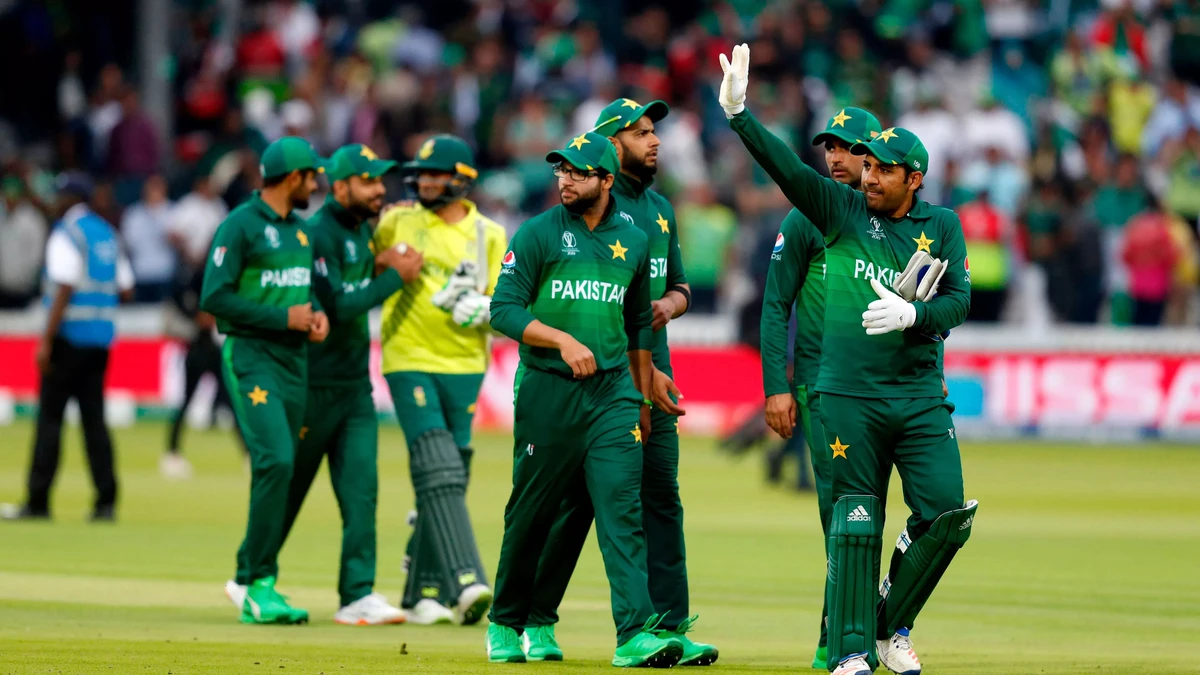
- Pakistan condemn South Africa to elimination with a 49-run win at Lord’s on Sunday
- Disciplined Pakistan bowling saw Shadab Khan and Wahab Riaz take three wickets each as South Africa surrendered without a fight
KARACHI: At a press conference right after Pakistan’s win over South Africa at Lord’s on Sunday, the look on Pakistan coach Mickey Arthur’s face turned from disbelief to anger as a Pakistani reporter raised the question of stamina concerns regarding Player of the Match Haris Sohail.
“Why can’t we write something positive about Haris?” Arthur said of a player who had just scored a brilliant 59-ball inning of 89 in Pakistan’s total of 308-7.
As the reporter tried to continue his point about Sohail’s fitness, Arthur cut him off: “He got 80 off 59 balls today… Is that right, or did I miss something? Why are you always talking negatively about our players? That today was one of the all-time, brilliant innings that I’ve seen. Let’s just write something positive for a change. Please!”
While the Pakistani coach had a point, what his exchange with the reporters showed was that he was either unaware of or unwilling to accept, the central reason Pakistanis as a society like to watch cricket. For them, cricket is not so much a sport as it is a grand soap opera that functions as a national obsession.
Consider the exchange above. Haris Sohail had played perhaps the most important innings by a Pakistani middle order batter in a World Cup for almost thirty years. It was a stunning knock that was the difference between the two sides, elevating Pakistan’s score from a competitive one to a winning one. The only question that arose was about Haris Sohail’s fitness and Arthur couldn’t understand why that was the case.
When Indian journalist Abhilasha Ojha attempted to understand the secret to the success of Balaji films, makers of super-hit soap operas like Kyunki Saas Bhi Kabhi Bahu Thi, she noted that “Balaji’s perfect mantra [was] bifurcating a simple plot and turning it into unbelievable melodrama.”
That’s precisely what was happening here: Haris Sohail’s obviously brilliant innings was being complicated with drama.
Just a few minutes earlier, Arthur had spoken about the perils of criticizing the players. “Our guys need to be built up all the time. The minute they’re bashed, like they have been the past week, our guys don’t respond to that.”
He was talking specifically about Mohammad Amir, whose two wickets today were of the opposition’s best batters and which catapulted him to joint top wicket-taker of the tournament. Amir has three times the wickets at this World Cup than he had over the past two years, and Arthur was trying to explain how the criticism during that time had diminished his impact.
This sort of response to critique isn’t unique to Pakistani players. Relentless criticism for the media isn’t helpful to players and succeeding in elite sports requires a very high level of self-belief that such pressures can erode. But again, the journalists at the presser and the fans around the world aren’t quite viewing this simply as sports, but as a soap opera also.
The critic Polly Chadwick wrote that “fans like nothing better than to disappear into someone else’s world ... fraught with problems and incidents that make their own lives seem like a box of chocolates.” She was referring to fans of soap operas, but in a country as bedevilled with problems as Pakistan, perhaps the fans do need this level of obsession with the national team in order to forget their own troubles.
In the past week since a crushing defeat against arch-rivals India, Pakistani cricket fandom has been at its wildest. Effigies were burnt, experts and fans launched thunderous tirades on TV and torrents of memes, parodies and Tiktok videos were unleashed. Perhaps the most touching act came when the local courts were moved against the team’s performance, an act carried out at almost every World Cup. But after a certain point, a line was crossed. A video emerged of a fan who started abusing captain Sarfaraz Ahmed while taking a selfie with him. Sarfaraz didn’t react in the video though ex-captain Wasim Akram said he would have punched the guy if it were him. Other players, including those in the current squad, also spoke about the need for boundaries. The ‘fan’ posted a video with a convoluted non-apology, and it marked the moment that the tide had turned.
The eternal, soap opera narrative of Pakistan coming back from the brink was slowly rekindled, and despite the overwhelming odds, as both New Zealand and India stumbled last night and England lost earlier in the week, the impossible felt possible again.
Like always, but especially like in 1992, Pakistan was finding momentum right when it mattered and right when others seemed to be losing their nerve. Sunday’s win saw the rest of the bowling line-up find its sparkle, while Haris’s blockbuster innings came on the back of unspectacular but solid efforts from the rest of the batting lineup.
Back in London, another reporter colorfully captured the mood back home in light of this enduring narrative: “We say in Pakistan that the party starts now, abhi tou party shurroo hui hai. Is it necessary for Pakistan to first lose the matches and then they will [get] on the victory path?”
Once again, Arthur’s reaction belied a naivety toward this Pakistani approach at looking at cricket. He was shocked, denied this was the case and argued that “we don’t do this by design.” But this idea of the ‘cornered tiger’ as popularised by former captain, current Prime Minister Imran Khan, is the very ethos of the Pakistani cricket soap opera. And for all his bemusement, Arthur himself acknowledged that “what I do know when the guys backs are to the walls we get some good performances out of them.”
Mickey Arthur might not understand why the media and the public want the team to be in these do-or-die situations, but it is simple once you see that they are looking for the things that make soap operas interesting, not sports teams.
Sports teams that are successful win regularly, and almost everyone, eventually at some level, finds them boring even when they dazzle with their brilliance. Pakistani fans, despite what they might claim, are not looking for success. They are looking for an escape, for a narrative more fantastical and dramatic than the one of their own lives. This escape, this larger than life narrative, this soap opera, is what they want from their cricket team, whether it likes it or not.