- Analysts say absence of support from central bank, government also building pressure on rupee
- Currency dealers blame political instability, government’s uncertain future for rupee depreciation as well
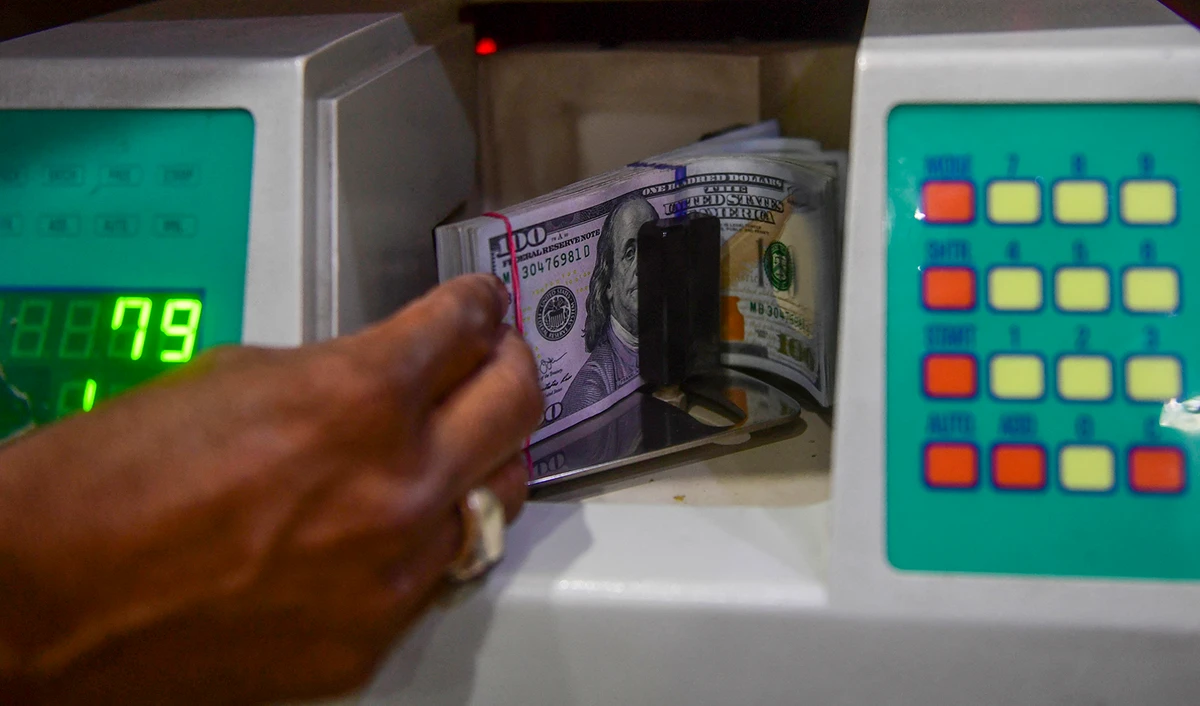
KARACHI: Pakistan’s currency tumbled further to another historic low of Rs239.94 against the US dollar in the interbank market on Thursday, with currency dealers and analysts pointing out the greenback’s smuggling to Afghanistan amid a liquidity shortage and inaction on part of the central bank as the main reasons for the rupee’s decline.
The Pakistani rupee, during Thursday’s trading session, plunged to Rs 242.26 but recouped somewhat before closing at Rs 239.94, 1.63% lower than yesterday against the greenback. Pakistan's import payments also continued to build pressure on the rupee in the interbank market.
Pakistan’s national currency has devalued by 13.7% since July 15, 2022, according to data from the State Bank of Pakistan (SBP).
“The tight dollar supply position in the interbank market is persistently building up pressure against the rupee in the absence of any support coming from the central bank or the government,” Abdul Azeem, Head of Research at Spectrum Securities, told Arab News.
“The government has taken import controlling measures until [it receives] inflows from the International Monetary Fund (IMF) while the central bank is facing a shortage of dollars,” Azeem said, adding that due to the IMF’s condition, the SBP could not intervene in the current scenario.
“Authorities want to minimize imports to contain the dollar outflow,” he added.
After signing a staff-level agreement with the Fund earlier this month, Pakistan is expecting $1.17 billion immediately after the IMF board gives the green signal to release the funds, by the end of next month.
The South Asian country’s foreign reserves have decreased to $9.32 billion, which analysts say are barely enough to cover 45 days’ worth of imports.
Currency dealers said smuggling of the US dollar amid its shortage in the market is further compounding the problem.
“For the last two days, the smuggling of dollars mainly from Peshawar has multiplied,” Zafar Paracha, General Secretary of Exchange Companies Association of Pakistan, told Arab News. “Smuggling has increased dollar rates to Rs 250 for buying and Rs 255 for selling in the grey market,” he added. Paracha believed “anti-state elements” are trying to bleed Pakistan economically.
Paracha estimated that around $30-$40 million were being smuggled to Afghanistan on a daily basis, which is further building pressure on the rupee amid a shortage of US dollars.
“We are unable to sell the dollar to banks for the last two days because the flow has been stopped amid smuggling of the currency,” he said, adding that on usual days, currency dealers would send $15-20 million to banks.
Pakistani dealers said commercial banks were charging up to Rs 245 to Rs 250 from importers for payments related to the Letter of Credit (LC) due to shortage of dollars in the interbank market.
However, the central bank did not comment when Arab News asked whether any action would be taken against such banks.
Pakistan’s political uncertainty and the recent interest rate hike by the United States Federal Reserve (FED) by 0.75% have also exerted pressure on the rupee.
“Currently, ongoing import payments are keeping the rupee under pressure. However, the FED rate hike is also impacting the dollar rate in the local market to some extent,” Samiullah Tariq, Director Research at Pakistan Kuwait Investment Company, told Arab News.
The FED on Wednesday jacked up the interest rate by 75 basis points 2.25% and 2.50% to fight higher inflation at 9.1%. The US has not seen such high inflation since the 1980s.
Currency dealers said the prevalent political instability and uncertainty over the government’s future were also causing the rupee to depreciate.
“Some of the PML-N leaders, the major coalition partner, are calling for snap polls while others are willing to stay,” Malik Bostan, President of Forex Association of Pakistan, told Arab News.
“These kinds of gestures are creating confusion among investors and exporters,” he added.
He urged Pakistan’s political leadership to sit together for the stability of the currency market and the economy as a whole, and draw a collective plan.
Pakistan’s widening current account deficit (CAD) has also strained the currency of the South Asian country.
The South Asian country reported a $2.27 billion CAD for the month of June 2022 compared to a deficit of $1.63 billion recorded during June 2021. Overall, the CAD was $17.4 billion in FY22 compared to $2.8 billion in FY21, according to data released by the central bank on Wednesday.