- Pakistani rupee rises by Rs9.58 against US dollar in interbank market
- Expected disbursement of IMF tranche by late August also led to rupee appreciation
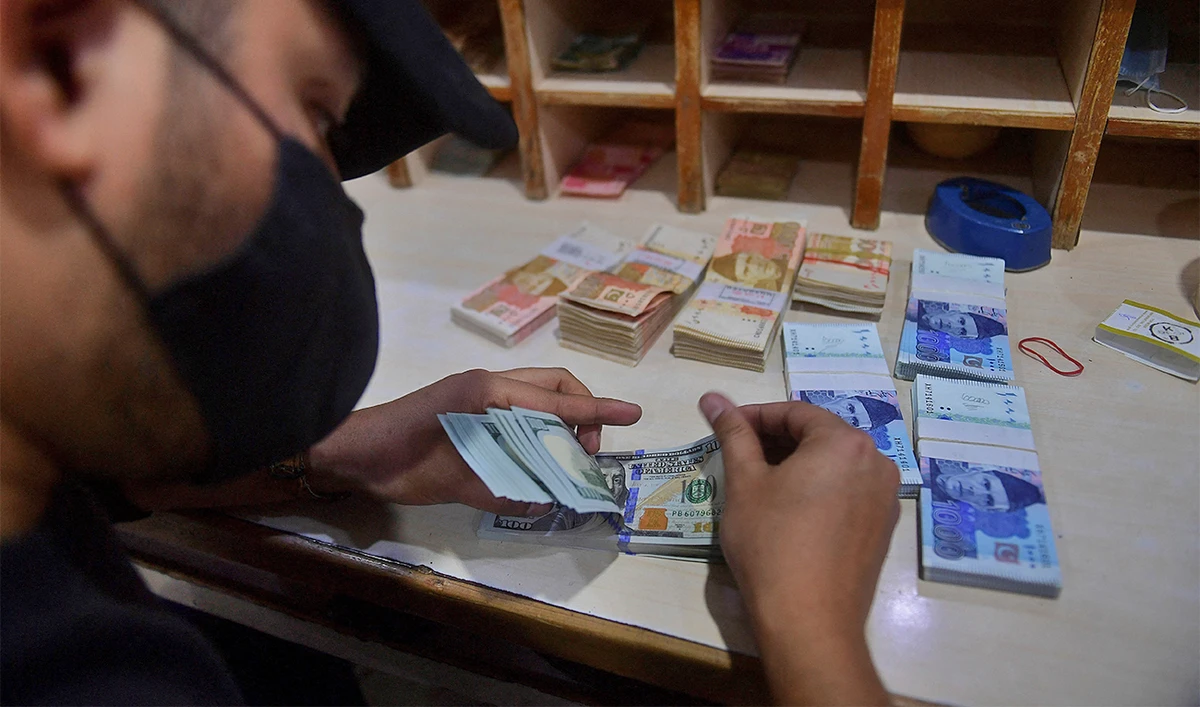
KARACHI: After suffering losses for weeks, Pakistan’s national currency on Wednesday recorded the highest-ever increase against the US dollar in a day, appreciating by Rs 9.58 against the greenback as pressure from import payments decreased, analysts and dealers said, also crediting exporters’ rush to sell dollars for the bullish close.
With depleting foreign reserves, a widening current account deficit and a surging import bill, Pakistan has been witnessing the depreciation of the rupee for weeks.
The rupee has depreciated by 22.85 percent since January, mainly due to higher imports coupled with uncertainties related to the IMF program.
The rupee in the open market was trading at Rs 229 for selling and Rs 227 for buying on Wednesday as compared to Rs 240.50 and Rs 238.50earlier,according totheExchange Companies Association of Pakistan (ECAP).
Official figures released by the State Bank of Pakistan (SBP) showed the rupee gained against the US dollar by 4.19 percent on Wednesday, the highest-ever appreciation recorded in a single day against the greenback.
As markets closed, figures showed that the dollar’s value had decreased to Rs228.80 in the interbank market.
“The rupee appreciation was due because the currency was much overvalued against the dollar. Now, it would bring stability in the currency market,” Tahir Abbas, Head of Research at Arif Habib Limited, told Arab News.
“There are a couple of reasons for the rupee appreciation including the slow run rate of our imports after the federal government and central bank took measures to curtail imports,” Abbas said, adding that exporters who withheld dollars due to the currency deprecation rushed to encash their export proceeds after witnessing “a reversal trend.”
Dr. Khaqan Najeeb, a former adviser to the Ministry of Finance, told Arab News the news of the International Monetary Fund (IMF) disbursing a $1.17 billion tranche of $6 billion program to Pakistan, which according to expectations could be by the end of August, had also played a key role in the rupee’s appreciation.
“The IMF news, coupled with a drop in import payments as high petroleum and gas LCs (Letter of Credit) from July cleared, and the exporters selling dollars in the market have strengthened the national currency,” Najeeb said.
Pakistan last week met the last prior action for the combined 7th and 8th review of the IMF program by increasing the Petroleum Development Levy (PDL). The IMF tranche is expected to be disbursed to Pakistan in the last week of August after Pakistani authorities assures the Fund regarding the arrangement of a $4 billion financing gap from “friendly countries.”
“Pakistan is expected to get assurance from friendly countries within a week,” Abbas said. “Going forward, we see the current account deficit shrinking which is expected to remain around $6-$8 billion as compared to $17 billion in the outgoing year.”