- Pakistan, Iran agreed to establish joint ‘reaction force’ amid border tension
- Pakistan will not allow any militant group to operate from its soil, PM Khan says
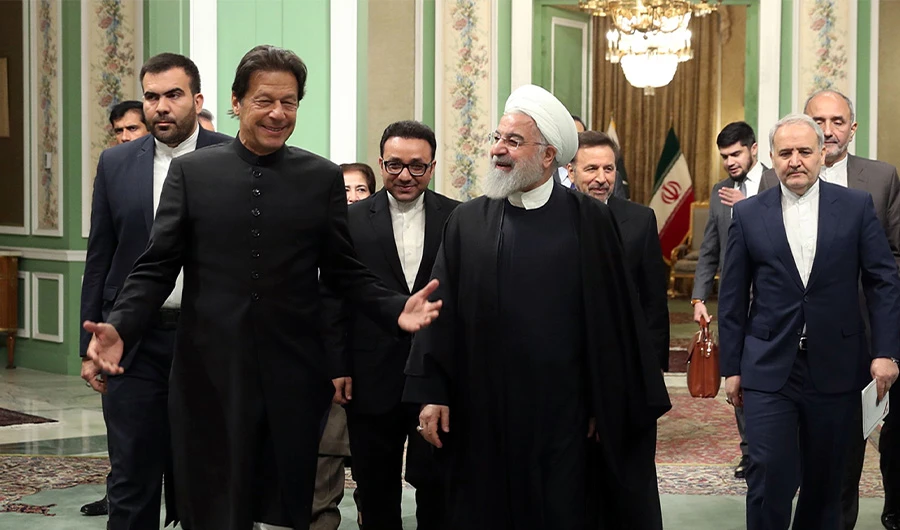
ISLAMABAD: Pakistan’s Prime Minister Imran Khan returned home after two-day long visit where he along with Iranian President Hassan Rouhani on Monday agreed to set up a Joint Rapid Reaction Force during a meeting in Tehran that focused on the vexing issue of cross-border terrorism.
The agreement on the formation of the joint force came in the midst of heightened tensions between the two countries, following a string of cross-border attacks targeting security forces on both sides. Iran and Pakistan share a long and volatile border, and each country has accused the other of not doing enough to eliminate security threats to them.
Angry with Tehran, Islamabad recently claimed that the new Baloch Raji Aajoi Saangar (BRAS) militant faction, an umbrella organization of several Baloch insurgent groups that claimed the responsibility for killing 14 people along Pakistan’s coast last week, was based in neighboring Iran. Pakistan also formally protested over Iran's inaction against terror groups operating from Iranian soil.
Foreign Minister Shah Mehmood Qureshi, speaking to journalists in Islamabad, claimed: “The training camps and logistical camps of this new alliance ... are inside the Iranian border region.”
He said, Islamabad had “irrefutable evidence” that the “terrorist outfits” that carried out the attack received “training and [had] logistic camps inside Iranian areas bordering Pakistan.”
The country’s Foreign Office, in an official letter, also urged Iran to take action against the insurgent outfits.
Addressing the joint press conference over a range of regional issues and topics with President Rouhani, Khan underscored on Monday that “no militant groups will be allowed to operate from Pakistan.”
He began his first official visit to Iran as prime minister along with a large delegation of ministers and special assistants on Sunday, making a brief stopover in the Iranian city of Mashhad before proceeding to Tehran.
Since February this year, the Pakistan-Iran relations have soured following a suicide bombing that killed 27 members of Iran’s elite Revolutionary Guards. Tehran asserted that Pakistan was involved in the attack, a charge Islamabad strongly denies.
Security experts believe Pakistan and Iran must address the trust deficit between them since it has been putting undue pressure on their bilateral relations. “There is a major disconnect” between both sides, said international relations expert, Qamar Cheema, while talking to Arab News on Monday.
“Until this mistrust is not addressed, the joint force will not be effective in dealing with terror-related issues,” he added.
Regional security analyst Dr. Zafar Nawaz Jaspal echoed the same view, pointing out that Iran and Pakistan had made efforts in the past to share information on such issues but faced a significant obstacle in the form of their “trust deficit.” Other than that, their “border area checkpoints are not always capable of identifying threats correctly or timely relaying information about them.”