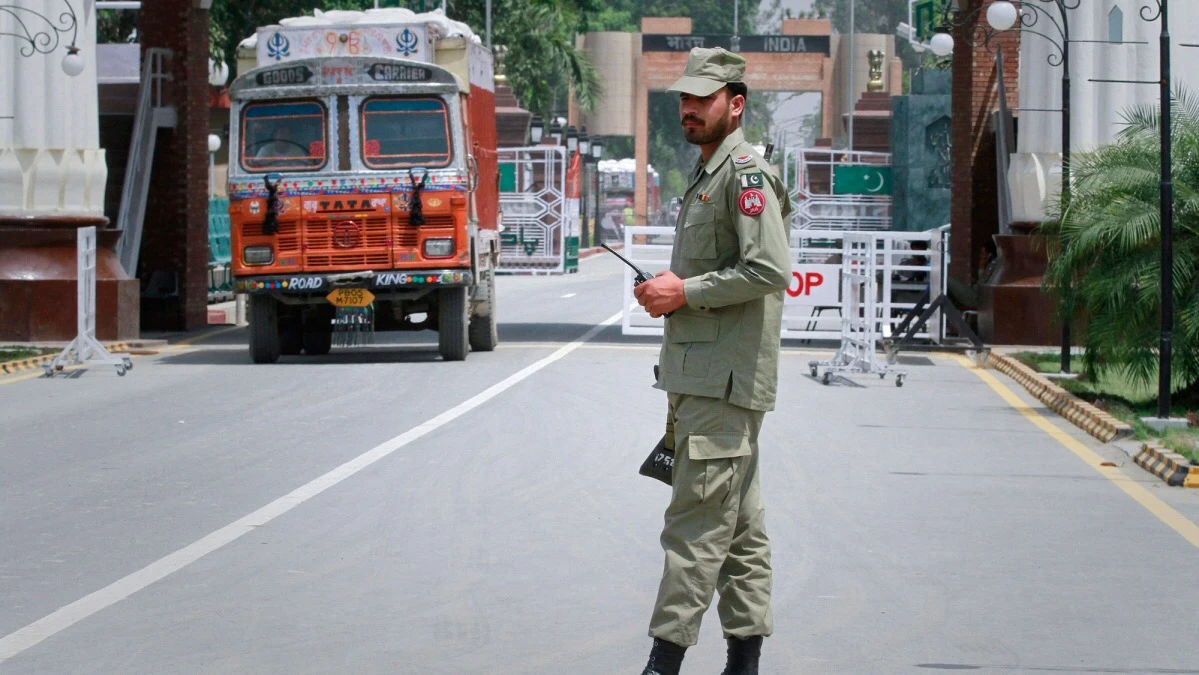
- Total volume of trade between the two countries is minuscule, at around $2 billion per year
- Trade suspension will boost informal trade, with essential items transported via other countries at higher costs, economists say
ISLAMABAD: Pakistan’s decision to suspend bilateral trade with India in response to New Delhi’s attempted annexation of the internationally recognized disputed territory of Kashmir is nothing more than ‘symbolic’ due to the low volume of commercial exchanges between the two countries, economic experts said on Saturday.
Relations between the two South Asian nuclear-armed neighbors worsened on Monday after India announced it would scrap a constitutionally assured special status to Jammu and Kashmir under Indian control, as per Article 370 of its constitution. It also placed the region under complete security lockdown to prevent angry residents from protesting the decision.
In response to the move, Pakistan downgraded diplomatic ties with India, suspended key train and bus services and suspended bilateral trade.
“The quantum of Pakistan’s trade with India was already below its real economic potential,” senior economist and member of the government’s Economic Advisory Council (EAC), Dr. Ashfaque Hasan Khan, told Arab News. “In other words, this suspension is merely symbolic.”
Khan added that the trade between the two countries had never flourished due to their hostile relationship and non-tariff barriers. “We can only hope that the Kashmir dispute will be resolved one day and both India and Pakistan will unleash their full potential of bilateral trade,” he said.
Pakistan and India share more than 3,000 km border and are connected with a commercially vibrant international sea route.
The longstanding hostility between the two South Asian states has led them to squander the true benefits of their region’s geostrategic location, according to the World Bank’s Pakistan@100 Regional Connectivity report released in March this year.
“Pakistan’s share of exports to India has been less than 2 percent of its total exports, and for India, imports from Pakistan are not even 0.5 percent of its total imports,” the report said, adding that total volume of the bilateral trade remained around $2 billion per annum.
“The estimated total trade potential between Pakistan and all its immediate and near neighbors is $58 billion— three times more than its current merchandise trade,” the report added.
Dr. Abid Qayium Suleri, economist and another EAC member, said the trade suspension would only lead to a boosting in the informal trade between both the countries.
“The essential items will be traded through Dubai, Singapore and other routes, but this will obviously raise their cost,” he told Arab News.
Suleri said that Pakistan’s move of suspending trade with India was aimed at telling the international community about the nature of the conflict between the two states and Islamabad’s moral and political attachment to the Kashmir dispute.
“Being a sovereign nation, this is the least we can do to support our Kashmiri brothers at this difficult time,” he said.
Pakistan’s business community has also supported the government’s move and vowed to stand by the people of Kashmir in the face of Indian aggression.
“We have condemned India’s illegal actions and violation of the rights of Kashmiri people, and lauded the government’s decision of suspending trade ties with New Delhi,” Dr. Mirza Ikhtiar Baig, senior vice president at the Federation of Pakistan Chambers of Commerce and Industry, told Arab News.