- A matter of great concern,’ says the ex-foreign secretary of Pakistan
- India has ascribed to the doctrine of ‘no first use’ for its nuclear weapons since 1999
ISLAMABAD: The Indian Defense Minister’s statement reflects India’s “irresponsible state of mind” with New Delhi “saber-rattling all over the place,” Tehmina Janjua, a retired Pakistani career diplomat and former foreign secretary, told Arab News on Saturday.
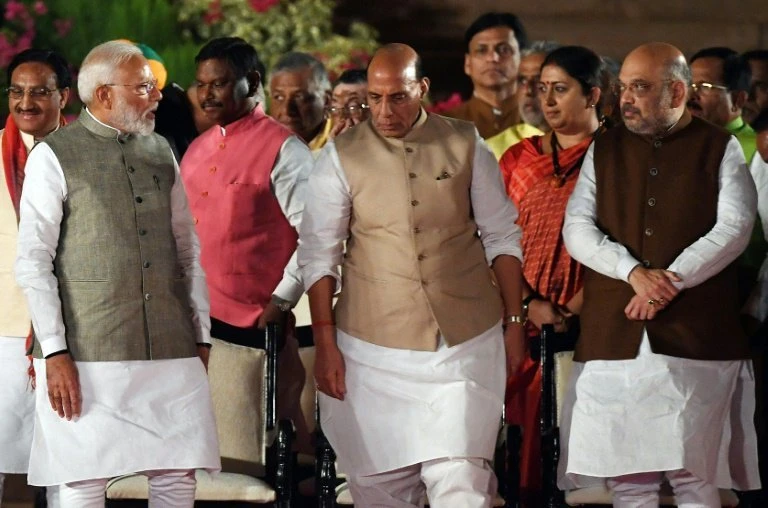
Her remarks come a day after Indian Defense Minister Rajnath Singh hinted India might be changing its ‘no first use’ (NFU) nuclear policy, in a Twitter post that has been widely perceived as a veiled threat to fellow nuclear power Pakistan amid heightened tensions between the two countries, and on the same day as a special UN Security Council (UNSC) meeting over the recently inflamed Kashmir issue.
Singh made the comment on Twitter on Friday, after visiting Pokhran, the site of India’s first successful nuclear tests in 1998 under then Prime Minister Atal Bihari Vajpayee.
“Pokhran is the area which witnessed Atal Ji’s firm resolve to make India a nuclear power and yet remain firmly committed to the doctrine of ‘No First Use.’ India has strictly adhered to this doctrine. What happens in future depends on the circumstances,” Singh wrote in his Twitter post.
In response, Pakistan’s Foreign Minister Shah Mahmood Qureshi replied on Twitter, and called Singh’s comment “another damning reminder of India’s unbridled thirst for violence,” in contrast to Pakistan’s efforts at diplomacy.
“History reminds fascist warmongering state can never win,” Qureshi tweeted.
NFU refers to a pledge or policy made by nuclear power to not use nuclear weapons unless attacked first with the same, pursuing a policy of ‘retaliation only.’ Though India has adhered to NFU since 1999, experts in Pakistan say the doctrine has become a largely symbolic one over time.
“When we look at the ‘no first use’ option, it’s good as rhetoric but it has no value in the strategic paradigm. If there is a war and the state requires nuclear weapons, it is going to use them,” nuclear expert Zafar Nawaz Jaspal told Arab News.
On Saturday, in a joint press conference with the Foreign Minister, Pakistan’s military spokesperson, General Asif Ghafoor, said the army was prepared to defend its homeland and announced that the military was mobilizing additional troops toward the disputed Kashmir border between the two countries, known as the Line of Control (LoC).
“India appears to be in a completely irresponsible state of mind where it is not even willing to consider the mood of the international community,” Janjua said and added that India’s NFU policy cannot be taken at face value, “especially amid developments of its offensive capabilities” and posturing.
“There have been very belligerent and very strong statements made against Pakistan post-Pulwama and after the recent Indian elections,” said Janjua, who has also served as Pakistan’s representative to the United Nations.
“Then...the special status given to Jammu and Kashmir was revoked. The Indians have been saber-rattling all over the place with very strong statements about taking action against Pakistan,” she said.
“All of that put together with what the Indian defense minister has said is obviously a matter of great concern to Pakistan,” she said.
Some experts believe that India’s aggressive nuclear posturing has been on the cards since earlier this year, with unverified reports that India had deployed mobile nuclear weapons after the Pulwama suicide attack on February 14, where 40 Indian soldiers died in Indian-administered Kashmir. The resulting escalation in violence brought the countries to the brink of all-out war and was the first time in history that two nuclear-armed countries had conducted airstrikes against one another.
“It is clear, India can use nuclear weapons first,” Jaspal said. “The Indian defense minister’s statement reiterates or highlights the developments which have been taking place to build a nuclear strategy in India.”
“Pakistan should not take the statement lightly,” he added.
On August 5, India revoked two special articles in its constitution that gave legal autonomy to Jammu and Kashmir and protected its Muslim majority demographic, effectively bringing the disputed region, where both India and Pakistan stake a claim, under the ambit of its own constitution.
The UNSC has passed several resolutions on the disputed territory, and after Friday’s emergency meeting, Janjua said she firmly believed the international body was capable of resolving the matter by ordering India to reinstate the region’s special legal status and stop its atrocities in Indian-administered Kashmir.
“It is the UNSC and its members that have to ensure that its resolutions are respected,” she said.
“The most important thing that has happened from the meeting yesterday is that the UNSC has recognized the continued validity of the resolutions of the UNSC with regard to Jammu and Kashmir,” she continued.
“There should be continued recognition by India of the disputed nature of Jammu and Kashmir,” she said.