- Interim government will oversee elections which must be held within 90 days of dissolution of National Assembly
- Ballot may be delayed as election regulator has to draw new boundaries for hundreds of constituencies first
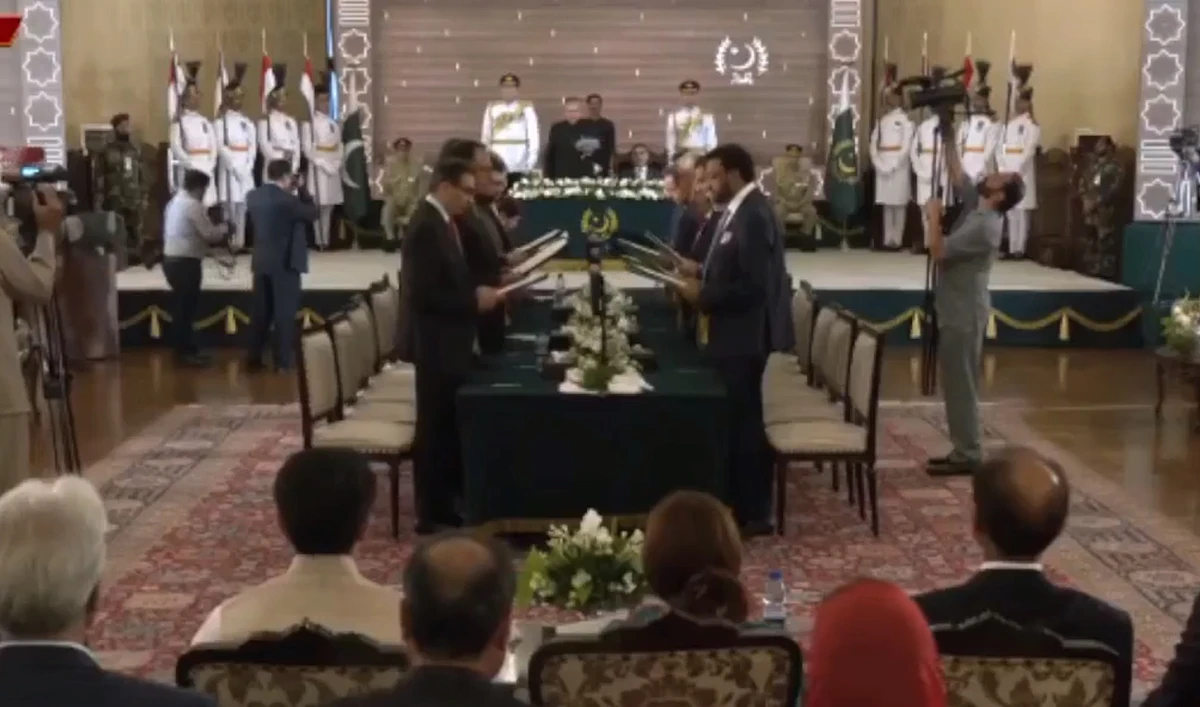
ISLAMABAD: Pakistani President Dr. Arif Alvi on Thursday administered oath to a caretaker cabinet, days after Anwaar-ul-Haq Kakar was sworn in as interim prime minister to oversee general elections.
Kakar, from the impoverished southwestern province of Balochistan, will name a cabinet and head a government until a new administration is elected. He was sworn in by Alvi on Monday in a ceremony at the Presidency.
“The interim PM has decided to form a small cabinet and personally review the profiles of all possible candidates,” The News, Pakistan’s largest English-language daily, said.
Local media widely debated the composition of the new cabinet, with top names being foreign secretary Jalil Abbas Jilani, former civil servant Shoaib Suddle, former Supreme Court Bar Association (SCBA) president Ahsan Bhoon, former senator Sarfaraz Ahmed Bugti, former police IG and acclaimed columnist Zulfiqar Ahmad Cheema and former information minister Muhammad Ali Durrani.
Under Pakistan’s constitution, a neutral caretaker government must hold general elections within 90 days of the dissolution of the parliament’s lower house, which in this case means early November. However, the ballot may be delayed as the Election Commission, after the approval of the results of the latest census, has to first draw new boundaries for hundreds of federal and provincial constituencies and set an election date based on that.
Political analysts say that if the caretaker set-up stretches beyond its constitutional tenure, a prolonged period without an elected government would allow the military, which already has an outsized role in politics, to consolidate control.
With widespread concerns that polls may be delayed, the choice of caretaker prime minister and his cabinet has assumed greater importance. Kakar’s government will also have extra powers to make policy decisions on economic matters after changes to Pakistan’s election laws by the outgoing government of Shehbaz Sharif.
Among Kakar’s top challenges is economic stabilization, with the $350 billion economy on a narrow recovery path after an ongoing $3 billion International Monetary Fund bailout averted a sovereign debt default. Economic reforms have already fueled historic inflation and interest rates.
Political uncertainty is also a factor after the jailing of former prime minister Imran Khan and a ban on him running for political office after being convicted in a graft case. Independent analysts say Khan’s continued detention so close to general elections will raise questions about the credibility of the election as the ex-premier is arguably the country’s most popular politician.