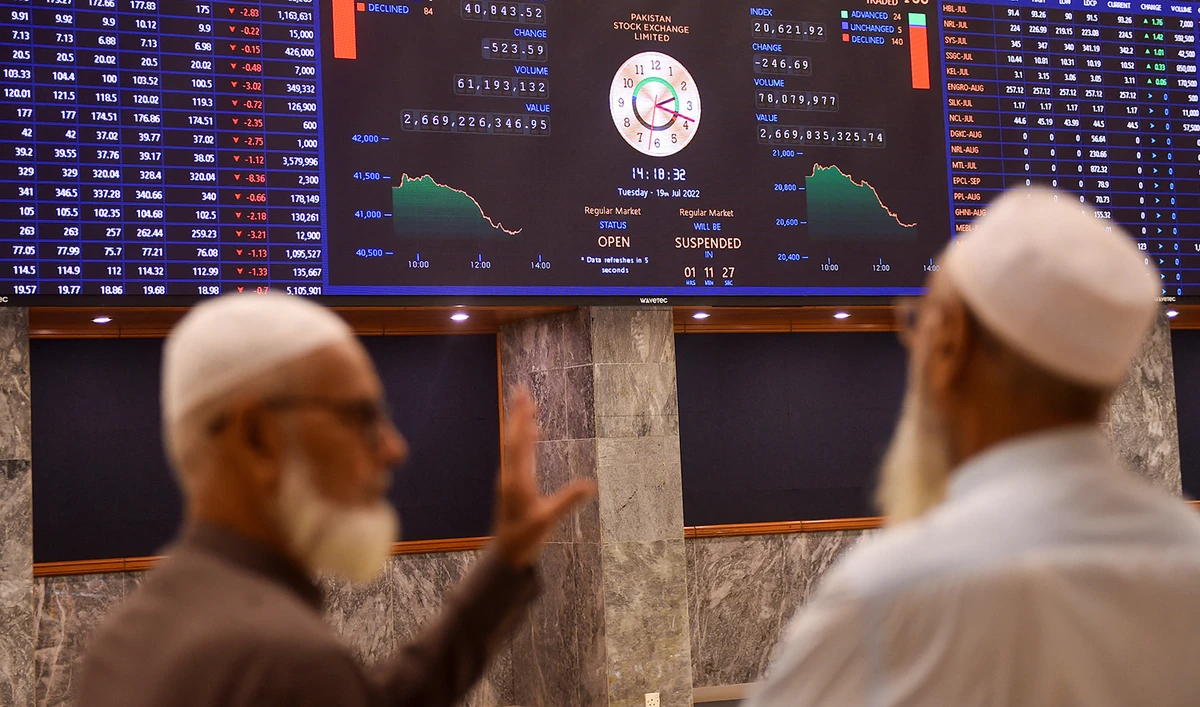
- The benchmark KSE100 index slides below 40,000 points, hitting 20-month low amid rising political uncertainty
- Local industrialists ask the government to cap the exchange rate of dollar while seeking economic support
KARACHI: Pakistan’s national currency and stocks continued to decline on Thursday, with rupee closing at yet another lifetime low of Rs226.81 against the US dollar while the equity market hitting the 20-month low amid the prevailing political uncertainty after the coalition government lost by-elections in a key political battle in Punjab on Sunday.
The rupee has lost its value by 7.7 percent or Rs11.61 during the course of this week against the greenback.
There has been an overall deterioration of 22.18 percent in its value since January, owing to uncertainty related to the International Monetary Fund (IMF) program and several political developments, including the departure of the administration of former prime minister Imran Khan in a no-trust move earlier this year.
On Wednesday, Pakistan’s finance minister Miftah Ismail attributed the freefall of the Pakistani rupee to the political turmoil following the outcome of the recent by-polls in Punjab. However, market players said investors were not willing to believe such assertions.
“The currency market needs practical measures to arrest the freefall of the Pakistani rupee,” Zafar Paracha, general secretary of the Exchange Companies Association of Pakistan, told Arab News.
“It seems the market participants are not ready to trust government officials holding press conferences over the issue,” he continued.
Contrary to expectations, the Pakistani currency has been fast depreciating even after the country reached a staff-level agreement with the International Monetary Fund (IMF).
However, currency dealers believe the freefall of the rupee was part of the IMF agreement, pointing out that the government did not intervene in the currency market to take remedial measures.
The downward slide of the national currency also mounted pressure on the country’s stock market, as the benchmark KSE100 index shed 628 points and closed at 39,832, the lowest level since November 2020.
“Bearish activity witnessed at the Pakistan Stock Exchange owes to political reasons and dismal earning outlook amid a record decline in the rupee and surge in energy prices,” Ahsan Mehanti, CEO of Arif Habib Corporation, told Arab News.
“Reports of the IMF’s new conditions related to the assurance over $4 billion Saudi funding ahead of the release of $1.17 billion tranche and uncertainty over funding from friendly countries played a catalyst role in a bearish close,” he continued.
Pakistani industrialists have sought government intervention to bring stability to the currency market, saying the depreciation of the rupee had been increasing their production cost.
“The historic freefall of the rupee is becoming a national security issue, creating a risk that Pakistan can witness a situation like Sri Lanka,” Irfan Iqbal Sheikh, president of the Federation of Pakistan Chamber of Commerce & Industry, said at a news conference in Karachi while asking the government to take corrective steps within 72 hours.
“The depreciation of eight to nine rupees against the dollar on a daily basis is very dangerous for the country’s economy,” he added. “The government must regulate the dollar. If it does not pay attention to the problem, the country will not move forward.”
Sheikh urged all political parties to sit together and devise a “charter of economy,” calling it the need of the hour.
In another news conference held at the Karachi Chamber of Commerce and Industry (KCCI), chairman of Businessmen Group Zubair Motiwala called for immediate appointment of the central bank governor.
“These are unusual times that require hard decisions to be made,” he said, adding: “Politicians should separate politics from the economy.”
The Pakistani finance minister told reporters in Islamabad on Thursday that the government would appoint the state bank governor next week.
Aqeel Karim Dhedhi, Pakistani business tycoon and chairman of the AKD Group, called for capping the exchange rate of dollar for two weeks while addressing the news conference with Motiwala, saying the next two weeks were “crucial” for Pakistan for which immediate actions were needed.
Pakistani currency dealers and industrialists also blamed banks for speculative trading and called for their forensic audit.