- Foreign Office confirms ‘some deployments’ under bilateral defense pact with the Kingdom
- Islamabad voices concern over the situation around Bab Al-Mandab amid Houthi advancement
ISLAMABAD: Pakistan on Thursday said its bilateral defense pact with Saudi Arabia was “operational” but declined to disclose details of the military cooperation, reiterating that it would implement the bilateral treaty and another trilateral defense pact with Riyadh and Ankara in its “intent and spirit.”
The statement by Pakistan’s Foreign Office followed Houthi attacks against Saudi Arabia. The Kingdom said its air defenses destroyed a drone launched by Yemen’s Iran-aligned Houthis south of Makkah on Tuesday evening before it could enter the restricted airspace over Islam’s holiest city.
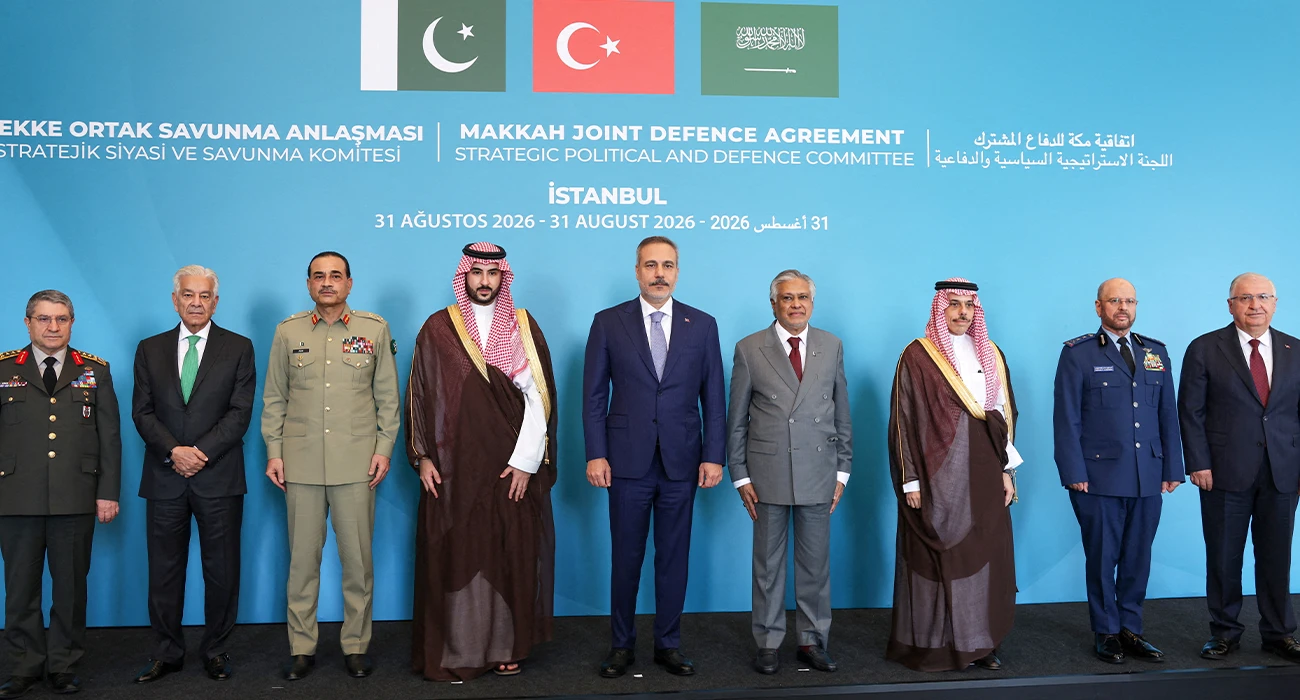
Pakistan, Turkiye and Saudi Arabia signed the Makkah Joint Defense Agreement last month. The agreement stipulates that an attack against any one of the three countries will be considered an attack against all three.
Addressing a weekly press briefing, Pakistani Foreign Office spokesman Sajjad Haider Khan confirmed Pakistan had made “some deployments” in Saudi Arabia under the bilateral Strategic Mutual Defense Agreement (SMDA) signed in September last year.
“Pakistan is committed, you know, in intent and spirit to implement SMDA as well as the Makkah Joint Defense Agreement,” Khan said.
“However, when, how, where and what force will be used against what objectives, in which modes and, you know, matters, operational confidentiality requires some discreteness.”
The accords were aimed at strengthening regional peace and stability, according to Khan.
“So that is, I mean objective number one. Our partnership with Saudi Arabia and Turkiye in the area of security and defense is well recognized,” he said, adding the Makkah accord was purely defensive in nature.
“It is neither directed against any country nor constitutes formally as a new bloc.”
The trilateral defense pact has essentially formalized and further strengthened many aspects of ongoing cooperation and longstanding bilateral relations among the three countries.
“It aims to enhance... the existing defense cooperation, including training and capacity building, exchange of best practices, learning from mutual experiences in defense technologies and research as well as collectively deter any acts aimed at destabilizing the regional security,” Khan said.
“On SMDA, of course it was signed last year... There were some deployments also of forces there. And since it’s an operational matter, I would not comment beyond that.”
IRAN DIPLOMACY
To a question about Pakistani Defense Forces Chief Field Marshal Asim Munir’s recent conversations with Iranian leadership, Khan said Islamabad had long advocated peace and stability through dialogue and diplomacy, voicing concern over the situation around the Bab Al-Mandab Strait.
“Pakistan has for a long time been, you know, sharing this perspective that we want, would like to have peace and stability because this is in the interest of not only Pakistan, Iran, but the entire region and beyond our region also,” Khan said.
“And the situation in Bab Al-Mandab is exceptional, you can say that it’s a serious matter, of serious concern and we need to bring peace in the entire region and Houthis must stop their activities also.”
Known as the “Gate of Tears” in Arabic, the Bab Al-Mandab strait sits at the southern tip of the Red Sea, connecting it with the Gulf of Aden in the Indian Ocean. About 100 kilometers (62 miles) long and 30 kilometers (18 miles) wide at its narrowest, it separates Yemen on the Arabian Peninsula from Djibouti and Eritrea on the Horn of Africa.
The Houthis have advanced along Yemen’s Red Sea coast around the strategic Bab Al-Mandab Strait, raising fears about commercial shipping and energy supplies already strained by disruptions through the Strait of Hormuz due to the United States-Iran war.
Pakistan emerged as a key mediator in the US-Iran war, hosting rare, direct talks between the parties and helping reach an interim peace deal in June. However, the peace deal quickly fell apart, and both sides resumed attacks against each other in the Middle East.
“In this regard, our discussions basically revolve around bringing peace and stability through dialogue and diplomacy and not through coercive measures,” Khan added.