- Rupee ended in the interbank market at all-time low of 164 against the US dollar
- Steady decline follows May agreement with International Monetary Fund for a $6 billion loan
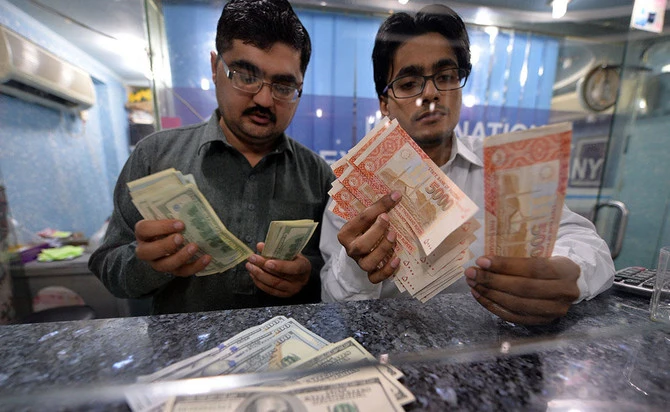
KARACHI: Pakistan’s rupee currency fell more than 3.3 percent against the dollar on Wednesday, a steady decline following a May agreement with the International Monetary Fund for a $6 billion loan that is expected to come with strict conditions including a “market determined” exchange rate.
The rupee ended the day in the interbank market at 164 against the US dollar, closing at 162.2 as compared to Tuesday’s close of 156.99, the State Bank of Pakistan said.
“With the rising exchange rate our hearts are sinking,” Malik Bostan, the president of the Forex Association of Pakistan, told Arab News. “Rates in interbank is increasing but there is no one to intervene and we are unable to understand the situation and where it is heading.”
In his first media interaction on June 17, Dr. Reza Baqir, Pakistan’s newly appointed central bank governor, had tried to dispel the impression that the central bank would not intervene in the currency market due to IMF conditionalities.
“Neither fixed nor floating exchange rates are in the interest of the country’s economy; the first creates external imbalances and the second leads to manipulation,” Baqir had said, saying he would “keep a close eye on the exchange market and would intervene in case of major volatility through a market-based exchange rate mechanism.”
Financial experts say the recent currency devaluation wave is senseless because it would “only burden the government with more debt, and people with more inflation, and industries with high cost and no export growth, resultantly strangulating the economy,” Khurram Schehzad, CEO of Alpha Beta Core, a financial advisory firm, said.
The steady depreciation of the currency has created uncertainty about exchange rate stability, Bostan said, as those holding dollars were reluctant to sell, expecting gains from further depreciation.
“The average daily volume in the open market was 5 to 7 million dollars but today only 2 to 2.5 million trading volume is being recorded,” the forex association president said. “No one is taking risks due to a fear of further rate hikes. In the open market buyers and sellers both are confused.”
The currency has lost more than a third of its value against the dollar since the start of last year amid mounting economic challenges for Pakistan, which is facing slowing growth and a squeeze on its balance of payments.