- The UAE government had announced to deposit $3 billion in SBP’s account in December 2018
- Pakistan has so far received $3 billion from Saudi Arabia and the UAE
KARACHI: Pakistan on Thursday received the first tranche of $1 billion from the United Arab Emirates (UAE), confirmed the State Bank of Pakistan (SBP).
Islamabad has been desperately looking for external assistance to address its balance-of-payments crisis and jack up its declining foreign exchange reserves. In this context, the UAE government had pledged in December 2018 to deposit $3billion in SBP’s account to support Pakistan’s financial and monetary policy and enhance its liquidity and monetary reserves of foreign currency.
Pakistan’s foreign exchange reserves declined to $13.3 billion on January 18, 2019, with half of that amount being held by the central bank and the other half by commercial banks. With the transfer of $1 billion by the Abu Dhabi Fund for Development (ADFD), however, the foreign reserves have increased to $14.3 billion.
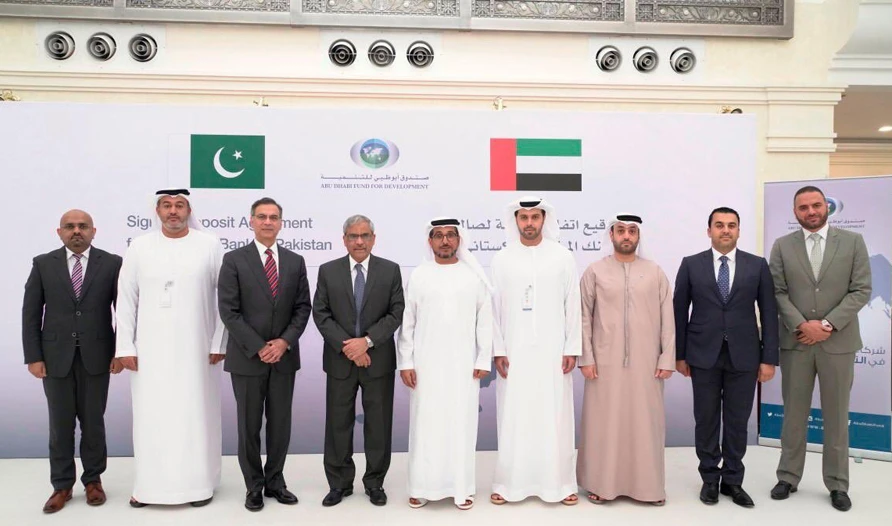
ADFD Director General Mohammed Saif Al Suwaidi,and State Bank of Pakistan Governor Tariq Bajwa had signed an agreement in Abu Dhabi to transfer $3 billion (AED11 billion) into Pakistan’s central bank’s account.
Speaking at the signing ceremony, the SBP governor said that UAE’s support was vital for the country “to overcome [its] short term [economic] difficulties”.
“The $3 billion we are going to receive as a deposit from the Abu Dhabi Fund for Development is going to help us tackle our current account challenges,” Bajwa noted.
Speaking at the signing ceremony, the director general of ADFD said: “The directive to deposit $3 billion with the State Bank of Pakistan aligns with the UAE leadership’s keenness to bolster Pakistan’s economy, help its government achieve financial stability, overcome economic challenges, and drive comprehensive development in that country.”
Islamabad has so far received $3 billion from Arab states following the visits of Prime Minister Imran Khan after he assumed the country’s top political office in August 2018. Saudi Arabia has given $2 billion while the UAE has provided $1 billion to the country.
Pakistan is also negotiating with the International Monetary Fund to avail a bailout program, but it is still reluctant to take a decision since such assistance packages are mostly accompanied by stringent economic conditions.
“The government will approach the IMF when the conditions will be in favor of the country’s economy and the masses,” said Finance Minister Asad Umar on Thursday during a news briefing in Islamabad.
He reiterated that the emergency situation was over and things were likely to improve further in the next couple of weeks. “Friendly countries have supported us and, in addition to that, the government has taken emergency measures to improve the situation,” Umar added.