- Iqbal warns unchecked urban expansion is consuming productive farmland, worsening food security
- Minister calls for groundwater regulation as Pakistan’s water availability continues to decline
ISLAMABAD: Pakistan’s Planning Minister Ahsan Iqbal on Wednesday criticized the way constitutional devolution has been implemented over the past 15 years, saying powers and resources transferred from the federal government largely stopped at the provincial level instead of reaching districts and local communities.
His comments came amid a broader debate over Pakistan’s administrative structure, after Interior Minister Mohsin Naqvi called for a “reset” of the decades-old system and proposed smaller administrative units to bring government closer to citizens. Iqbal focused on what he described as an incomplete process of decentralization following the 18th Amendment to the constitution.
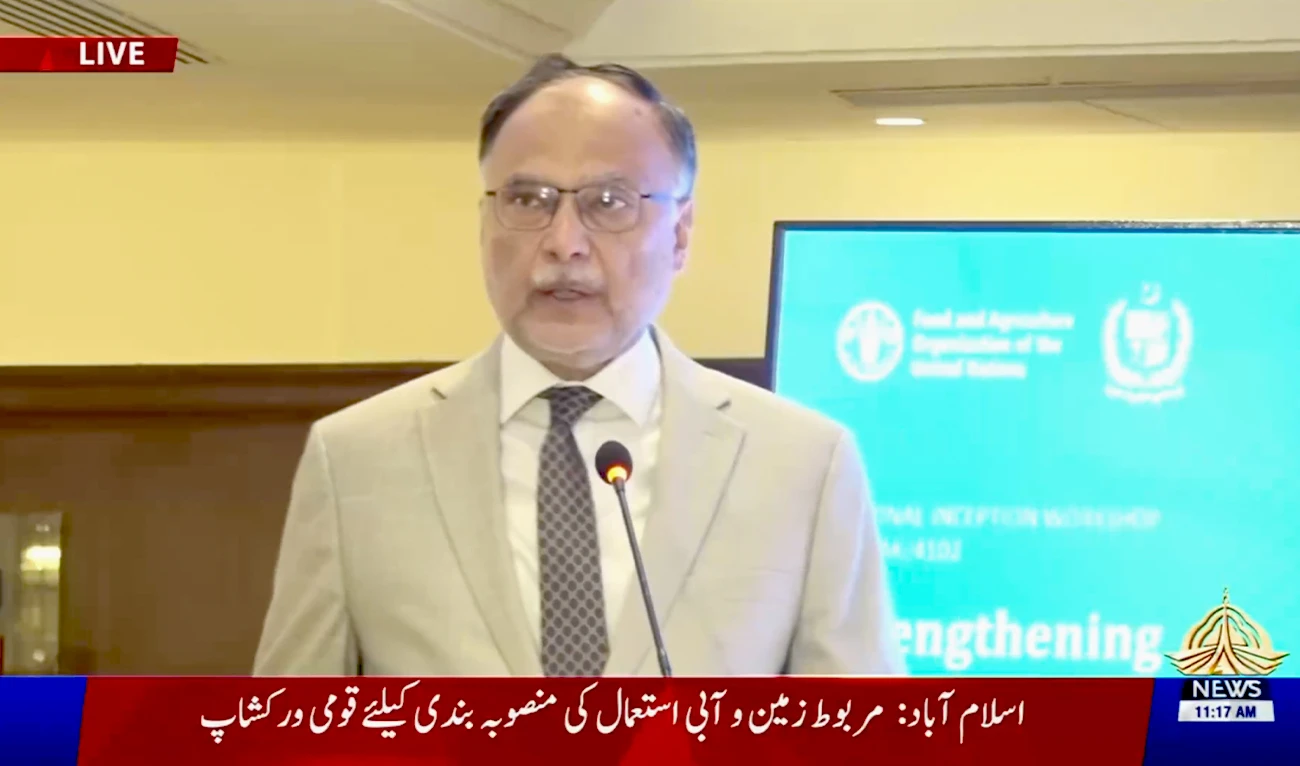
Speaking at a workshop on food systems and urban planning, the planning minister said transferring authority from Islamabad to the provinces was not in itself the problem, but argued that provinces had failed to devolve sufficient authority and resources further downward.
“The defect in our devolution was that we put a full stop after the devolution on the provinces,” he said. “The powers that the federation gave to the provinces ... the provinces should have given the powers to the district governments.”
Iqbal said the resulting system had weakened coordination while failing to produce models of improved service delivery at the local level, arguing that after around 15 years there was “not a single” successful case that could be pointed to in areas including education, health, population control and childhood stunting.
The 18th Amendment, passed in 2010, expanded provincial autonomy and transferred responsibility for a range of social and economic sectors from the federal government to the provinces.
The planning minister also linked weaknesses in governance and urban planning to Pakistan’s growing food-security challenges despite the country’s substantial agricultural resources.
“We are a net agriculture importing country,” he said. “We import net 4-5 billion dollars annually. And agriculture is not a multiplier for us, but a burden on our external sector.”
He warned in particular that the horizontal expansion of cities was consuming some of Pakistan’s most productive agricultural land.
“Like a blackhole, our cities are eroding the agricultural land,” he said.
Iqbal called for cities to grow vertically rather than continuing to spread outward and said productive agricultural zones needed stronger legal and regulatory protection, citing areas known for crops including citrus, mangoes and basmati rice.
Rapid population growth, he said, meant Pakistan could not afford the continued loss of farmland at a time when demand for food was increasing and the country was already dependent on agricultural imports.
He also raised concerns about Pakistan’s shrinking water resources, saying per capita water availability had fallen from around 5,000 cubic meters in 1950 to about 800-900 cubic meters today.
He called for stronger regulation of groundwater extraction and warned that the growing use of solar-powered pumping could accelerate depletion by making it cheaper and easier to draw water from underground aquifers.
The minister said Pakistan needed to address food, land and water pressures together rather than treating them as separate policy challenges, as rapid urbanization and population growth placed increasing strain on the country’s natural resources and public services.