- Export processing factories facing delays in orders as gas pressures and temperatures plunge, industry insiders say
- Earlier this month, PM’s commerce adviser said the government had decided there would be no gas outages for exporters
KARACHI: The government is in touch with Pakistan’s major exporters and industrialists to sort out a solution to the chronic gas shortage delaying production in the winter months, the parliamentary secretary for commerce, industries & production said on Sunday.
The government announced on Saturday it would import more liquefied natural gas (LNG) in January next year to meet demand, as
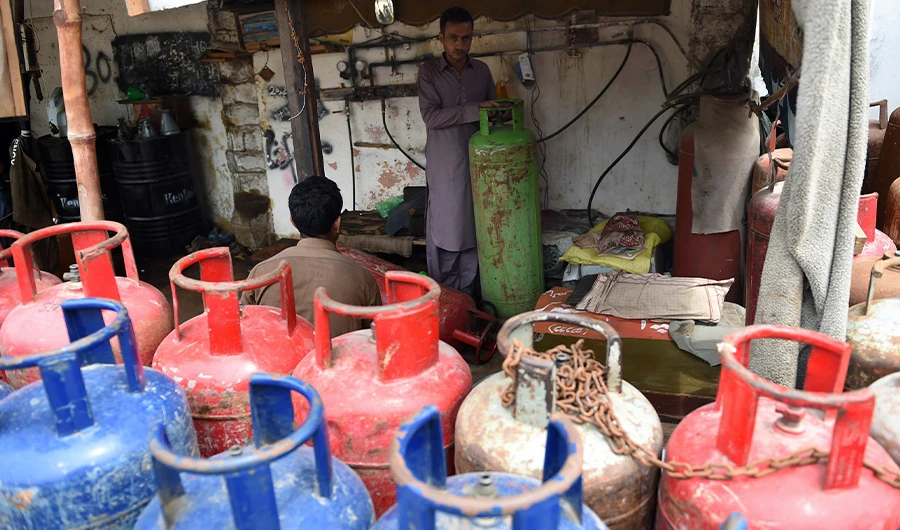
Pakistani industries continue to undergo a critical shortfall of gas due to supply cuts and low pressures in major parts of the energy deficient country.
“We are in contact with exporters and other industrialists. This is our responsibility, to sort out all their problems and we are doing this already,” Aliya Hamza Malik told Arab News.
Natural Gas constitutes 50 percent of Pakistan’s primary energy mix. The local production of gas has been stagnant at 4,000 million cubic feet per day (MMcfd) for almost 10 years as compared to the constrained demand of 6,000 MMcfd and unconstrained demand of 8,000 MMcfd.
Pakistan, chronically short of natural gas, diverts gas supplies toward its 220 million strong population in the winter by cutting down supplies to industries and power plants. This long-held practice disrupts the production activities of major industries which rely heavily on gas supplies to function.
“We are receiving complaints from industrialists all over Pakistan”, Sheikh Sultan Rehman, Vice President of the Federation of Pakistan Chambers of Commerce & Industry (FPCCI) told Arab News on Saturday.
“Industries are facing low pressure and supply cuts and the situation is getting worse because even domestic consumers are facing problems,” he continued.
“Business activities are suffering due to the gas supply situation,” he added.
Industrialists from Karachi, Pakistan’s largest city and business hub, have said the gas shortfall is delaying export orders.
“The gas supply situation at the moment is really bad. The pressure is so low that the generators can’t be operated and the textile factories that need gas for processing orders are delayed,” M. Shariq Vohra, President of the Karachi Chamber of Commerce and Industry (KCCI) told Arab News.
Earlier this month, Abdul Razak Dawood, adviser to the Prime Minister for commerce, said the government had decided that there would be no gas outages for exporters.
But industry insiders say this is not the case.
“All of Pakistan’s industries, whether they are export oriented or not, should be treated at par and a uniform policy should be in place”, FPCCI Vice President Rehman said.
The gas supply situation is similar in Pakistan’s eastern and most populous province Punjab, where production facilities are suffering as temperatures plunge.
“We are facing difficulty at the domestic and industrial level. The routine supply of gas is disrupted, as there is a supply break of three hours each in the morning and evening,” M. Nasir Hameed Khan, Senior Vice President, Lahore Chamber of Commerce and Industry (LCCI) said.
“The government has assured (us) that they will supply gas for 24 hours from January 6,” he added
The South Asian country, which faces a 2,000 MMcfd shortage, meets its deficit through the import of LNG.
The petroleum ministry on Saturday said the government had arranged 12 LNG cargoes for Jan. 2021.
“One cargo that was scheduled for 30th December, and was intended to supply for January 2021, has been moved a few days ago into January. In addition, the volume has been increased in certain cargoes,” the ministry said in a statement.
The ministry said the country’s gas utilities were facing a more than 9 percent load increase after temperatures dropped in different cities.
With each 1-degree Celsius drop in temperatures, demand for gas increases by 6 MMcfd in the twin cities of Islamabad-Rawalpindi alone, according to the ministry.
The ministry said Pakistan will be moving 30 percent more LNG in January 2021 compared to January 2018, at the cheapest ever price of $6.34 (MBtu) for a peak winter month.
But former federal finance minister, Miftah Ismail, warned that in January the shortage would further intensify and said if domestic industry was not supplied, it could have a major economic fallout.
“Gas shortage will increase in January and they (government) are saying they will not supply gas to domestic industry, and if they will not supply... how will employment increase? Then how will tax be collected? And if you will not supply (gas) to the export industry, how will foreign exchange come,” Ismail told Arab News.