- Two sides work to finalize draft as negotiations stretch into Sunday
- No clarity on Khan meeting or whether PTI will call off planned march
ISLAMABAD: Pakistan’s government and opposition remained locked in intense negotiations into Sunday, as the two sides sought to finalize a draft aimed at defusing political tensions hours before jailed former prime minister Imran Khan’s party was due to begin a march toward Islamabad.
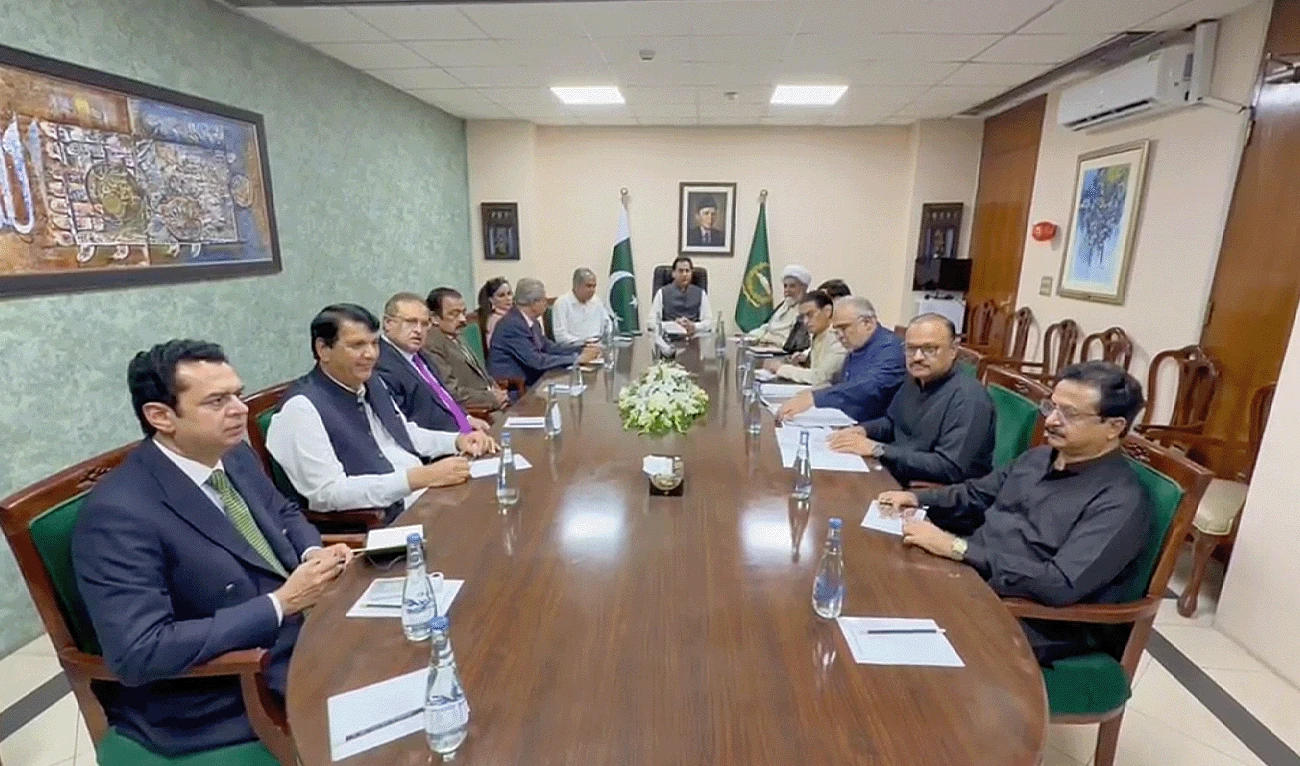
The second round of talks began at Parliament House at around 4:45 p.m. on Saturday after a nearly three-hour delay and continued for several hours, with no official announcement on the outcome by the time of filing.
It remained unclear whether the negotiations were moving toward a breakthrough or a deadlock, with no confirmation that the government was prepared to facilitate a meeting between opposition leaders and Khan or that his Pakistan Tehreek-e-Insaf (PTI) party was willing to call off its Oct. 4 march.
The two sides were trying to finalize a draft as intense political activity continued late into the night. Interior Minister Mohsin Naqvi was seen leaving Parliament House during the negotiations and later returning. Local media, citing sources, reported that Naqvi had briefed President Asif Ali Zardari on the discussions before returning to the talks.
A government source involved in the process blamed the opposition for the prolonged negotiations, describing the PTI as “confused” in response to an Arab News query.
Zafar Sultan, director general of media at the National Assembly, told reporters inside Parliament House that the negotiating parties would no longer speak to the media outside the speaker’s chamber as previously planned, adding that a joint statement would be issued instead.
PTI plans to begin the march from the northwestern Khyber Pakhtunkhwa province on Sunday to demand Khan’s release from prison.
PTI Chairman Barrister Gohar Ali Khan had said before Saturday’s meeting that his party had come to the talks “with very good intentions,” describing the negotiations as an important round but saying progress would depend on the government’s approach.
“Look, we have come with very good intentions,” he told reporters. “We attended the meeting [previously], and today as well we will participate with very good intentions. It will depend on the government’s attitude.”
The talks came amid heightened political tensions between the federal government and PTI, which governs Khyber Pakhtunkhwa, over the planned march as well as governance and worsening militant violence in the province.
Federal ministers have raised the possibility of governor’s rule, which would place provincial government functions under federal control, though no decision to impose it has been announced.
Gohar criticized efforts to stop the planned march and what he described as talk of taking “extreme measures.”
“The way attempts are being made to stop our long march, or the way there is talk of taking extreme measures, these things should not happen in a democracy,” he said.
He also accused some government ministers of making “irresponsible statements” that were undermining efforts to reduce political tensions.
“If you say that democracy has to function and move forward, then everyone has to play a positive role and work toward cooling things down,” he added.
PTI Secretary-General Salman Akram Raja, who also attended the talks, said before the meeting it was too early to say whether the two sides would reach an agreement.
“What we want is the well-being of this country,” he told reporters. “We want harmony between the Pakistani nation and the powers of the state. That is our larger objective.”
Asked about the seriousness of the government in pursuing negotiations, Raja said there were “certainly some serious people” in the administration but accused others of wanting to worsen the political situation.
“The government now has to decide whether it wants deterioration or improvement,” he said.
Raja also said any decision on PTI’s planned march would be made in consultation with Khyber Pakhtunkhwa Chief Minister Sohail Afridi, who is leading it.
“We will make all decisions through mutual consultation,” he said. “Sohail Afridi is the leader of this march. He will be included in the discussions, and whatever decision is made will be a joint decision.”
He reiterated PTI’s concerns about Khan’s imprisonment and health, saying his medical examinations should be conducted regularly, and said the party would not retreat from its “principled position.”
Members of the ruling coalition, including Naqvi, Minister of State for Interior Talal Chaudhry, Senator Sherry Rehman and Amir Muqam, also attended the negotiations.
“We always believe in creating space for negotiated agreements and settlements. That is the democratic, constitutional way. And it gives a message of safety and consistency and stability to the country,” Rehman, a member of the coalition partner Pakistan Peoples Party, told reporters.
“If they [the opposition parties] want to work something out, a way forward in parliament, as opposed to the streets, then yes, of course, we will listen to them and move forward.”
The government agreed to pursue talks after a Thursday meeting between Zardari and Prime Minister Shehbaz Sharif that reviewed the political and security situation and expressed concern over conditions in Khyber Pakhtunkhwa.
PTI said on Friday its Oct. 4 march remained on schedule. The party had postponed the march from Sept. 27 after authorities blocked routes toward Islamabad with shipping containers and deployed security forces.
After the first round of negotiations on Friday, Gohar denied reports that harsh words had been exchanged during the meeting.
“The positive thing is that the talks are continuing,” he said. “Both sides informed each other of their positions.”
Federal Minister for Parliamentary Affairs Tariq Fazal Chaudhry also described Friday’s atmosphere as “very positive,” saying the two sides had agreed not to disclose details of their discussions.
“The very purpose of negotiations is to listen to one another and to find a political solution through dialogue, patience and tolerance,” he told reporters. “And we are moving in that direction.”