- Analysts say crisis may lead to delay in economic reforms, talks with IMF for completion of $6 billion loan program
- Pakistan has faced pressure on forex reserves in recent months amid elevated global commodity prices
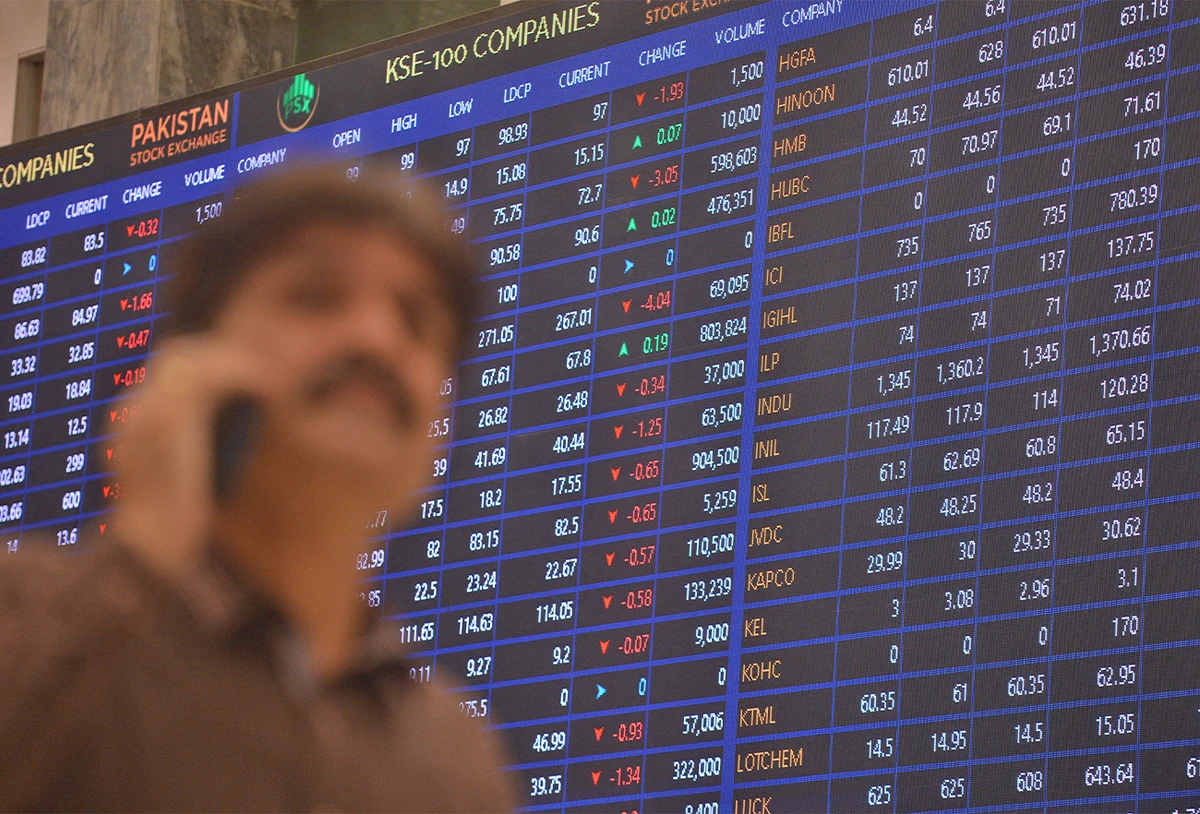
KARACHI: Political turmoil in Pakistan has clouded the economic outlook of the South Asian country, with the stock market recording erosion of more than 1,200 points and financial experts predicting a “difficult year” ahead.
Last week, international credit rating agency Moody’s termed an ongoing no-confidence motion against Prime Minister Imran Khan as “credit negative” for the country.
On Monday, the Pakistani stock market’s benchmark KSE 100 index declined by 2.7 percent, or 1,250 points, to close at 43,902 points as investors resorted to selling amid higher uncertainty following Sunday’s political developments. These included the deputy speaker of the National Assembly, who belongs to Khan’s party, blocking a vote on the no-confidence motion from taking place, and the president subsequently dissolving the lower house of parliament on the PM’s advice, triggering political and constitutional crisis in the country.
“Stocks fell across the board on investor concerns for political crises,” Ahsan Mehanti, Chief Executive Officer of Arif Habib Corporation, told Arab News. “Rupee instability, slump in global crude oil prices and investor concerns for political noise, current account deficit and higher import bills played a catalyst role in record bearish close.”
Analysts say the political crisis may also lead to a delay in economic reforms and, most importantly, in talks with the International Monetary fund for the completion of a $6 billion loan program whose seventh review is ongoing.
“Markets negatively respond to uncertainty and the current political crisis has substantially increased uncertainty for the next several months,” said Haroon Sharif, former Chairman Board of Investment. “As Moody’s has pointed out, this situation will lead to a slowdown in reforms.”
“That means a potential delay in IMF tranche, higher premium on bond and sukuk issues and further pressure on current account,” Sharif said. “For the medium term, I see a slowdown in CPEC (China Pakistan Economic Corridor) industrial cooperation, some withdrawal of diaspora investments and a hold on future investments. So, it’s going to be a difficult year ahead from an investment perspective.”
Pakistan is undergoing its seventh review under the IMF’s program and has so far received $3 billion out of the stipulated $6 billion. Moody’s said last week discussions between Pakistan and the IMF appeared to have stalled since early March, with the IMF expressing concerns over a government relief package in response to rising inflation.
Pakistani senior economists have also expressed concern over the political situation, saying the uncertainty was worrying investors.
“The current state of affairs in Pakistan has made local and foreign investors stay away from active business routines,” senior economist Dr. Ashfaque Hassan Khan said. “The impact of political crisis are visible and are reflected in the sharp depreciation of Pak rupee which is trading at all time low.”
Pakistan has faced significant pressure on its foreign-exchange reserves in recent months, amid elevated global commodity prices and a recovery in domestic demand. The Russia-Ukraine military conflict, which has driven up global commodity prices, has amplified pressure on its external position.
Official forex reserves of Pakistan have decreased by $2.915 billion to $12 billion, mainly due to payments made to external creditors including China. The South Asian country is also expecting $2.3 billion to be returned by China after Beijing agreed to rollover a syndicated facility.
The Pakistan Finance ministry last week said Pakistan’s economic performance was strong and still on a trajectory compatible with an economic growth target of around five percent in the current fiscal year.
However, the ministry also warned that recent geopolitical tensions, in particular the Ukraine crisis, were the most important external risk factor, while domestic political conditions were also building domestic risks.