- Service providers, social media giants can be fined up to Rs500 million for non-compliance
- Any content against Islam, Pakistan’s security, public order, decency can be removed or blocked
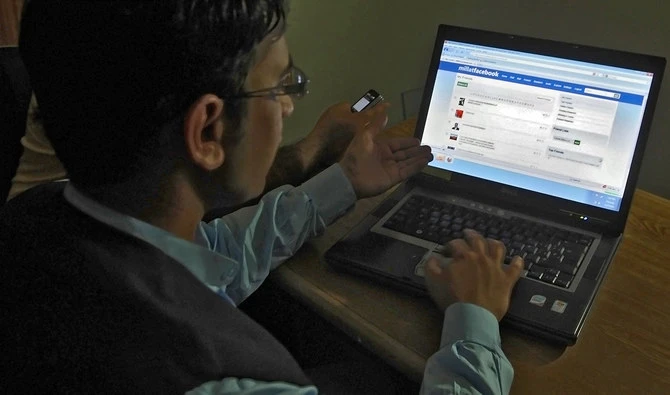
ISLAMABAD: The Pakistan government on Thursday notified controversial new rules to regulate cyberspace, including imposing a penalty of up to Rs500 million, or roughly $3 million, on service providers and social media companies in cases of statutory violations.
The rules, which have been under discussion since November last year, have invited fierce criticism from rights groups who fear they may be used to stifle dissent and free speech.
The Removal and Blocking of Unlawful Online Content (Procedure, Oversight and Safeguards) Rules, 2021 will come into force at once and apply to licensees that provide social media or social networking services.
The new rules are subject to provisions of the Pakistan Telecommunication Act, 1996, and the terms and conditions of the licenses issued by the authority, the government said in a notification.
The notification said the authority would not restrict, disrupt flow or dissemination of any online content unless it considered doing so necessary for the “glory of Islam,” “security of Pakistan,” “public order,” “decency and morality,” and the “integrity or defense of Pakistan.”
“The direction, issued by the authority under the act and under these rules, shall prevail and take precedence over any contrary community guidelines and such community guidelines shall be deemed to be of no legal effect,” the notification read.
Any person, their guardian, ministry, division, attached department, subordinate office, provincial or local department or office, law enforcement or intelligence agency, or a company owned or controlled by the government could file a complaint “for blocking and removal of online content” while making full disclosure of available information, according to the new rules.
The authority shall ensure that the online content and the identity of the complainant is kept confidential. It may also on its own take cognizance of any online content, and exercise its powers to remove or block content. A complaint would be decided by the authority within 30 days.
A person against whom a complaint is received will be given the chance to explain their position while service providers and social media companies would have 48 hours to comply with the directions of the authority.
In case, a service provider or social media company failed to remove or block access to online content or to comply with the directives, the authority could serve a notice, degrade services, block the entire online information system or impose a penalty of up to Rs500 million, or roughly $3 million.
A complaint would not be entertained where the complainant failed to furnish necessary information, the subject matter was sub-judice and failed to disclose the cause of action to justify removal or blocking of content.
The new rules also provide an oversight mechanism under which service providers are required to make community guidelines available for users to access or use any online information system. Social media companies are also required to not “knowingly host, display, upload, publish, transmit, update or share any online content in violation of local laws.”
Social media companies will have to register themselves with the authority within three months of coming into force of these rules; appoint an authorized compliance officer in Pakistan and a dedicated grievance officer in Pakistan for the redressal of grievances; establish an office in Pakistan, as and when feasible, on the directions of the authority with a physical address, preferably in Islamabad; and comply with the user data privacy and data localization in accordance with applicable laws, according to the notification.
Any person aggrieved by any order of the authority may file an application for review within 30 days from the date of the issuance of an order, it said. The authority will decide on the application within 30 working days.
“An appeal against the decision of the authority in review shall lie before the high court within 30 days of the order,” the notification added.
The new social media rules come weeks after Information Minister Chaudhry Fawad Hussain said a newly proposed media regulator would be able to impose fines of up to Rs250 million, or roughly $1.5 million, on Pakistani media outlets that violated rules.
The proposed Pakistan Media Development Authority Ordinance, 2021 — which will oversee films and monitor electronic, print and digital media, including Web TV, over-the-top content platforms and news websites — has rattled journalists and rights advocates, who fear it could be used to institutionalize censorship.
The Pakistan Electronic Media Regulatory Authority (PEMRA) currently has the authority to impose a maximum fine of Rs1 million, which Hussain has said was not large enough to deter media organizations from breaking rules.
At present, Hussain had said, there were seven laws to regulate media in Pakistan, but they needed to be converged under one authority in order to be implemented properly.