- The cuts render most of the province's public transportation inoperative
- More than 1.6 million vehicles have been converted to run on CNG in Sindh province
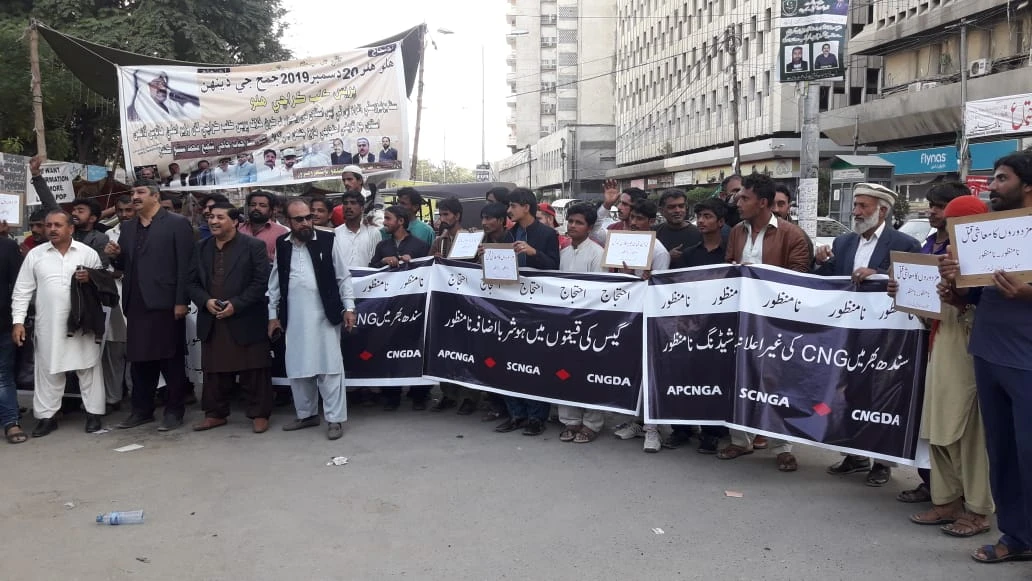
KARACHI: Owners of gas stations protested in Karachi on Monday, as Pakistan’s winter gas crisis continues to haunt consumers and businesses with supply cuts and low pressure.
Following a longer than scheduled suspension of compressed natural gas (CNG) supplies in Sindh province, the sector’s stakeholders staged a demonstration at the Karachi Press Club (KPC) on Monday, demanding that authorities intervene to save their businesses from collapsing.
“Gas to around 640 CNG stations, mostly in the interior of the province, remained opened only 27 hours last week, but due to low pressure more than 50 percent filling stations could not carry out their business,” Abdul Sami Khan, chairman of the Pakistan Petroleum Dealers Association, said at a press conference held at the KPC.
In Sindh, more than 1.6 million vehicles have been converted to run on CNG, which was introduced in the early 2000s as an environmentally friendly, cheap, and alternative source of fuel. The supply cuts to the stations render most of the province’s public transportation inoperative.
“CNG stations only consume 5 percent of the gas, while other sectors which as per management schedule should have been closed, are continuously supplied with the gas,” Khan said.
The gas shortage and supply disruptions are also likely to stoke inter-provincial tensions, as Sindh stakeholders claim the federal government is supplying their share of gas to Punjab.
“Sindh produces 2,200 to 2,400 mmcfd, and per the Constitution, it is the right of the people of Sindh to get the gas on a priority basis,” said Mumtaz Ali Jatoi, chairman of the Sindh CNG Association, said. “If the situation is not normalized, CNG stakeholders would protest in Hyderabad and block the main motorway from Tuesday.”
The stakeholders say the situation has jeopardized the livelihoods of thousands of people directly or indirectly associated with the sector.
Faced with persistent demand and supply issues, Pakistan cuts supplies to the industry sector during winters and channels gas to domestic consumers to avoid a public outcry.
According to the Oil and Gas Regulatory Authority (OGRA), the demand-supply gap during the 2017-18 fiscal year was 1.45 bcfd. It is expected to expand to 3.7 bcfd during FY2019-20.
Amid the country’s depleting reserves, the gap is forecast to reach 4.6 bcfd in FY2022-23 and 6.7 bcfd by FY2027-28, without gas imports.