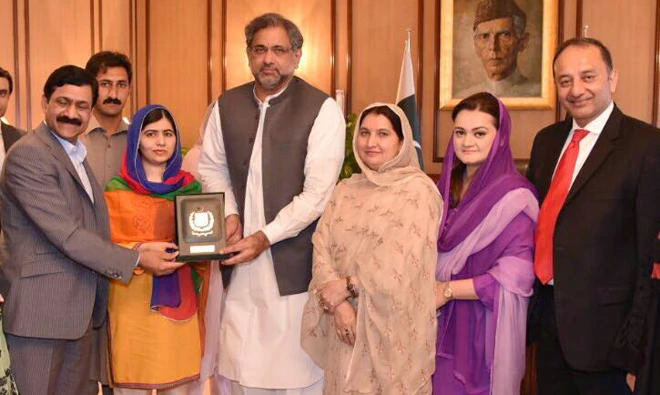
ISLAMABAD: The world’s youngest Nobel Laureate, Malala Yousafzai, and her family met Prime Minister Shahid Khaqan Abbasi and some of his Cabinet members on Thursday.
She briefed them on her work as an activist, and discussed ways to promote girls’ education in Pakistan.
A celebrity and Oxford University student, Yousafzai arrived in Pakistan on a four-day visit nearly six years after being shot in the head by a Taliban gunman in her hometown of Swat.
She was only 11 when she started advocating for girls’ education, and won the Nobel Peace Prize at the age of 17.
Yousafzai began her campaign by pseudonymously writing a blog for the BBC, wherein she described the harshness of life in Swat.
Back then, the Taliban had seized control of the area, stopped girls from going to school, and blew up their educational institutes.
It carried out beheadings and displayed severed heads in a public square. The Taliban also reportedly flogged women on roadsides for leaving their house unaccompanied.
The group was driven out of the area when the army launched an operation in 2009. But the Taliban still launched sporadic attacks until the government fully managed to re-establish its writ in the area.
During one such attack, the Taliban shot Yousafzai, then 15, in the head for speaking out against it. She was taken to the UK for surgery, and did not return to Pakistan due to security concerns.
Yousafzai settled in Britain, where she continued with her work by launching the Malala Fund and supporting girls’ education in Pakistan, Nigeria, Syria and several other countries.
Addressing a ceremony at Abbasi’s office on Thursday, she said the fund had already invested $6 million in Pakistan. Teary-eyed, she said it was hard for her to believe she was visiting her country once again.
Abbasi applauded her work and praised her for representing Pakistan in various international forums, saying: “Welcome back, Malala!”
He told her she was not an ordinary citizen anymore, and her security was the responsibility of the state.
Abbasi said terrorism was “at its peak” when she left Pakistan, but the country had made significant gains by fighting a difficult battle against militancy and religious extremism. “The biggest war against terror has been fought by Pakistan,” he said.
Yousafzai is scheduled to meet with civil society activists during her visit. While she will not be able to travel to Swat, she is expected to meet with her relatives in Islamabad.
Malala Yousafzai meets PM, Cabinet members