- Biennale’s third edition will be held from Oct. 6-Nov. 8 at historic Lahore Fort
- Artists from over 30 countries collaborate with Pakistani peers for the exhibition
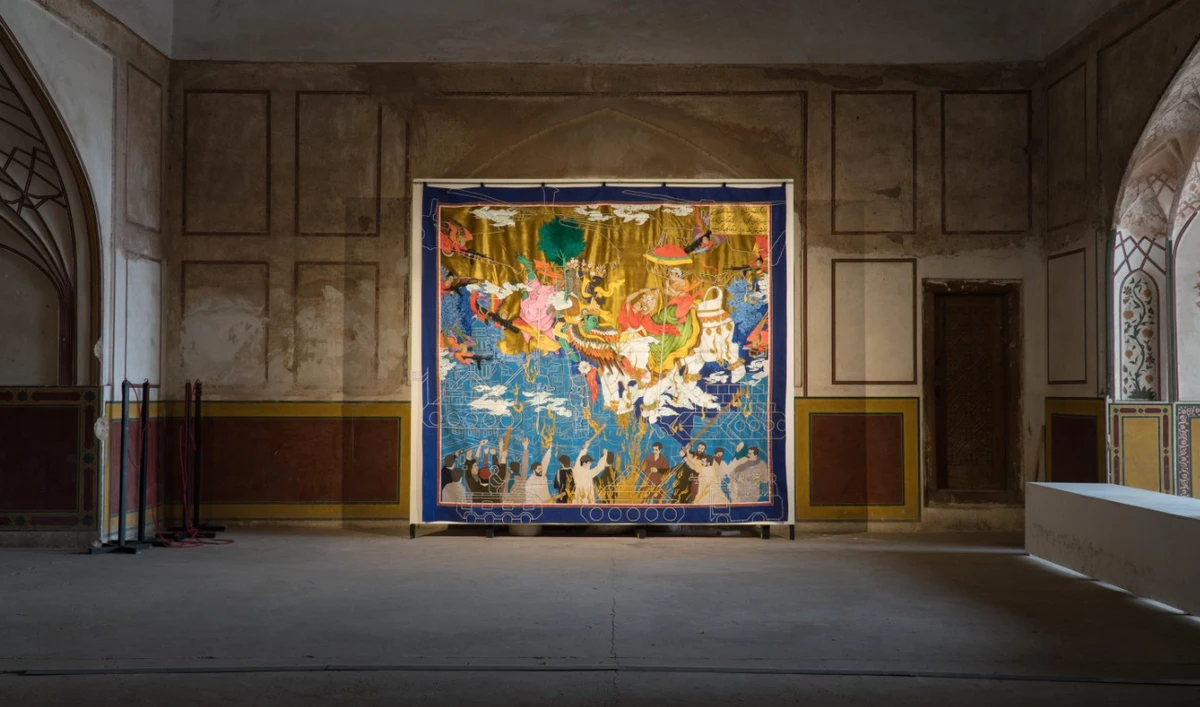
LAHORE: The Lahore Biennale is set to return after a four-year hiatus today, Sunday, at the city’s historic Lahore Fort with a grand spectacle featuring the works of at least 60 local and international artists revolving around the themes of ecologies and sustainable futures.
The theme for the third edition of the biennale is titled: ‘Of Mountains and Seas.’ It showcases the convergence of art, environmental awareness, and global collaboration to help imagine alternative futures, the biennale said on its official website.
The exhibition, which will showcase the art of around 60 artists from 30 countries, is expected to run till Nov. 8. Ahead of the spectacle on Sunday, the Pakistan Art Forum joined hands with the Lahore Biennale Foundation for a curtain-raiser event on Thursday titled: ‘Decolonial Feminist Ecologies: On Body and Land.’
The curtain-raiser featured performances by its curator and local artist Abdullah Qureshi, Iranian-born artist Sepideh Rahaa and Kenyan-German collaborative artist Syowia Kyambi. The curtain-raiser was held at the Brown House in Lahore, overlooking the historic Shahi Hamaam bathhouse and the iconic Wazir Khan Mosque.
“We wanted to showcase our art in a bustling public space, not art as gate-kept by colonial legacies or their bureaucracies,” Abdullah Qureshi told Arab News on Thursday.
Qureshi is also a multidisciplinary artist, educator and filmmaker. He roped in Rahaa and Kyambi, his friends and fellow artists, from Iran and Kenya respectively for the biennale.
“We tend to think of art as this controlled, quiet space where people are observers from a distance,” Qureshi explained.
“[The three of us wanted to] think about these ideas outside the Western canon.”
Kyambi’s art exhibited two distinct worlds, the high-rises and apartment complexes to the rural countrysides. The Nairobi-based artist handed out maps and pictures to her audience, shared stories and painted bright colors on a mud wall.
“[Art] can’t be constricted to a neat and tidy studio or a clean canvas,” she said. “Art is forever moving, changing and clamoring.”
Kyambi encouraged her audience to speak out during her performance and voice their opinion on whether they liked it or disliked it, and whether they understood her art or not.
“We want to imagine futures of solidarity, community and resistance,” she told Arab News. “Not just stay quiet at everything unfolding in front of them.”
Rahaa, the Iranian-Finnish artist, focused on feminizing labor by showcasing a short documentary on women working in Punjab’s rice fields.
“I am building up ancestral knowledge, indigenous knowledge [related to Pakistan] as well as ancient ways of cultivation of rice,” Rahaa told Arab News.
She was particularly taken by women farmers singing as they toiled the rice fields.
“These women are cultivating the same their grandmothers would have, singing the same songs,” she said. “As artists, this is important for us to record.”
The event was sponsored by the Norwegian Embassy and Kone Foundation, a non-profit organization based in Helsinki, Finland.
“The themes of [this] exhibition are sort of very much ones we identify with,” Per Albert Ilsaas, Norway’s ambassador to Pakistan, told Arab News. “Feminist ideals, human rights, rights of women, and marginalized communities are important to Norway.”
Pakistan Art Forum founder Imtisal Zafar said he wanted to promote lesser-known local artists by arranging their collaboration with international ones.
“Show the world how much talent we have here,” he told Arab News.