- The power distributor says its tariff differential subsidy claims have ballooned to $125 million
- KE fears possible prolonged outages may send the public in panic in the largest Pakistani city
KARACHI: K-Electric (KE), a majority shareholding company of Saudi Arabia’s Aljomaih Holdings, has sought support of the Sindh government to alleviate its cash flow constraints, saying the persistent issue could result in up to nine-hour-long power outages and panic in the largest Pakistani city of Karachi.
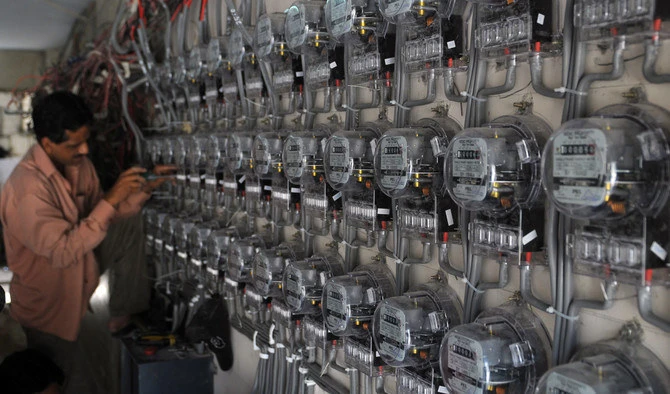
KE, formerly known as Karachi Electric Supply Company (KESC), supplies power to more than 2.5 million customers across Karachi, Dhabeji and Gharo in Sindh province, and Uthal, Vinder and Bela areas of Balochistan province.
The power distributor claims the Pakistani government has to pay it Rs25 billion ($125 million) on account of subsidies rolled out over the years.
“The accumulation of KE’s Tariff Differential Subsidy (TDS) Claims has ballooned to a critical point. The utility’s net receivables due to TDS claims stand at least PKR25 billion,” KE said in a letter to Murad Ali Shah, the chief minister of Sindh province that Karachi is the capital of, earlier this week.
The TDS is the difference between the electricity tariff paid by consumers and the permissible cost of the power utility determined by the regulator. Over the years, successive Pakistani governments have not passed on the high cost of electricity to low-income consumers for sociopolitical reasons. The gap between the tariffs and the costs was covered by the governments in the form of tariff differential subsidies to power distribution companies.
“These funds are critical towards procurement of fuel from PSO (Pakistan State Oil) and SSGC (Sui Southern Gas Company) which power KE’s generation capacity. Compounding this matter is an increase in the base tariff due to the unavailability of indigenous Natural Gas to KE, which is being substituted by very expensive imported RLNG (Re-gasified Liquefied Natural Gas),” the KE letter seen by Arab News read.
The utility said the rising prices of energy would triple tariff differential claims, which might lead to prolonged load-shedding and a law-and-order situation in Karachi.
“The prices of Furnace Oil have doubled within one year. While base tariffs continue to rise for utilities, consumer tariffs remain unchanged. Resultantly, Tariff Differential Claims are projected to triple from current level of PKR3/kWh (kilowatt-hour) to almost PKR10-12/kWh. KE is unable to sustain this widening gap without settlement of dues,” the company said.
“These current conditions are severely hindering KE’s ability to pay SSGC. In case of non-payment, SSGC may disconnect supply resulting in a sharp curtailment of power generation by approximately 500MW (megawatts). This translates into incremental load shedding of 5 hours across the city, over and above the existing regime of 6 to 9 hours.”
The power distributor said with the rising cost of power generation, electricity charges were expected to substantially increase in the coming months, which would go beyond the affordability of a large number of people in the Pakistani port city.
On Friday, the National Electric Power Regulatory Authority (NEPRA) approved the Fuel Cost Adjustment (FCA) charges of Rs4.82/unit for the consumers of KE for March 2022, against the company’s claim of Rs5.275/unit. The impact of the FCA would be Rs7.9 billion ($40 million) that would be recovered in the bills of June 2022, according to NEPRA.
However, KE said the FCA for April and May was likely to increase by Rs5-10/unit due to higher cost of power generation.
“Currently, SSGC is supplying RLNG to KE instead of indigenous gas. This RLNG cost, which is 5 times more expensive than local gas, is creating burden not only on exchequer but will also result in exorbitantly high fuel adjustment costs per unit in coming months,” KE said.
“This in itself is a big challenge and unsustainable for everyone in the value chain, be it power producers, businesses or residential customers as fuel costs are pass-through.”
With declining local output, Pakistan’s gas import bill has increased by 83 percent to $3.7 billion from July 2021 to April 2022, according to the Pakistan Bureau of Statistics (PBS).
Aljomaih Holdings, one of the largest business groups in Saudi Arabia, is the largest investor in KE through the consortium that bought out then KESC in 2005. The group is seeking the Pakistani government’s assistance for offloading its 66.4 percent controlling stake in KE to Shanghai Electric Power’s (SEP).