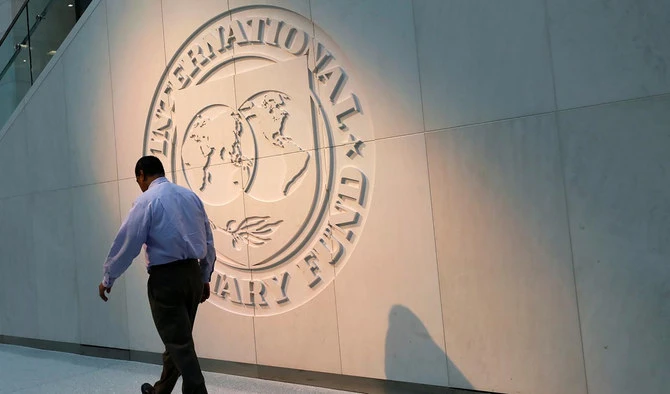
- International Monetary Fund this week approved $1 billion disbursement to Pakistan under $6 billion loan program
- Moody’s says current-account deficit will narrow and stabilise at 2%-3% of GDP through subsequent two to three year period
ISLAMABAD: The Moody’s Investor Service has said the International Monetary Fund’s approval of a $1 billion disbursement to Pakistan under its $6 billion loan program was “credit positive” and would help Pakistan shore up its foreign exchange reserves.
The disbursement brings Pakistan's total draw against the Extended Fund Facility program for budget support to about $3 billion. The program was initially approved in July 2019.
“The successful disbursement is credit positive, shoring up Pakistan's foreign-exchange reserves, which have faced significant pressures in recent months amid a sharp widening in the current-account deficit as higher global oil and commodity prices contributed to a yawning goods trade deficit,” Moody’s said.
From July to December 2021, the current-account deficit was a cumulative $9.0 billion, compared with a surplus of $1.2 billion during the same period a year earlier. The rapid widening in the current-account deficit led to a drawdown in foreign-exchange reserves, which declined to $14.4 billion in November 2021 from $18.9 billion in July 2021, according to IMF data. The injection of $3 billion financing from Saudi Arabia to Pakistan in December boosted the latter's foreign reserves to $16 billion in that month.
“We project the current-account deficit will widen to 3.0%-3.5% of GDP in fiscal year 2022 (ending June 2022),” Moody’s said. “The IMF disbursement will partially offset pressures on foreign exchange reserves, while facilitating further financing from other official sources.”
“Thereafter, we expect a moderation in global oil and commodity prices to contain growth in the import bill, while the ongoing global economic recovery supports exports and remittance inflows. As a result, we assume that the current-account deficit will narrow and stabilise at 2%-3% of GDP through the subsequent two to three year period.”
Moody’s said though the IMF had acknowledged the greater credibility of Pakistan's macroeconomic and fiscal management, it also noted the need for further structural reforms, particularly in the energy and state-owned enterprise sectors, to foster a business environment conducive to investments and private sector development.