- Protest follows Tuesday’s bomb blast which killed anti-Taliban leader, others
- Swat resident says militants are back in mountainous areas of Kanala, Balasoor
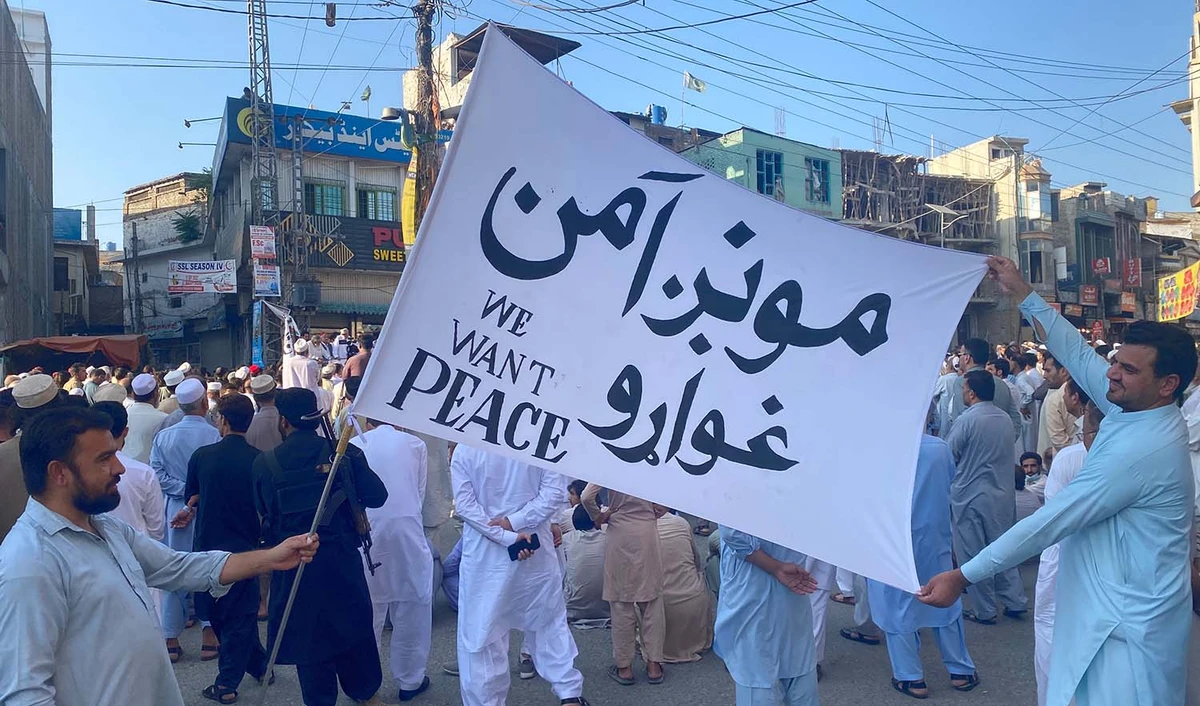
MINGORA: Hundreds of people took to the streets in northwestern Pakistan’s Swat valley on Sunday to demand peace as fears rise of the possible return of the Pakistani Taliban to an area which was once a battleground between militants and security forces.
The protest was held after Tuesday's bomb blast which killed five people, including an influential anti-Taliban leader Idrees Khan, in what was the first major bombing in the area in over a decade.
Swat remained a stronghold of the Pakistani Taliban—also known as the Tehreek-e-Taliban Pakistan (TTP)—until a major military offensive launched by Pakistan Army forced militants to flee.
Green Chowk, a roundabout of Swat district’s headquarter Mingora, would frequently be referred to as ‘Khoni Chowk’ (Bloody Roundabout) where militants would hang bodies from telephone poles for days before allowing them to be buried.

Hundreds of protesters gathered under the banner of the Swat Qaumi Jirga—a representative body of local residents—at Mingora in Swat District to protest the possible return of the militants to the picturesque valley.
“Peace is foremost. If our lives are safe, our homes are safe, our schools are safe, our mosque and hujras (drawing rooms) are safe, we will carry on with our routine politics,” Bahadur Khan, a jirga leader, told Arab News. “But if our children cannot go to school and our lives are endangered, all political groups should come out to resist the Taliban,” he added.
Khan said the Pakistani Taliban had returned to the area, vowing that people would resist them. “If the government cannot protest [for] our lives, I urge people to stand against the Taliban,” he added.
Khan said TTP militants have been spotted in the Kanala and Balasoor mountainous regions of Swat, adding that they were threatening traders and contractors to pay extortion money.
Speaking to the gathering, Brigadier (retired) Muhammad Saleem Khan said the people of Swat had come out to protest for peace.
“We, the people of Swat, have witnessed insult and destruction during lawlessness from 2006 to 2011. We don’t want that time to return,” he said.
“Today, I see courage in the people to stand against the Taliban. We can stand and resist,” the retired brigadier said, adding that people were earlier misled by militants in the name of Islamic law or Shariah. Now, he said, Swat’s people were aware of the reality.
“This is not Jihad, it’s Fassad [depravity],” the retired official said. “These people [Taliban militants] have been brought here and people know it,” he added, without elaborating further.
An unverified video went viral on social media last month in which security officials, including a senior police officer, could be seen held captive by militants in the area. The hostages were later released after the area’s tribal elders mediated.
Barrister Muhammad Ali Saif, a spokesperson of the government of Pakistan’s northwestern Khyber Pakhtunkhwa province, reacted to the incident by saying the government had already taken notice of the episode.
Last month, Pakistan Army rejected reports of TTP fighters returning to Swat as “grossly exaggerated and misleading”.
“Presence of militants anywhere will not be tolerated and they will be dealt with full use of force if required,” the army said.