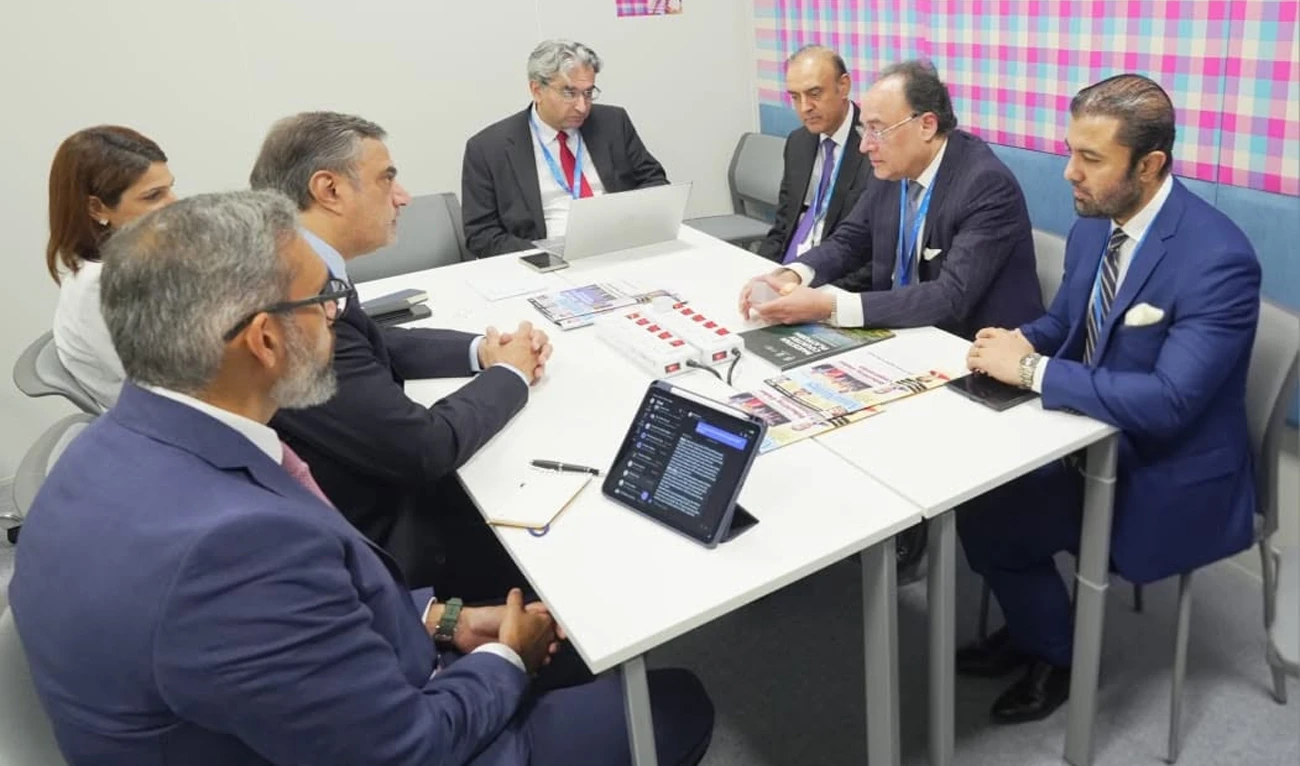
- Azfar Ahsan this month introduced his ‘Capital Systems’ framework for understanding how investment drives long-term economic value
- Capital may enter an economy, but strong institutions determine whether it becomes productive and compounds over time, Ahsan says
KARACHI: Pakistan needs to look beyond how much foreign direct investment (FDI) it attracts and focus on whether that capital translates into jobs, productivity and lasting economic value, former investment minister Muhammad Azfar Ahsan said on Saturday.
Ahsan this month introduced his “Capital Systems” framework in fDi Intelligence, a Financial Times publication, for understanding how investment drives productivity, innovation and long-term economic value.
His framework does not challenge the importance of traditional FDI measurement but seeks to complement it by examining the economic journey of capital after it enters a country.
“FDI remains an indispensable measure of capital entry, but capital entering an economy is only the beginning of the investment story,” Ahsan told Arab News.
“The more important question is what happens after that capital arrives and how effectively an economy converts it into lasting economic value and productive capability.”
In Fiscal Year 2025-26 that ended in June, Pakistan’s net FDI fell 34 percent to $1.64 billion, equivalent to 0.39 percent of gross domestic product, according to World Bank data. This was well below the recent Emerging
Market and Developing Economies average of around 2 percent of GDP, and far below the nearly 5 percent peak recorded in 2008.
Ahsan’s framework views investment through four interconnected stages: Capital Entry, Capital Absorption, Capital Circulation and Capital Transformation.
“Capital may enter an economy, but strong institutions determine whether it becomes productive and whether its impact compounds over time,” Ahsan said, adding that foreign capital no longer remains external finance at final stage but becomes part of the productive architecture of an economy.
The framework consequently changes the central question for investment policymakers.
“Instead of asking only, ‘How much capital did we attract?’, policymakers should increasingly ask, ‘How effectively did we convert that capital into long term economic value?’” Ahsan said.
“FDI explains where capital goes. Capital Systems explains what that capital becomes.”
For policymakers, according to the former minister, investment promotion should not end when an investor enters the country.
“It is about moving investment, thinking from measuring capital flows alone to understanding how capital creates enduring economic capability,” he said.
IMPORTANT SHIFT
Leena Abid, an economic analyst at Arif Habib Limited, said the Capital Systems framework shifts the focus from the volume of capital entering a country to how that capital is deployed and its impact on the economy.
“This represents an important shift in emphasis, even if the underlying concepts themselves are not entirely new,” she told Arab News.
“The priority must be to ensure that the limited inflows Pakistan receives must be effectively absorbed, circulated and translated into productive investment activity,” Abid said.
“The main limitation, however, is practical rather than conceptual.”
While FDI inflows can be clearly measured, it remains difficult to quantify how effectively capital is subsequently absorbed, circulated, and transformed within the economy.
“These later stages do not have the same clear, trackable indicators as the initial entry of FDI, making it challenging to assess the true economic impact of capital inflows,” Abid said.
Abdul Aleem, chief executive of Pakistan’s Overseas Chamber of Commerce and Industry (OICCI), declined to comment when asked to test Ahsan’s argument against Pakistan’s actual experience, like what happens after FDI enters Pakistan and what determines whether foreign companies should reinvest, expand and build local linkages.
Meanwhile, a spokesman of a foreign energy firm said investors face significant challenges on the ground in Pakistan, where officials may not have received instructions or the necessary systems may not exist despite decisions and assurances made at the federal level.
“There is a big gap which creates a huge, huge, huge challenge,” the spokesman said, seeking anonymity for he was not authorized to comment on such issues publicly.
He identified the difficulty of repatriating funds as a major concern for foreign investors even after completing business activities and paying taxes.
“Even to take your money abroad, the process takes a year or a year and a half,” he said, adding that the tendency to “create unnecessary problems” is another challenge.
“In everything, everybody tries to create a problem... because they want to show that there is something to be done, where they are generating a value.”
Arab News reached out to the secretary of Pakistan’s Board of Investment, Jamil Ahmad Qureshi, but he did not respond to requests for comment on the foreign investor’s remarks.
About the utility of FDI in Pakistan, the foreign energy firm spokesman said its very first impact should be on the employment of university graduates.
“It means that you would have a requirement of fresh graduates or experienced graduates into your system,” he said. “The second impact is that when you build a terminal, steel, drivers, trucks, so there is that money that goes into the whole system as well, which is another positive that people are generating employment.”