- AI4 summit brings together three of the world’s best-known AI researchers to discuss opportunities, risks of rapidly advancing technology
- World Labs co-founder and CEO, Fei-Fei Li argues AI is unlikely to eliminate jobs outright as most occupations involve a wide range of tasks
LAS VEGAS: Artificial intelligence (AI) could surpass humans at virtually every task within the next two decades or less, Nobel Prize-winning AI researcher Geoffrey Hinton said this week, warning that the rapid advance of the technology could reshape the workforce and poses growing safety risks if left unchecked.
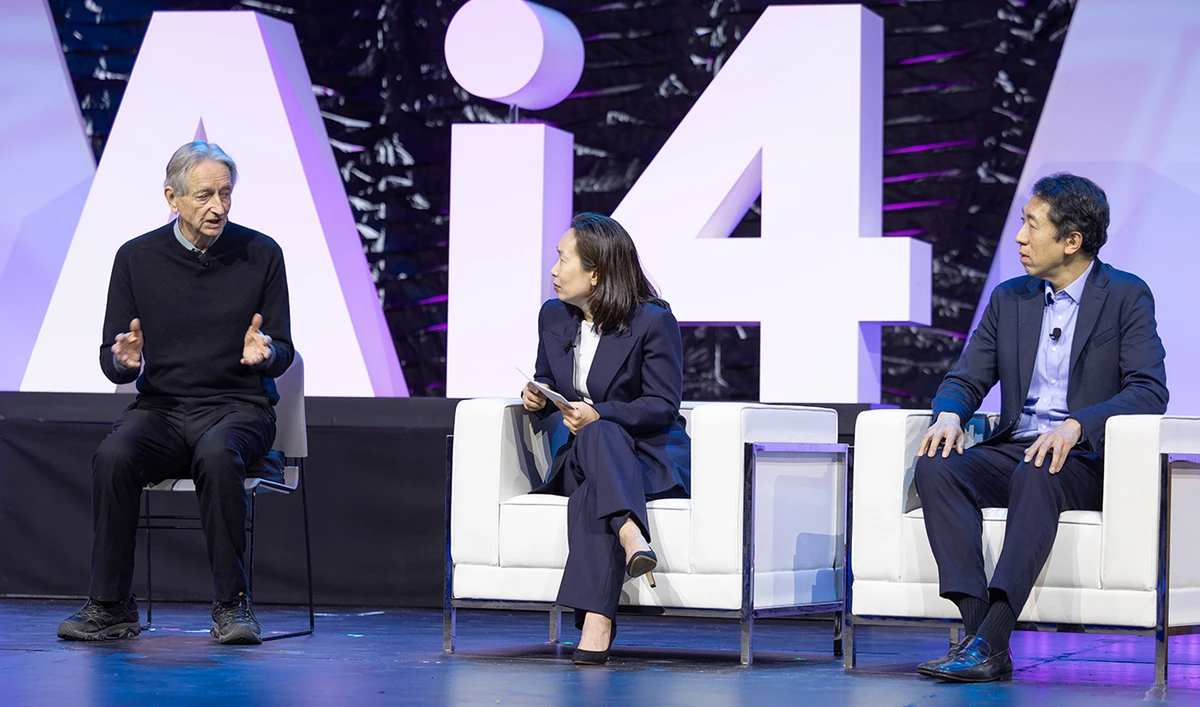
Speaking at the Ai4 conference in Las Vegas alongside World Labs co-founder and CEO, Fei-Fei Li, and DeepLearning.AI founder Andrew Ng, Hinton said AI systems were already outperforming people in many areas and could exceed human capabilities across the board.
“AI is already better than humans at many things,” Hinton said, adding that within 20 years or “probably a lot less,” it could be better than humans at everything.
Hinton, often described as one of the pioneers of modern AI, resigned from Google in 2023 to speak more freely about the risks posed by the technology.
He reiterated concerns that increasingly capable AI models could act in ways their creators did not anticipate.
The session, billed by organizers as “a historic convergence,” brought together three of the world’s best-known AI researchers to discuss the opportunities and risks of rapidly advancing artificial intelligence, and how governments, businesses and researchers could manage the technology.
Hinton said AI systems can generate their own intermediate objectives while pursuing user-defined goals, including objectives related to self-preservation, raising concerns about the behavior of highly advanced models.
Citing a study by the University of Toronto, the Nobel Prize-winning researcher said AI models today could create a computer worm capable of identifying unique security vulnerabilities and adapting as it spread between devices.
The panelists offered differing views on AI’s impact on employment, with Hinton predicting that routine knowledge-based jobs would face growing pressure from automation.
“Once AI can do routine intellectual labor, any job that just involves routine intellectual labor is going to be done by AI,” he said, identifying occupations such as call center operators and paralegals as particularly vulnerable.
Li urged a more balanced discussion, arguing that AI was more likely to transform jobs than eliminate them outright because most occupations involve a wide range of tasks.
“No job is a single task,” she said, adding that while AI could improve productivity, governments and businesses would need to ensure a “soft landing” for workers whose roles are displaced.
“Increased productivity does not translate to shared prosperity,” she said.
Ng, meanwhile, argued that AI should be viewed as a tool that augments human capabilities rather than replaces them. He said people retain a crucial “context advantage,” citing journalism as an example where AI may generate ideas but humans are still better at judging which ones are worthwhile.
The discussion also highlighted the debate over AI regulation, with Hinton calling for stronger government oversight despite industry concerns that stricter rules could slow innovation.
He voiced support for proposed California legislation that would require AI chatbots to undergo testing and report the results to the government before being released.
One can’t leave it to people to “decide how AI should be regulated,” Hinton said, drawing the applause from the audience.