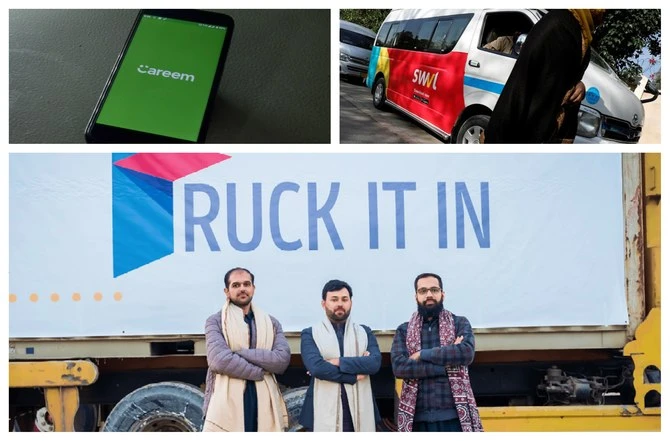
- Prominent startups Careem, SWVL, and Truck It In recently announced reduced services and layoffs
- Funding raised by Pakistani startups in 2021 was double total investment received in last six years
KARACHI: After a record year of Pakistani startups raising $350 million in venture capital funding in 2021, reality is now setting in for the local tech industry, with major companies announcing they are reducing services and laying off employees due to sluggish economic activity and amid rising fuel prices and inflation.
The global stock market drop in early May, combined with the continued crises of the war in Ukraine, domestic inflation, and a pandemic now well into its third year, has begun to cause significant pain at later-stage startups around the world, which seems likely to trickle down to smaller companies in the coming months, experts have warned.
Earlier this month, notable Pakistani startup player Careem said it had suspended its food service in Pakistan and would focus on its ride-hailing and delivery segments only. Separately, app-based bus service Swvl said it was “pausing” its service in Karachi, Lahore Islamabad and Faisalabad June 3 onwards because of the “global economic downturn.”
App-based freight management start-up Truck It In also announced layoffs, saying “global economic uncertainty” was forcing it to “recalibrate” its strategy. Last month, Airlift Technologies, a national grocery delivery service, said it was firing 31 percent of its workforce.
The announcements come as Pakistan has raised fuel prices thrice in a month, as part of efforts to revive a $6 billion loan from the International Monetary Fund (IMF) that the South Asian country of 220 million people desperately needs as it faces a balance of payments crisis — with foreign reserves falling below $10 billion, hardly enough for 45 days of imports — and a widening current account and ballooning fiscal deficits.
The economic downturn is also hitting the startup scene, where a combination of investor exuberance, pandemic-induced digital adoption, an improved regulatory environment and interest from foreign investors drove VC funding to a record high of $350 million last year — five times the amount raised in 2020 and double the total investment received in the last six years.
Funds continued to flow into Pakistan till the first quarter of 2022, with startups raising around $176.6 million, according to data from Invest2Innovate and Alpha Beta Core.
But reality is setting in now.
Truck It In CEO Sarmad Farooq told Arab News he didn’t expect the funding flow to resume in the next six months but said startups who responded to the changing economic climate would manage to pull through the current challenges.
“If someone does not do something and thinks things will improve automatically, I think their survival would be tough,” Farooq said. “We also adapted to the new realities despite being among one of the privileged startups.”
Farooq said his company had decided it was not “prudent” to run the organization with the same number of people: “It was not a wise decision to keep people unproductive and bring unproductivity into the organization’s culture.”
The year 2021 saw a lot of investment for startups as the interest rates on the US dollar were very low and many businesses shifted online, Farooq said. But now, he added, “correction was on the cards for Pakistani startups.”
He also hoped funding would pick up in the third and fourth quarter of 2023.
“After 18 months, you will see a solid recovery taking place after consolidations and resizing,” Farooq said.
Pakistan expects its economy to slow to 5 percent by next year, as it targets fiscal measures meant to cool down inflation, which is hovering around 13.8 percent. Farooq said he viewed the economic climate as an opportunity for startups to improve the fundamental operations of their respective organizations.
Last year, he said, startups were focused on growth, enabling Pakistan to attract foreign investment through venture capital funds.
“There would be no or very little flow of capital into Pakistan in the coming months, hence this is a good time for people to focus on their fundamental [strengths],” Farooq said.
Kalsoom Lakhani, co-founder and general partner at i2i Ventures, a venture capital fund, warned that Pakistani startups would have little opportunity to draw huge funding in the near future.
“For Truck It In, all I can say is that those founders were being preemptive, not prescriptive in their decision to rightsize at this time,” said Lakhani.
“They were building smart but on the off chance that Pakistani companies can’t raise large rounds in the next 18-24 months, they were thinking ahead and streamlining the company now to build for a future where they can succeed with less capital.”
Ansab Naqvi, the founder of the Asani.io, an automation-based startup offering water management solutions, told Arab News in the future businesses “with right unit economics and low expenses will thrive, so with this approach we are also keeping our expenses low.”
“Fancy valuations will no longer be seen,” he added, “and money will be available for the robust businesses and startups only in the days to come.”