Stories based on real characters may not be a recipe for box office success, but Ayman Jamal’s animated movie “Bilal” aims to bring forward the inspiring story of a real life hero to young and adult audiences. It is the most prestigious CG-animated movie to come out of the Middle East that is both empowering and inspiring in its call for social justice and equality.
Inspired by the real-life story of Bilal Ibn Rabah, an African slave who became one of the most well-known names in Islamic history, Jamal, the film’s director and producer, has not only narrated a story of a hero that has managed to achieve heights and overcome obstacles, but has also let the audience experience Bilal’s journey that was filled with struggles and how ultimately it led to success.
“Bilal” will premiere on Animation Day at the Cannes Film Festival 2016 alongside some heavyweight international names. Jamal tells Arab News about the prestigious nomination and his inspirational journey.
Please tell us a little bit about your background.
I completed my studies in MBA with marketing specialization and took courses in production and filmmaking. For the past 10 years, I was involved in the business of advertising, media production and marketing campaigns. However, I was always hooked to storytelling and filmmaking. Moreover, I had the pleasure of working with hundreds of talented people over the years, especially for this movie.
What sparked your interest in filmmaking?
Well, technically I’ve always had an interest in giving it a shot. Besides, I have always been interested in telling stories about heroes that history has forgotten. I was precise to tell the audience the history not through a book, but via a movie, which is an effective form of conveying inspirational messages to the youth.
While growing up I was fond of animated movies and in making them, I fell in love with the process. I think that’s how it actually starts. You just start doing it and then the rest just falls into place.
First of all congratulations on the nomination of ‘Bilal’, which is set to open the Animation day at the Cannes Film Festival 2016. For those unfamiliar with the movie “Bilal”, can you tell us a little about the movie and the character?
The film offers the humanity lessons for timeless faith, hope and self-discovery. It is a story based on the life of the historical figure Bilal Ibn Rabah, an African slave who lived in the Arabian Peninsula and became one of the heroes of his era. The movie focuses on the character’s resilience to face the danger, his role as a guardian and protector of his younger sister after both were abducted as children. His strong beautiful voice was a real gift from the Creator. It was the voice that called for justice and against inequality. Bilal brings out a new dimension to the duality of a superhero.
The movie is set in Makkah around a thousand years ago, when Bilal finds himself with his sister under the hopelessness of captivity. He bears many burdens of life in his childhood from which he discovers inner strength he did not know he possessed before. The story reveals the brave side of Bilal on how he raises his voice and chooses his own path that everything is possible with faith and his faith was able to undo his handcuffs and set him free.
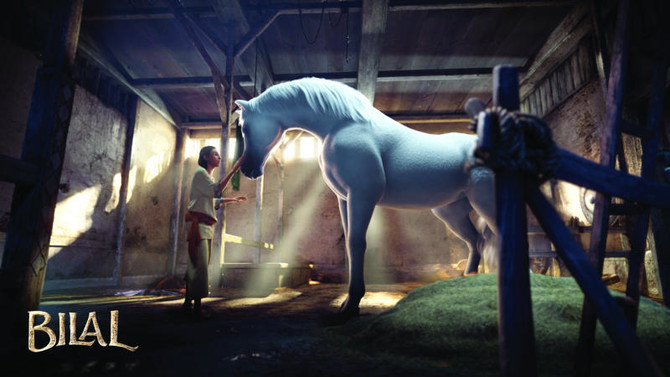
Apart from the animation factor, it is a strong story that narrates fascinating glimpses of history with plenty of emotional moments. Also, the costumes and the backgrounds give a realistic impression of the historical period.
Why did you choose to tell Bilal’s story?
I chose to tell Bilal’s story for two reasons. On the one hand, it’s a simple story of a 7-year-old boy who faced injustice and tyranny and then became one of the most prominent figures in history who have called for justice and equality. And on the other hand, it’s about a lot of things that are much bigger and teach important lessons from the history of this region, lessons of emancipation and egalitarianism. The combination of these two things is what I thought was very powerful.
How does it feel like to be nominated to premier at the animation ceremony at the Cannes Film Festival?
I think it’s anybody’s dream to be participating in such a festival, especially one like the Cannes Film Festival because it’s one of the most established film festivals and the most prestigious. A number of movies with astounding work are predicted to be competing for Cannes 2016 and it is a good start for us to be a part of it.
From a directorial standpoint, what were the most challenging things you encountered in making the film?
Well, this was something I was passionate about, but everything comes with obstacles. As a new animation company, we were aware that we would have to experience a lot of hurdles and face challenges to prove our abilities in this area and since it was the first animated movie from the Middle East, it was very hard to convince people to be a part of it. On the flip side, overpowering all the challenges we could select around 327 talented artists and animators from 22 different nationalities who were able to produce this movie, in addition to many great celebrities to perform the voices for complex and multidimensional figures that made the movie a successful one. Having to tell an involving story with an important moral and example is challenging but not impossible.
Given the humanistic content of the subject matter, how did you aim to maintain objectivity?
I think that you need to open yourself to a broad range of subjects and understand the impact that they can have on you and the people. I have an incredible team of people that I work very closely with. With endless conversations about the content we could shape a successful historical story. It aims at focusing on the main theme that is the struggle for humankind’s freedom and equality. Such stories motivate you to make a film that serves to impress and please young and adult audiences.
Have you been surprised by the audience’s reaction to the film?
I am overwhelmed. I’m living every filmmakers’ dream. Everyone loved the concept of the movie. People usually love watching fictional characters’ animated movie, but it was amazing to see the audience’s response toward a real life hero story. Although the story took place in the past, the biography of the great Bilal is vibrant to this day, and I wish that it is emulated by every person at anytime and anywhere.
What is ‘Barajoun Entertainment’?
It is a Dubai-based leading animation and visual effects studio in the MENA region. Barajoun Entertainment produced the movie “Bilal” for $30 million. This superior quality film was made with very high-end professionalism and the best techniques used by a selected international award-wining crew of artists and technicians.
Barajoun was born out of great passion for storytelling, art and innovative technologies, bringing to life enchanting stories and lovable characters. We set up the first animation studio of its kind in the Middle East with a goal to contribute to the development of the filmmaking industry in the region.
Do you have any other upcoming projects?
This is just the start in a long list of new and exciting projects that we will be working on in the coming months and years. We have another movie in the works that will start after 6 months once we finish the R&D part.
—
Email: [email protected]


‘Bilal’ to bring Muslim hero’s story to Cannes screen
‘Bilal’ to bring Muslim hero’s story to Cannes screen

Cambodia takes back looted historic artifacts handled by British art dealer
- The objects were returned under a 2020 agreement between the Ministry of Culture and Fine Arts and the family of the late Douglas Latchford, a British art collector and dealer who allegedly had the items smuggled out of Cambodia
PHNOM PENH, Cambodia: Cambodian officials on Friday received more than six dozen historic artifacts described as part of the country’s cultural heritage that had been looted during decades of war and instability.
At a ceremony attended by Deputy Prime Minister Hun Many, the 74 items were unveiled at the National Museum in Phnom Penh after their repatriation from the United Kingdom.
The objects were returned under a 2020 agreement between the Ministry of Culture and Fine Arts and the family of the late Douglas Latchford, a British art collector and dealer who allegedly had the items smuggled out of Cambodia.
“This substantial restitution represents one of the most important returns of Khmer cultural heritage in recent years, following major repatriations in 2021 and 2023 from the same collection,” the Culture Ministry said in a statement. “It marks a significant step forward in Cambodia’s continued efforts to recover, preserve, and restore its ancestral legacy for future generations.”
The artifacts were described as dating from the pre-Angkorian period through the height of the Angkor Empire, including “monumental sandstone sculptures, refined bronze works, and significant ritual objects.” The Angkor Empire, which extended from the ninth to the 15th century, is best known for the Angkor Wat archaeological site, the nation’s biggest tourist attraction.
Latchford was a prominent antiquities dealer who allegedly orchestrated an operation to sell looted Cambodian sculptures on the international market.
From 1970 to the 1980s, during Cambodia’s civil wars and the communist Khmer Rouge ‘s brutal reign, organized looting networks sent artifacts to Latchford, who then sold them to Western collectors, dealers, and institutions. These pieces were often physically damaged, having been pried off temple walls or other structures by the looters.
Latchford was indicted in a New York federal court in 2019 on charges including wire fraud and conspiracy. He died in 2020, aged 88, before he could be extradited to face charges.
Cambodia, like neighboring Thailand, has benefited from a trend in recent decades involving the repatriation of art and archaeological treasures. These include ancient Asian artworks as well as pieces lost or stolen during turmoil in places such as Syria, Iraq and Nazi-occupied Europe. New York’s Metropolitan Museum of Art is one of the prominent institutions that has been returning illegally smuggled art, including to Cambodia.
“The ancient artifacts created and preserved by our ancestors are now being returned to Cambodia, bringing warmth and joy, following the country’s return to peace,” said Hun Many, who is the younger brother of Prime Minister Hun Manet.


