ROME: An Italian nurse has been arrested on suspicion of killing 13 elderly patients in the intensive care ward where she had worked for decades, police said on Thursday.
Fausta Bonino, 56, allegedly killed the patients aged between 61 and 88, over the course of 2014 and 2015 at a hospital in the Tuscan town of Piombino, local police said. The “hospital ward killer,” as police have called her, administered lethal doses of a blood-thinning drug into her victims’ intravenous drips. Twelve died of internal bleeding and one of cardiac arrest, police said.
Investigators believe the victims, all seriously but not terminally ill, died as a result of being given strong doses of anticoagulant drugs used to prevent blood clotting, triggering internal bleeding.
Bonino was arrested after a study of all the recent abnormal deaths at the hospital identified her as being the only staff member involved in every case, the AGI news agency reported.
“In the horror rankings we have reached a new peak of human misery,” Health Minister Beatrice Lorenzin said in a statement. Bonino has been imprisoned pending formal charges.
Her case follows the arrest in October 2014 of Daniela Poggiali, a then 42-year-old nurse who is suspected of killing up to 38 of her patients and is awaiting trial for the murder of one of them.
Poggiali achieved global notoriety after it emerged she had taken ‘selfies’ next to recently deceased patients and as a result of reports that she had given huge doses of potassium to sick people she found “annoying.”
They did not identify the suspect, who worked at a hospital in Piombino, a city on the Tuscan coast. The alleged murders all took place in 2014 and 2015, although she had worked there for many years prior to that.
Some of the victims, men and women aged between 61 and 88, were found to have 10 times the normal dose of the drug Heparin in their bloodstream even though they had not been prescribed it.
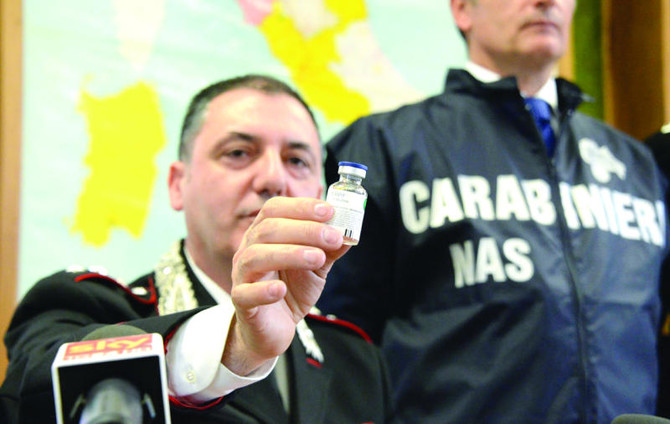
The suspect was the only member of hospital staff working when all 13 of the suspicious deaths occurred, Carabinieri police commander Gennero Riccardi told reporters.
When she became a suspect and was transferred out of intensive care in October of last year, the mortality rate of the ward fell from 20 percent to 12 percent, he said.
“We do not yet know of a specific motive,” Riccardi said. “But the suspect suffers from depression.” She had been receiving psychological treatment for many years, he added.
Police detained the woman late on Wednesday when she returned from a holiday with her husband. The families of the victims have not yet been informed that their relatives may have been murdered, police said.
Health Minister Beatrice Lorenzin called the case “chilling, hideous,” in a statement in which she said: “It isn’t the first time that nurses have been found to be serial killers.”
Earlier this month, a nurse in the city of Ravenna was given a life sentence for murdering a patient with a lethal injection of potassium. She is under investigation for some 10 more suspicious deaths and is appealing her conviction.

‘Killer nurse’ held for slaying 13 patients
In show of support, Canada, France open consulates in Greenland
- Decisions taken in a strong show of support for Greenland government amid threats by US President Trump to seize the island
COPENHAGEN, Denmark: Canada and France, which both adamantly oppose Donald Trump’s wish to control Greenland, will open consulates in the Danish autonomous territory’s capital on Friday, in a strong show of support for the local government.
Since returning to the White House last year, Trump has repeatedly insisted that Washington needs to control the strategic, mineral-rich Arctic island for security reasons.
The US president last month backed off his threats to seize Greenland after saying he had struck a “framework” deal with NATO chief Mark Rutte to ensure greater American influence.
A US-Denmark-Greenland working group has been established to discuss ways to meet Washington’s security concerns in the Arctic, but the details of the talks have not been made public.
While Denmark and Greenland have said they share Trump’s security concerns, they have insisted that sovereignty and territorial integrity are a “red line” in the discussions.
“In a sense, it’s a victory for Greenlanders to see two allies opening diplomatic representations in Nuuk,” said Jeppe Strandsbjerg, a political scientist at the University of Greenland.
“There is great appreciation for the support against what Trump has said.”
French President Emmanuel Macron announced Paris’s plans to open a consulate during a visit to Nuuk in June, where he expressed Europe’s “solidarity” with Greenland and criticized Trump’s ambitions.
The newly-appointed French consul, Jean-Noel Poirier, has previously served as ambassador to Vietnam.
Canada meanwhile announced in late 2024 that it would open a consulate in Greenland to boost cooperation.
The opening of the consulates is “a way of telling Donald Trump that his aggression against Greenland and Denmark is not a question for Greenland and Denmark alone, it’s also a question for European allies and also for Canada as an ally, as a friend of Greenland and the European allies also,” Ulrik Pram Gad, Arctic expert at the Danish Institute of International Studies, told AFP.
“It’s a small step, part of a strategy where we are making this problem European,” said Christine Nissen, security and defense analyst at the Europa think tank.
“The consequences are obviously not just Danish. It’s European and global.”
Recognition
According to Strandsbjerg, the two consulates — which will be attached to the French and Canadian embassies in Copenhagen — will give Greenland an opportunity to “practice” at being independent, as the island has long dreamt of cutting its ties to Denmark one day.
The decision to open diplomatic missions is also a recognition of Greenland’s growing autonomy, laid out in its 2009 Self-Government Act, Nissen said.
“In terms of their own quest for sovereignty, the Greenlandic people will think to have more direct contact with other European countries,” she said.
That would make it possible to reduce Denmark’s role “by diversifying Greenland’s dependence on the outside world, so that it is not solely dependent on Denmark and can have more ties for its economy, trade, investments, politics and so on,” echoed Pram Gad.
Greenland has had diplomatic ties with the European Union since 1992, with Washington since 2014 and with Iceland since 2017.
Iceland opened its consulate in Nuuk in 2013, while the United States, which had a consulate in the Greenlandic capital from 1940 to 1953, reopened its mission in 2020.
The European Commission opened its office in 2024.