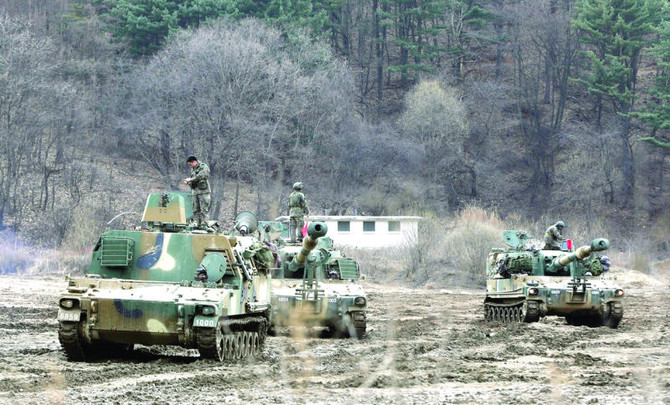
SEOUL: South Korean and US troops began large-scale military exercises on Monday in an annual test of their defenses against North Korea, which called the drills “nuclear war moves” and threatened to respond with an all-out offensive.
South Korea said the exercises would be the largest ever following North Korea’s fourth nuclear test in January and a long-range rocket launch last month that triggered a UN Security Council resolution and tough new sanctions.
Isolated North Korea has rejected criticism of is nuclear and rocket programs, even from old ally China, and last week leader Kim Jong Un ordered his country to be ready to use nuclear weapons in the face of what he sees as growing threats from enemies.
The joint US and South Korean military command said it had notified North Korea of “the non-provocative nature of this training” involving about 17,000 American troops and more than 300,000 South Koreans.
South Korea’s Defense Ministry said it had seen no sign of any unusual military activity by the North.
North Korea’s National Defense Commission said the North Korean army and people would “realize the greatest desire of the Korean nation through a sacred war of justice for reunification,” in response to any attack by US and South Korean forces.
“The army and people of the DPRK will launch an all-out offensive to decisively counter the US and its followers’ hysterical nuclear war moves,” the North Korean commission said in a statement carried by the North’s KCNA news agency.
The North, the Democratic People’s Republic of Korea (DPRK), as it is officially known, routinely issues threats of military action in response to the annual exercises that it sees as preparation for war against it.
The threat on Monday was in line with the usual rhetoric it uses to denounce the drills.
Chinese Foreign Ministry spokesman Hong Lei noted that North Korea had already said it opposed the drills, adding that Beijing was “deeply concerned” about the exercises.
“China is linked to the Korean Peninsula. In terms of the peninsula’s security, China is deeply concerned and firmly opposed to any trouble-making behavior on the peninsula’s doorstep. We urge all sides to keep calm, exercise restraint and not escalate tensions,” he told a daily news briefing.
The latest UN sanctions imposed on North Korea were drafted by the United States and China as punishment for its nuclear test and satellite launch, which the United States and others say was really a test of ballistic missile technology.
South Korea’s spy agency said it would hold an emergency cyber-security meeting on Tuesday to check readiness against any threat of cybertattack from the North, after detecting evidence of attempts by the North to hack into South Korean mobile phones.
South Korea has been on heightened cyber alert since the nuclear test and the rocket launch.
South Korea and the US militaries began talks on Friday on the deployment of an advanced anti-missile Terminal High Altitude Area Defense (THAAD) system in South Korea.

South Korea, US start exercises as North threatens ‘all-out offensive’
China’s top diplomat to visit Somalia on Africa tour
- Stop in Mogadishu provides diplomatic boost after Israel formally recognized breakaway Somaliland
- Tour focusses on Beijing's strategic trade access across eastern and southern Africa
BEIJING: China’s top diplomat began his annual New Year tour of Africa on Wednesday, focusing on strategic trade access across eastern and southern Africa as Beijing seeks to secure key shipping routes and resource supply lines.
Foreign Minister Wang Yi will travel to Ethiopia, Africa’s fastest-growing large economy; Somalia, a Horn of Africa state offering access to key global shipping lanes; Tanzania, a logistics hub linking minerals-rich central Africa to the Indian Ocean; and Lesotho, a small southern African economy squeezed by US trade measures. His trip this year runs until January 12.
Beijing aims to highlight countries it views as model partners of President Xi Jinping’s flagship “Belt and Road” infrastructure program and to expand export markets, particularly in young, increasingly affluent economies such as Ethiopia, where the IMF forecasts growth of 7.2 percent this year.
China, the world’s largest bilateral lender, faces growing competition from the European Union to finance African infrastructure, as countries hit by pandemic-era debt strains now seek investment over loans.
“The real litmus test for 2026 isn’t just the arrival of Chinese investment, but the ‘Africanization’ of that investment. As Wang Yi visits hubs like Ethiopia and Tanzania, the conversation must move beyond just building roads to building factories,” said Judith Mwai, policy analyst at Development Reimagined, an Africa-focussed consultancy.
“For African leaders, this tour is an opportunity to demand that China’s ‘small yet beautiful’ projects specifically target our industrial gaps, turning African raw materials into finished products on African soil, rather than just facilitating their exit,” she added.
On his start-of-year trip in 2025, Wang visited Namibia, the Republic of Congo, Chad and Nigeria.
His visit to Somalia will be the first by a Chinese foreign minister since the 1980s and is expected to provide Mogadishu with a diplomatic boost after Israel became the first country to formally recognize the breakaway Republic of Somaliland, a northern region that declared itself independent in 1991.
Beijing, which reiterated its support for Somalia after the Israeli announcement in December, is keen to reinforce its influence around the Gulf of Aden, the entrance to the Red Sea and a vital corridor for Chinese trade transiting the Suez Canal to Europe.
Further south, Tanzania is central to Beijing’s plan to secure access to Africa’s vast copper deposits. Chinese firms are refurbishing the Tazara Railway that runs through the country into Zambia. Li Qiang made a landmark trip to Zambia in November, the first visit by a Chinese premier in 28 years.
The railway is widely seen as a counterweight to the US and European Union-backed Lobito Corridor, which connects Zambia to Atlantic ports via Angola and the Democratic Republic of the Congo.
By visiting the southern African kingdom of Lesotho, Wang aims to highlight Beijing’s push to position itself as a champion of free trade. Last year, China offered tariff-free market access to its $19 trillion economy for the world’s poorest nations, fulfilling a pledge by Chinese President Xi Jinping at the 2024 China-Africa Cooperation summit in Beijing.
Lesotho, one of the world’s poorest nations with a gross domestic product of just over $2 billion, was among the countries hardest hit by US President Donald Trump’s sweeping tariffs last year, facing duties of up to 50 percent on its exports to the United States.