

UK’s Starmer calls Trump’s remarks on allies in Afghanistan ‘frankly appalling’

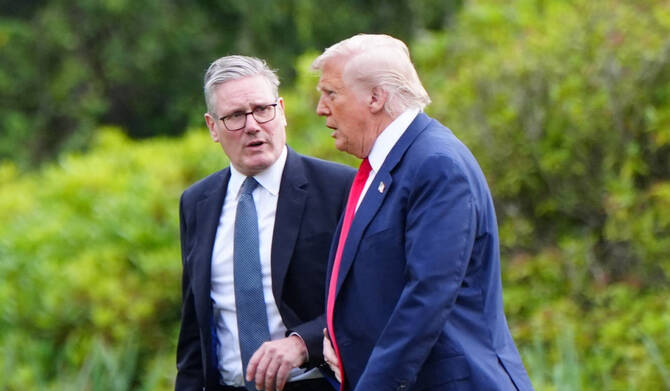
US President Donald Trump and British Prime Minister Keir Starmer walk at Trump International Golf Links, in Aberdeen, Scotland, Britain, July 28, 2025. (REUTERS)
Short Url
Updated 24 January 2026
Follow

UK’s Starmer calls Trump’s remarks on allies in Afghanistan ‘frankly appalling’

  • Britain lost 457 service personnel killed in Afghanistan, its deadliest overseas war since the 1950s

LONDON: British Prime Minister Keir Starmer called ​US President Donald Trump’s comments about European troops staying off the front lines in Afghanistan insulting and appalling, joining a chorus of criticism from other European officials and veterans.

“I consider President Trump’s remarks to be insulting and frankly appalling, and I’m not surprised they’ve caused such hurt for the loved ones of those who were killed or injured,” Starmer told reporters.

When asked whether he would demand an apology from the US leader, Starmer said: “If I had misspoken in that way or said those words, I would certainly apologize.”

Britain lost 457 service personnel killed in Afghanistan, its deadliest overseas war since the 1950s. For several of the war’s most intense years it led the allied campaign in Helmand, Afghanistan’s biggest and most violent province, ‌while also fighting as ‌the main US battlefield ally in Iraq.

Starmer’s remarks were notably strong coming ‌from ⁠a ​leader who has ‌tended to avoid direct criticism of Trump in public.

Trump told Fox Business Network’s “Mornings with Maria” on Thursday the United States had “never needed” the transatlantic alliance and accused allies of staying “a little off the front lines” in Afghanistan.

His remarks added to already strained relations with European allies after he used the World Economic Forum in the Swiss ski resort of Davos to again signal his interest in acquiring Greenland.

Dutch Foreign Minister David van Weel condemned Trump’s remarks on Afghanistan, calling them untrue and disrespectful.

Britain’s Prince Harry, who served in Afghanistan, also weighed in. “Those sacrifices deserve to be spoken about truthfully and with respect,” he said in a statement.

‘We paid in ⁠blood for this alliance’

“We expect an apology for this statement,” Roman Polko, a retired Polish general and former special forces commander who also served in Afghanistan and ‌Iraq, told Reuters in an interview.

Trump has “crossed a red line,” he added. “We ‍paid with blood for this alliance. We truly sacrificed our ‍own lives.”

Britain’s veterans minister, Alistair Carns, whose own military service included five tours including alongside American troops in Afghanistan, called ‍Trump’s claims “utterly ridiculous.”

“We shed blood, sweat and tears together. Not everybody came home,” he said in a video posted on X.

Richard Moore, the former head of Britain’s MI6 intelligence service, said he, like many MI6 officers, had operated in dangerous environments with “brave and highly esteemed” CIA counterparts and had been proud to do so with Britain’s closest ally.

Under NATO’s founding treaty, members are bound by a collective-defense clause, Article ​5, which treats an attack on one member as an attack on all.

It has been invoked only once — after the September 11, 2001 attacks on New York and Washington, when allies pledged to support ⁠the United States. For most of the war in Afghanistan, the US-led force there was under NATO command.

Polish sacrifice ‘must not be diminished’

Some politicians noted that Trump had avoided the draft for the Vietnam War, citing bone spurs in his feet.

“Trump avoided military service 5 times,” Ed Davey, leader of Britain’s centrist Liberal Democrats, wrote on X. “How dare he question their sacrifice.”

Poland’s sacrifice “will never be forgotten and must not be diminished,” Defense Minister Wladyslaw Kosiniak-Kamysz said.

Trump’s comments were “ignorant,” said Rasmus Jarlov, an opposition Conservative Party member of Denmark’s parliament. In addition to the British deaths, more than 150 Canadians were killed in Afghanistan, along with 90 French service personnel and scores from Germany, Italy and other countries. Denmark — now under heavy pressure from Trump to transfer its semi-autonomous region of Greenland to the US — lost 44 troops, one of NATO’s highest per-capita death rates.

The United States lost about 2,460 troops in Afghanistan, according to the US Department of Defense, a figure on par per capita with those of Britain and Denmark.


Britain’s Starmer ends China trip aimed at reset despite Trump warning

Updated 1 sec ago
Follow

Britain’s Starmer ends China trip aimed at reset despite Trump warning

  • Keir Starmer’s visit was the first to China by a British prime minister in eight years
  • Leaders from France, Canada and Finland have flocked to Beijing in recent weeks
SHANGHAI: British Prime Minister Keir Starmer wrapped up a four-day trip to China on Saturday, after his bid to forge closer ties prompted warnings from US President Donald Trump.
Starmer’s visit was the first to China by a British prime minister in eight years, following in the footsteps of other Western leaders looking to counter an increasingly volatile United States.
Leaders from France, Canada and Finland have flocked to Beijing in recent weeks, recoiling from Trump’s bid to seize Greenland and tariff threats against NATO allies.
Trump warned on Thursday it was “very dangerous” for Britain to be dealing with China.
Starmer brushed off those comments on Friday, noting that Trump was also expected to visit China in the months ahead.
“The US and the UK are very close allies, and that’s why we discussed the visit with his team before we came,” Starmer said in an interview with UK television.
“I don’t think it is wise for the UK to stick its head in the sand. China is the second-largest economy in the world,” he said.
Asked about Trump’s comments on Friday, Beijing’s foreign ministry said “China is willing to strengthen cooperation with all countries in the spirit of mutual benefit and win-win results.”
Starmer met top Chinese leaders, including President Xi Jinping and Premier Li Qiang, on Thursday, with both sides highlighting the need for closer ties.
He told business representatives from Britain and China on Friday that both sides had “warmly engaged” and “made some real progress.”
“The UK has got a huge amount to offer,” he said in a short speech at the UK-China Business Forum at the Bank of China.
He signed a series of agreements on Thursday, with Downing Street announcing Beijing had agreed to visa-free travel for British citizens visiting China for under 30 days, although Starmer acknowledged there was no start date for the arrangement yet.
The Chinese foreign ministry said only that it was “actively considering” the visa deal and would “make it public at an appropriate time upon completing the necessary procedures.”
He also said Beijing had lifted sanctions on UK lawmakers targeted since 2021 for their criticism of alleged human rights abuses against China’s Muslim Uyghur minority.
“President Xi said to me that that means all parliamentarians are welcome,” Starmer said in an interview with UK television.
He traveled from Beijing to economic powerhouse Shanghai, where he spoke with Chinese students at the Shanghai International College of Fashion and Innovation, a joint institute between Donghua University and the University of Edinburgh.
On Saturday, Starmer visited a design institute and met with performing arts students alongside British actress Rosamund Pike, who spoke of her children’s experience learning Mandarin.
Later on Saturday, Starmer will arrive in Tokyo for a meeting with Japanese counterpart Sanae Takaichi.
Visas and whisky
The visa deal could bring Britain in line with about 50 other countries granted visa-free travel, including France, Germany, Australia and Japan, and follows a similar agreement made between China and Canada this month.
The agreements signed included cooperation on targeting supply chains used by migrant smugglers, as well as on British exports to China, health and strengthening a bilateral trade commission.
China also agreed to halve tariffs on British whisky to five percent, according to Downing Street.
British companies sealed £2.2 billion ($3 billion) in export deals and around £2.3 billion in “market access wins” over five years, and “hundreds of millions worth of investments,” Starmer’s government said in a statement.
Xi told Starmer on Thursday that their countries should strengthen dialogue and cooperation in the context of a “complex and intertwined” international situation.
Relations between China and Britain deteriorated from 2020 when Beijing imposed a national security law on Hong Kong and cracked down on pro-democracy activists in the former British colony.
However, China remains Britain’s third-largest trading partner, and Starmer is hoping deals with Beijing will help fulfil his primary goal of boosting UK economic growth.
British pharmaceutical group AstraZeneca said on Thursday it would invest $15 billion in China through 2030 to expand its medicines manufacturing and research.
And China’s Pop Mart, makers of the wildly popular Labubu dolls, said it would set up a regional hub in London and open 27 stores across Europe in the coming year, including up to seven in Britain.