LESBOS, Greece: She drowned trying to reach Europe, but her headless body was never identified. Her tombstone will bear no name.
Like others buried beside her in an olive grove on the Greek island of Lesbos, the marble plaque on her unmarked grave will proclaim the victim “Unknown.” Her epitaph an identification number, the date she washed ashore, and her presumed age: one.
Sixty-four earthen graves have been dug in this land plot for refugees and migrants who drowned crossing the Aegean Sea trying to reach Europe. Just 27 of those are named.
The others state plainly: “Unknown Man, Aged 35, No 221, 19/11/2015;” “Unknown Boy, Aged 7, No 40, 19/11/2015;” “Unknown Boy, Aged 12, No 171, 19/11/2015.”
More than half a million people fleeing Syria, Afghanistan, Iraq and other countries plagued by war and poverty in the Middle East and Africa have arrived on Lesbos since last year hoping to continue to northern Europe.
In 2015, the deadliest year for migrants and refugees crossing the Mediterranean, more than 3,700 people are known to have drowned or gone missing, the International Organization for Migration says. The actual number is believed to be higher.
Hundreds have drowned in Greece since arrivals surged last summer. So many, in fact, that the section of one Lesbos cemetery designated for refugees and migrants has long run out of space.
Locals conclude that entire families have drowned in the same shipwreck, leaving no survivors to identify the victims. They recall bodies found severely decomposed after days at sea, or dismembered from crashing against the rocks of the island’s long coastline.
“It doesn’t feel right, seeing a child of unknown identity, an unknown child, a child of ‘roughly this age’,” said Alekos Karagiorgis, a caretaker who has transported hundreds of corpses from beaches across the island to the morgue since summer.
“It doesn’t matter if it’s your job. It breaks your heart.”
Remote beaches on the island still bear the traces of arrivals: flimsy, discarded life jackets are strewn across the rocks as well as the odd shoe, a jacket, milk formula and nappies.


![]()
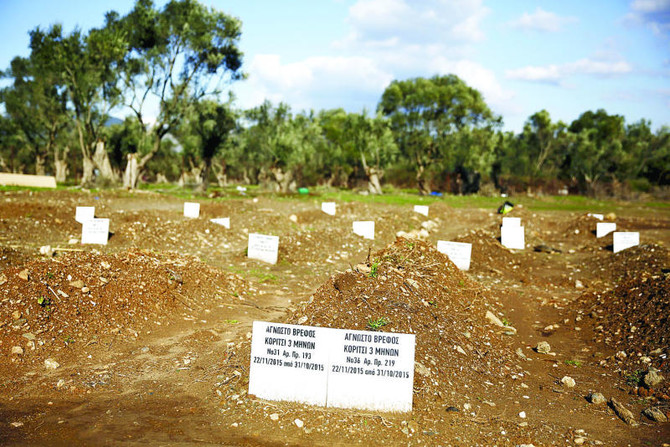
Unknown dead fill Lesbos cemetery for refugees drowned at sea
Unknown dead fill Lesbos cemetery for refugees drowned at sea
Latest updates


© 2026 SAUDI RESEARCH & PUBLISHING COMPANY, All Rights Reserved And subject to Terms of Use Agreement.