LONDON: Global regulators set out their "final tools" on Monday for ending the phenomenon of "too big to fail" banks, seeking to draw a line under a period of intensive rule making after a financial crisis that tarnished the sector and weighed heavily on taxpayers.
Mark Carney, chairman of the Financial Stability Board (FSB) that coordinates regulation across the Group of 20 economies (G-20) to plug gaps highlighted by the 2007-09 financial crisis, said many of the key reforms have been implemented decisively and promptly.
"As a consequence, the financing capacity to the real economy is being rebuilt and significant retrenchment from international activity has been avoided," Carney said in a letter to G-20 leaders ahead of their summit next week.
The G-20 tasked the FSB in 2009 with introducing a welter of reforms from increasing bank capital requirements to shining a light on derivatives markets and curbing bankers' bonuses.
Carney, who is also governor of the Bank of England, said the board has now finalized the tools needed to wind down "too big to fail" banks in an orderly way if necessary, seen as the last major financial reform of the crisis.
G-20 leaders meeting next week in Turkey will be asked to endorse a reform that requires the world's 30 top banks to issue a buffer of bonds by 2022 that can be written down to raise funds equivalent to 18 percent of risk-weighted assets, if the lender goes bust.
The aim of the buffer, known as total loss-absorbing capacity or TLAC, is to allow a big bank to fail without creating the kind of mayhem in markets seen after Lehman Brothers bank went bust in 2008.
Under the worse case scenario, the banks would have to issue a total of 1.1 trillion euros ($1.18 trillion) in bonds. The bulk of this, or 755 billion euros, would be in China and other emerging markets whose banks have been given and extra six years until 2028 to comply with TLAC, the FSB said.
Banks could also plug the shortfall by issuing shares or retaining earnings.
"It is clear the benefits far exceed the costs of introducing this standard," Carney said.
Citi bank analysts said the requirement will be manageable for European banks, with an estimated average 2 percent earnings hit in 2017, rising to 4-5 percent for Unicredit, Santander and BNP Paribas.
Banks moved early to meet tougher capital requirements since the crisis to reassure investors about their solvency. But Svein Andresen, FSB secretary-general, said he does not expect banks to necessarily rush headlong to meet TLAC rules early.
"Many banks have told us they will let existing liabilities run off and replace them in the course of normal refinancing," Andresen said.
Some of the banks like Bank of America, UBS, Credit Suisse and Citi have already said they already meet or will comfortably meet the TLAC rules.
The Swiss Finance Ministry said on Monday that the new rules it outlined last month would comprehensively meet TLAC standards and in parts exceed the minimum requirements of international standards.
Last month the Federal Reserve published rules to apply a TLAC-style rule on the biggest US banks who would need to raise an additional $120 billion in long-term debt.
The EU is applying a similar requirement on all banks based in the 28-country bloc with rules compatible with TLAC to avoid duplication.
As flagged, the basis for calculating how much TLAC the big banks must hold has been scaled back. An open-ended exemption for the big banks from emerging markets like China has also been scrapped in favor of a longer phase-in.
"Countries must now put in place the legislative and regulatory frameworks for these tools to be used," Carney said in a letter to G-20 leaders.
Banks had warned that the new capital rules being rolled out made it too expensive in some cases to keep markets as liquid as they were before the crisis by offering to buy and sell bonds at any time.
The FSB has completed its first review of all the rules that have been introduced and said it has "not found evidence of significant unintended consequences to date".
"Evidence is mixed, and the baseline for comparison should not be the unsustainable excess liquidity that existed prior to the crisis," Carney said.
He rejected criticisms from banks that TLAC and other changes to bank capital rules over the coming year amount to a quantum increase on the current Basel III framework.
"There is no Basel IV. What we are doing is ironing out issues that have been identified over time in the application of Basel III," Carney said.
The FSB is still assessing the risks to financial stability from the activities of big asset managers and will publish recommendations "as necessary in the first half of 2016".
Misconduct at banks, such as trying to rig the LIBOR interest rate benchmark and currency markets, can create systemic risks. The FSB has agreed an action plan to see if additional rules are needed, particularly regarding pay structures in the sector to stop encouraging reckless behavior.


G-20 finalizes tools for ending ‘too big to fail’ banks
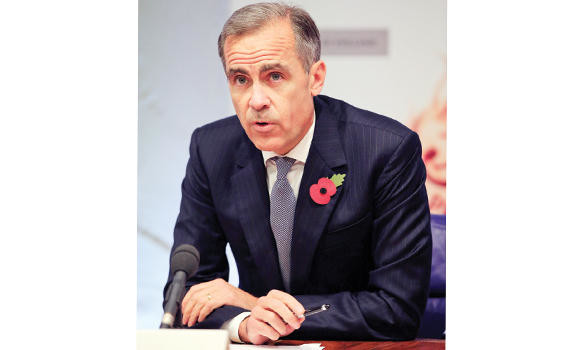
G-20 finalizes tools for ending ‘too big to fail’ banks

Free trade negotiations between GCC, India mark new phase of partnership, says sec-gen
RIYADH: The Gulf Cooperation Council’s secretary-general affirmed that the negotiations for a free trade agreement between the GCC and India, and the signing of the joint statement, represents a new phase of strategic partnership.
Jasem Mohamed Al-Budaiwi said that this contributes to enhancing close cooperation and strengthening economic and trade ties, according to the Saudi Press Agency.
This came during the signing ceremony of the joint statement on launching the free trade agreement negotiations between the Al-Budaiwi and India’s Minister of Commerce and Industry, Piyush Goyal, which took place in New Delhi, on Tuesday.
During the signing ceremony, Al-Budaiwi said that the Terms of Reference, signed on Feb. 5, provide a comprehensive and clear framework for these negotiations. The two nations agreed to discuss enhancing cooperation in vital strategic areas, including trade in goods, customs procedures, and services.
Additionally, the framework covers Sanitary and Phytosanitary measures, intellectual property rights, cooperation on Micro, Small, and Medium Enterprises, along with other topics of mutual interest. This reflects the comprehensive nature of the agreement and its ability to keep pace with the future economy.
Al-Budaiwi expressed hope that these negotiations would lead to a comprehensive and ambitious free trade agreement that works to remove customs and non-customs barriers, enhance the flow of quality investments in both directions, and achieve further liberalization in trade and investment cooperation between the GCC and India for mutual benefit.
This would provide a stimulating economic environment and an investment climate that opens broad horizons for the business sector, supports supply chains, and accelerates the pace of economic growth in line with the ambitious developmental visions of the GCC states.
The top official affirmed the full readiness of the General Secretariat to host the first round of negotiations at its headquarters in Riyadh during the second half of this year.
The two sides held a meeting during which they reviewed the existing cooperation relations between the GCC and India and discussed ways to develop and elevate them to broader horizons, serving mutual interests and enhancing opportunities for strategic partnership between the two sides, particularly in the economic, investment, and trade fields.
They praised the role undertaken by the negotiating teams from both sides, appreciating the efforts contributing to reaching a comprehensive agreement that enhances economic integration and supports the smooth flow of trade between the two nations.


