LILLE, France: More than 100 migrants stormed the Channel Tunnel early Saturday, penetrating a third of the way through in an incident which halted traffic overnight.
The incident came as the daily flow of thousands of migrants and refugees flocking to Europe’s shores showed little sign of easing, with 168,000 migrants and refugees arriving in September alone, UN figures showed.
Most are seeking refuge in Germany or Sweden, but others have continued their journey to France in the hope of somehow crossing the Channel to reach England.
Overnight, traffic through the Channel Tunnel, which connects Britain and France, was halted for more than seven hours after a group of 113 migrants stormed into the tunnel in the hope of reaching the other side.
Eurotunnel, which operates the complex, said the incident was unprecedented with migrants aggressively attacking its staff.
“This has never been seen before, it was a determined and well-planned attack,” a spokesman told AFP of the incident which took place shortly after midnight (2230 GMT) at the entrance to the tunnel near the northern port city of Calais.
He said the group had “run through the terminal, pinning a number of staff members to the ground and throwing stones at them.”
As Europe struggles with its biggest migration crisis since World War II, thousands have made their way toward France’s northern coast in the hope of finding passage across the Channel to England.
Fabienne Buccio, head of the Pas-de-Calais region, said the group had demonstrated “a certain level of aggressiveness” during the breach.
“Normally they stop before the security forces, but this time they wanted to get through,” she told AFP, saying they had managed to get a third of the way through the tunnel, which stretches some 50 kilometers (30 miles).
“The migrants went quite far into the tunnel, about 15 kilometers.”
Buccio said two police and four migrants sustained light injuries in the incident.
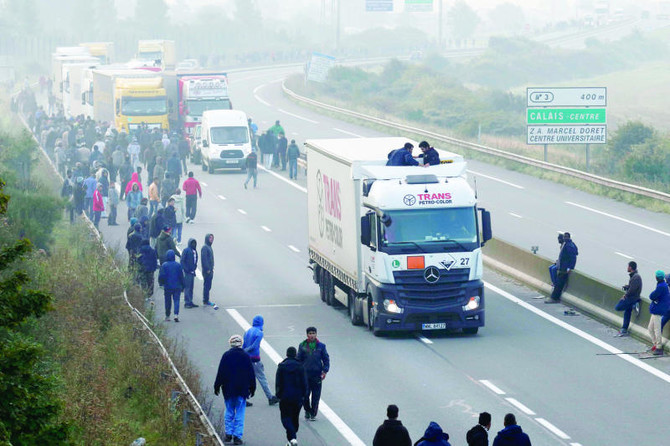
Inside the complex, groups of migrants could be seen walking single file accompanied by security officials, an AFP correspondent said as dozens of lorries lined the road leading to the terminal.
Elsewhere, border police were repairing a large breach of nearly 30 meters (yards) in one of the many fences around the site.
Eurotunnel said it had closed the tunnel had around 12:30 a.m. (2230 GMT on Friday) but by around 8:00am, services had resumed.
Shortly afterwards, there was another attempt at Calais port when 300 migrants tried to get into the terminal through several different entrances as well as trying to board lorries, port security officials told AFP.
But they began to disperse when the police turned up around 10:30am and blocked off the ring road leading to the port, an AFP correspondent said.
The tunnel complex, which covers an area of 650 hectares (1,600 acres) and has a 20-kilometer (12-mile) perimeter, has been hit by many attempted break-ins in recent months, most of which have taken place at night.
In August, the interior ministers of France and Britain signed an agreement to set up a new “command and control center” to tackle smuggling gangs in Calais.
The move came after several weeks of attempts to penetrate the sprawling Eurotunnel site, the biggest of which was on August 3, when there were 1,700 attempts to get in.
Since then, there has been major work to step up security with new barriers erected, and more staff deployed along with sniffer dogs. The number of attempted break-ins has fallen to around 100 per night, police say.
Such attempts can be fatal: in the past three months, some 13 people have died while trying to reach the tunnel.
Meanwhile at Hungary’s Beremend crossing on the border with Croatia, buses were awaiting to pick up the new arrivals after 4,987 people crossed on Friday, taking to 300,159 the total number who have entered so far this year.
Similar scenes were playing out on Croatia’s border with Serbia with buses waiting to ferry the new arrivals directly to the Hungarian border. Zagreb said it had logged 5,000 new arrivals on Friday, taking the total since mid-September to 100,066 people.
The European Commissioner for Migration, Dimitris Avramopoulos was expected to visit Zagreb on Monday for talks on the crisis, EC officials told AFP.
Austria also said it had registered 2,683 new arrivals on Friday and another 2,363 in the early hours of Saturday morning.
With little end in sight, Norwegian Prime Minister Erna Solberg said she feared for Europe’s borderless Schengen zone, urging countries to shore up their external frontiers.
“The challenge for the Nordic region is not an internal one, but the fact that Schengen’s outer borders have broken down,” she said.
“We must now make sure that the outer borders work.”


![]()
‘Unprecedented’ migrant breach briefly closes Channel Tunnel
‘Unprecedented’ migrant breach briefly closes Channel Tunnel
Latest updates


Recommended


© 2026 SAUDI RESEARCH & PUBLISHING COMPANY, All Rights Reserved And subject to Terms of Use Agreement.