Mina stampede deaths rise to 769

1 / 2
2 / 2
Updated 27 September 2015
Follow

Mina stampede deaths rise to 769


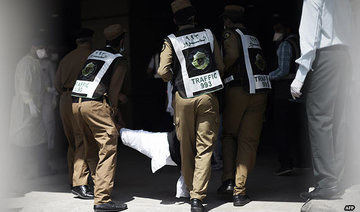
MAKKAH: Health Minister Khalid Al-Falih on Saturday said the number of pilgrims who died in Thursday’s stampede in Mina has risen to 769.
Al-Falih said the number of injured has also jumped to 934, of which many are still confined in hospitals.
“The latest statistics up to this hour reveal 769 dead. That is an increase of 52 on the previous figures,” he told a press conference. “Those are the ones who died in various hospitals since the event,” he said.
Iran has reported the biggest number of deaths at 136, with Morocco coming next with 87.
The other confirmed deaths, compiled by Agence France Presse, were from Cameroon, 20; Niger, 19: India, 18; Egypt, 14; Chad, 11; Pakistan, 9; Somalia, 8; Algeria, 7; Senegal, 5; Tanzania, 4; Indonesia, Kenya and Nigeria, 3 each; and Burkina Faso, Burundi and the Netherlands, 1 each.
Five Filipinos were also reported to have died in Makkah, but only one was caused by the stampede. The others died of illnesses aggravated by the heat, officials said.
Benin had also reported deaths but the number was unspecified.
Thursday’s stampede is the second worst in a number of tragedies to strike the pilgrimage, surpassed only by that of July 2, 1990, when 1,426 pilgrims, mainly from Asia, died during a stampede in a tunnel at Mina after a ventilation system failure.
 
Iran blame game
On Saturday, Iran, which has been accused by Gulf states of fomenting troubles in the Middle East, including Yemen, Iraq and Syria, stepped up its blame game rhetoric by accusing Saudi authorities of mismanaging the crowd in Mina. Iranians also protested in the Islamic Republic on Friday.
Crown Prince Mohammed bin Naif, chairman of the Haj Supreme Committee, had earlier ordered the formation of an investigation committee to determine the causes of the stampede. Its findings would be submitted to Custodian of the Two Holy Mosques King Salman.
But Saudi Grand Mufti Sheikh Abdulaziz Al-Sheikh said he was not holding authorities responsible for the disaster. Security officers and witnesses have been quoted in reports as saying Thursday’s stampede happened when two large groups of pilgrims arrived together at a crossroads in Mina.
“You are not responsible for what happened. You dealt with the beneficial factors that were in your hands and within your ability. As for the things that humans cannot control, you cannot blamed for them. Fate and destiny are inevitable,” Al-Sheikh said in a televised statement.
Al-Sheikh also appeared to deflect criticisms of the kingdom from outside as a product of “envy.”
“Many are envious of the kingdom for its religion, leadership, economy and the cohesion of its members, and for the great blessings it has experienced, unlike many other countries,” he said. 
Turkish President Recep Tayyip Erdogan on Friday came to Saudi Arabia’s defense. “I do not sympathize with the hostile statements against Saudi Arabia,” he told journalists in Ankara.
The Turkish leader said that it would be wrong to “point a finger at Saudi Arabia which does its best” to make the annual Haj pilgrimage possible.
“You have to see the glass as half full,” he said, adding that each country suffers failures.


RELATED STORIES:


Sha’abanah festival brings Hijazi heritage to life ahead of Ramadan 

Updated 6 sec ago
Follow

Sha’abanah festival brings Hijazi heritage to life ahead of Ramadan 

Jeddah: The Sha’abanah festival celebrating Hijazi heritage drew more than 18,000 visitors to the Abadi Al-Johar Arena in Jeddah as part of the city’s pre-Ramadan festivities. 

Organized by Vertex 33, the three-day event from Jan. 22-24 offered an immersive celebration of local culture, crafts, and cuisine. 

The festival featured local boutiques offering oud incense and perfumes, artisanal shoes and a variety of handcrafted products from local entrepreneurs. 

Visitors also enjoyed a range of artistic workshops, such as pottery and mosaic, while children engaged in scented candle-making, art activities by Global Art, and thread kneading to create keychains and home wall hangings with Ramadan themes. 

A dining area served traditional Saudi cuisine, coffee, and festive Ramadan treats. 

Guests were entertained with live traditional Yanbu’awi performances, Al-Ajal dance displays, and a contemporary Saudi-style DJ, bringing together the energy of modern entertainment with the rich cultural heritage of Hijaz. 

The project was led by four young cultural enthusiasts, Abdulaziz Al-Jehani, Abdulmajeed Abualkheer, Ghoroub Al-Barakati and Shahad Abualkheer. 

Al-Jehani, CEO of Vertex 33, said Sha’abanah was inspired by a desire to revive the social traditions that once brought Hijazi communities together ahead of Ramadan. 

“At Vertex 33, we believe events should feel meaningful, not just entertaining, and Sha’abanah was our way of creating a space where people could reconnect with heritage in a lively, modern setting,” he told Arab News. 

“Bringing the festival together took just three months of planning, from concept development and cultural research to vendor selection, design, and on-ground coordination. 

“The positive response from attendees has reinforced Vertex 33’s commitment to supporting local artists and making Hijazi heritage central to future events,” he added. 

Entrepreneurs taking part in Sha’abanah praised the festival for providing exposure and opportunities to engage directly with customers. 

Afraa Damanhouri, founder of RuaqAfraa, said: “We are participating to make scented cake candles for both adults and children. Workshops like these promote business and help people understand the process behind different types of candles.” 

Reem Awad, founder and CEO of Black Mus, said: “Through Sha’abanah, we were able to meet our customers face to face, share the story behind our products, and help them understand the range of services and items we offer.” 

Chef Fayzah Al-Sulami, who took part in the event preparing and selling her homemade spices and traditional white sweet Saudi coffee, said: “I started teaching cooking on YouTube, and when people asked about the ingredients I use, I began selling my products. 

“It was amazing to see so many people take an interest, and sales were strong throughout all three days of the festival.” 

With Ramadan approaching, many local entrepreneurs offered gift packages, prayer baskets, homemade traditional coffee, and spices. 

Duaa Shukri, founder of Printful, said: “Ramadan is a time for giving. We created unique gift packages for children, teenagers and adults, with thoughtful items.”