Overcrowding to blame for stampede: Eyewitnesses

Updated 15 November 2015
Follow

Overcrowding to blame for stampede: Eyewitnesses

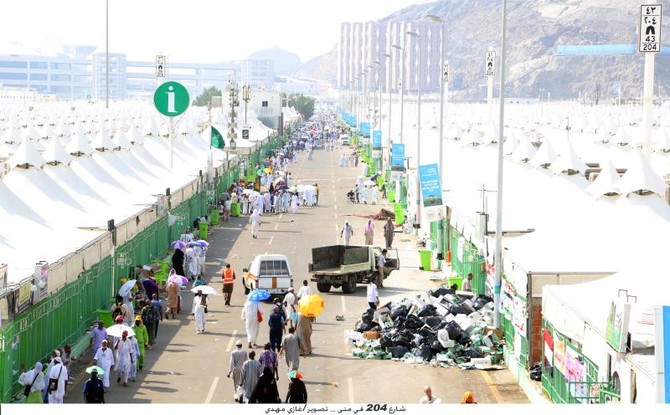
MINA: Several eyewitnesses held the view that the unfortunate incident at Mina happened because a large number of pilgrims converged on Street 204 at the same time. This ensued in panic that contributed to the suffocation of many of them while they were trying to escape the sudden stampede.

A pilgrim, Haj Abdulmunim Al-Safwan, said the majority of the dead people were elderly people who were walking with their children. They were not able to leave the children behind, thus they moved forward quickly or jogged to keep up with the crowd, which was an impossible task.
Other stories from eyewitnesses reveal that the stampede happened as a rush of Iranian pilgrims passed through Souq Al-Arab Street and refused to return, ignoring guidelines, as was reported by the website Sabq.
The website also quoted one of the officials in charge of the campaign as saying that “the Iranian pilgrims did not listen to the guidelines, ignored it and confronted us. They were raising slogans before the incident.”
In an expected act, Hussein Amir Abdul Leehan, assistant foreign minister of Iran, held the Saudi government responsible for the incident, said the website. Iranian officials have declared that 41 Iranian pilgrims died in the incident and 60 others were injured.
In most cases, Iranians indulged in excesses during Haj to promote what they call an Islamic revolution among pilgrims. Iranians have tried to transform the occasion of Haj as their political platform, exploiting some of their pilgrims to confront other pilgrims and security forces, said the website.
It also revealed that recently a Houthi leader, Mohammad Al-Maqaleh, wrote on his Facebook page that this year “during Haj there would be incidents which would not have examples in the history. Knock O men of Allah before the season so that you are crowned the day of staying in the mountain of Arafat.”
The post also said that some Haj pilgrims were organizing protest marches resulting in bloody confrontation as in the Haj of 1987. After that Iran boycotted Haj seasons between 1988 and 1990. Only after that did Iranian delegations start coming for Haj.
In 1987, Iranian pilgrims indulged in rioting and political protests. They held the portrait of their leader Ruhollah Khomeini and shouted slogans of the Iranian revolution on one hand and condemed US and Israel on the other. They created obstructions on roads.
In the past, Iranian pilgrims also tried to storm into the Holy Mosque of Makkah leading to confrontations between protesters and security forces. The Al-Muaisem tunnel incident of 1989 was most dangerous incident in which Iran was involved.


Saudi Arabia champions AI and sustainable growth at UN tourism meeting in Kuwait

Updated 12 February 2026
Follow

Saudi Arabia champions AI and sustainable growth at UN tourism meeting in Kuwait

  • Saudi Tourism Minister says tourism today accounts for approximately 10 percent of the world economy, contributing about $10 trillion to global GDP 

KUWAIT CITY: Saudi Arabia’s Tourism Minister Ahmed Al-Khateeb has called for stronger international cooperation to build a tourism ecosystem that is integrated, resilient, and future-ready, the Saudi Press Agency reported Thursday.

In a opening address at the 52nd UN Tourism Regional Commission for the Middle East in Kuwait City, he noted that tourism is “no longer a peripheral activity but a massive engine of economic development.”

“With an estimated contribution exceeding $10 trillion to global GDP, tourism today accounts for approximately 10 percent of the world economy,” said Al-Khateeb, speaking as president of the 26th UN Tourism General Assembly. The three-day conference opened on Feb. 10.

He pointed to the Middle East’s exceptional recovery, which recorded a 39 percent increase in international arrivals in 2025 compared to 2019, welcoming nearly 100 million visitors last year.

The minister highlighted Saudi Arabia’s driving force behind these regional statistics, noting that the Kingdom now represents approximately 30% of the Middle East tourism market in both visitor numbers and spending.

“We are proud that Saudi tourism’s uninterrupted growth has become a driving force for regional tourism, and we look forward to continuing our close cooperation with UN Tourism to share our expertise with the world,” he said.

Focus on AI

Addressing the meeting’s central theme of Artificial Intelligence (AI), Al-Khateeb emphasized the need for responsible innovation. He described AI as a key enabler for growth but stressed that the “human touch” defining the hospitality sector must be maintained and the workforce protected.

On the sidelines of the regional commission, the minister met with counterparts from across the region to explore ways to promote regional cooperation and alignment to enhance resilience and build tourism industries that can drive inclusive economic and social development.

Al-Khateeb also met with leading investors from Kuwait to discuss investments in the Kingdom’s tourism sector and explore new opportunities to leverage Saudi Arabia’s integrated investment ecosystem, designed to enable regional and international investors to achieve sustainable, long-term value.

The 52nd UN Tourism Regional Commission for the Middle East is the first held in the region since the 26th UN Tourism General Assembly, hosted in Riyadh last November. 

That assembly resulted in the historic “Riyadh Declaration on the Future of Tourism,” which established a global consensus on sustainability, inclusive growth, and the responsible adoption of human-centric AI for the next fifty years.