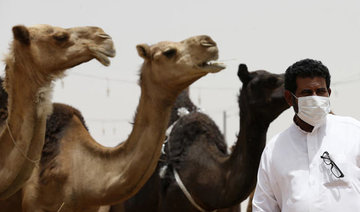
MADINAH: The Ministry of Health has reiterated that the ban on slaughtering camels during Haj would remain in place, with no exceptions, because of the danger posed by Middle East Respiratory Syndrome (MERS) coronavirus.
Faisal Al-Zahrani, spokesman of the ministry, said the ban covers the entire Kingdom during Eid Al-Adha. It also includes the Burmese community in Makkah, whose members traditionally sacrifice camels. They would now have to use lambs, he was quoted as saying by a local publication.
He said the Grand Mufti Sheikh Abdul Aziz Al-Asheikh had issued an edict instituting the ban to protect pilgrims. The fatwa states that people can use cows or sheep.
Abdulrahman Abdulkarim, an official at the Reconciliation Council at the Mount of Ohod in Madinah, said the Burmese community collects money to buy camels every year, with people sharing the meat of the animal.
He said that he has not received any official confirmation of the ban. However, several camel merchants have stopped buying camels and purchased sheep and cows because of the MERS virus, he said.
Camels have been identified as carriers of the MERS virus, which has infected 1,225 people in the kingdom since June 2012 when tit was first discovered by scientists.
Of the total, 521 victims have died, 633 have recovered and 71 are still under treatment, including 16 new cases in the past four days.
The Ministry of Agriculture earlier said that 3.3 percent, or 7,700 out of the 233,000 camels in the Kingdom, are infected with MERS virus.


Camel slaughter during Haj banned

Camel slaughter during Haj banned

Saudi hospital pioneers preventive type 1 diabetes treatment
RIYADH: King Faisal Specialist Hospital and Research Center introduced a groundbreaking preventive treatment aimed at slowing the progression of type 1 diabetes, the Saudi Press Agency reported on Wednesday.
The new therapy is designed for adults and children aged eight years and older who are diagnosed at stage two of the disease. It marks the first time such a treatment has been implemented in the Kingdom.
The initial application involved two patients who met all the criteria outlined in the approved protocol. The step represents a major advance in early preventive care for one of the most common autoimmune conditions affecting children and adolescents.
Both cases were treated at the hospital’s Department of Pediatrics. For families already managing type 1 diabetes, the innovation brings new hope.
Siblings of affected children often face increased risk due to shared genetic and immune factors. Preventive options like this could significantly lower those risks in the future.
The treatment targets the early, pre-type 1 diabetes stage when insulin-producing pancreatic cells begin to deteriorate. Through early intervention, doctors can slow this damage, delay the onset of symptoms and help extend the time before full disease progression.
Implementing the therapy required careful preparation. The drug was compounded in the hospital pharmacy under a precise protocol, while nursing teams received training on administration, monitoring and managing possible reactions.
Medical staff were also briefed on patient selection and follow-up criteria based on the latest clinical guidelines.
According to the SPA, experts expect the program to inspire national research focused on the early stages of the disease and on developing preventive approaches that enhance quality of life for at-risk groups.
KFSH&RC continues to gain recognition on the global stage. It was ranked first in the Middle East and Africa, and 15th worldwide among the top 250 academic medical centers for 2025.
The hospital was also named the most valuable healthcare brand in Saudi Arabia and the Middle East by Brand Finance 2025.
Additionally, Newsweek included KFSH&RC on its lists of the World’s Best Hospitals (2025), the World’s Smartest Hospitals (2026) and the World’s Best Specialized Hospitals (2026).


