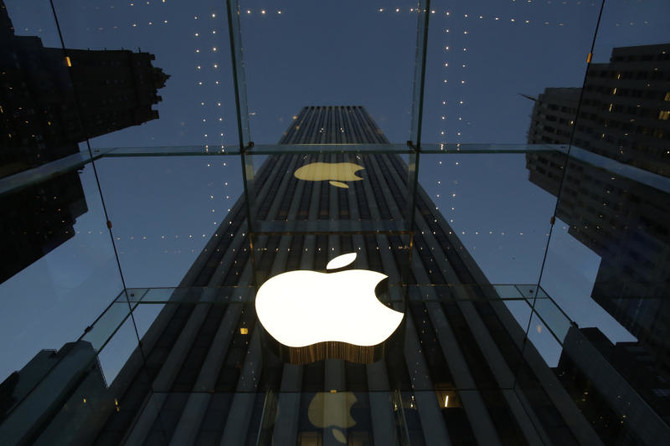
NEW YORK: Apple Inc, the largest US company by market value, will join the storied Dow Jones industrial average, replacing AT&T Inc, in a change that reflects the dominant position of iPhone maker in the US economy and society.
The decision to nudge aside AT&T, which has been part of the Dow for the better part of a century, is a recognition of the way in which communications and technology have evolved over the last several decades.
“This is a sign of the times, and it might get everyone to look at the Dow more than they have been,” said Richard Sichel, who oversees $2 billion as chief investment officer at Philadelphia Trust Co.
“It would be difficult to pick any 30 companies that would cover the entire economy, especially compared with the S&P 500, but it does give the Dow more credibility.”
With a market capitalization of $736 billion, Apple is the largest publicly traded company in the index. The action, by S&P Dow Jones Indices, had been widely expected since Apple split its shares seven-for-one in June 2014.
After the split, many investors felt it was only a matter of time before the iPad maker was added to the 30-stock average, since it had been excluded because its stock price was too high for the price-weighted index.
AT&T has a market value of $176.5 billion. Its deletion from the index leaves Verizon as the sole telecommunications company in the average.
The company has had two stints in the Dow. It was added in 1916 and removed in 2004. After SBC Communications renamed itself AT&T following a 2005 merger, it was reinstated.
Despite Apple’s size, it would as of Thursday’s close only have a 4.66 percent weighting in the Dow because of its price, the index company said in a statement. Apple will join the average on March 18.
In early trading, shares of Apple were higher, gaining 1.4 percent to $128.15, while AT&T’s shares fell 1.4 percent to $33.53.
Had Apple had replaced any one of the 30 Dow components except Visa after its June 2014 split, a Reuters analysis recently showed, the index would have been higher. Visa is the only Dow component that would have helped the Dow more during that time, in part because of its high stock price.
Kevin Landis, chief investment officer of Firsthand Capital Management, a Silicon Valley-based technology-investing specialist with $300 million in assets under management, said he hopes that this is not a sign that Apple is past its prime.
“The Dow Jones is such a backwards-looking list, I cringed when Intel and Microsoft were added,” Landis said.
“I’m cringing today. Let’s hope Apple can defy the forces of history.”
Intel and Microsoft joined the average in November 1999, and their performance was weak for years following.


![]()
iPhone maker to replace AT&T in Dow industrials
iPhone maker to replace AT&T in Dow industrials
Latest updates




© 2026 SAUDI RESEARCH & PUBLISHING COMPANY, All Rights Reserved And subject to Terms of Use Agreement.