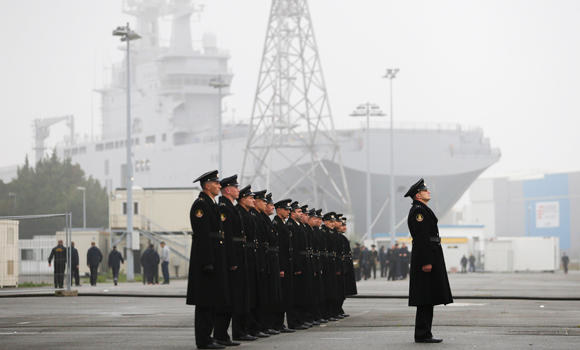
MOSCOW: A flotilla of Russian warships led by a large submarine hunting ship entered the English Channel on Friday in what naval officials said were preparations for a regular series of exercises.
Russia’s Northern Fleet said in a statement released to the RIA Novosti government news agency that its four vessels were led by the Severomorsk destroyer and the Alexander Otrakovsky amphibious landing ship.
It said the detachment had passed through the narrowest part of the channel between England and France at Pas-de-Calais and would begin a series of planned manuevers shortly.
The quoted statement said a storm had forced the detachment to take temporary shelter at the Bay of the River Seine off the northwestern coast of France.
“During its stay, the ships’ crew will perform a series of maneuvers aimed at combating underwater vessels and technology,” the news agency quoted the Russian statement as saying.
Both British and French officials told AFP that such Russian naval detachments visit the region on a nearly-annual basis and that they usually do not extend their stay beyond a few days. But a NATO spokesman said the ships “are not exercising in the channel, as some Russian headlines would have us believe.”
“Our information indicates that the ships are transiting and have been delayed by weather conditions,” NATO spokesman Jay Janzen told AFP.

Russian warships enter English Channel
Bangladesh to fund Rohingya education for first time as foreign donors pull back
- Funding shortfalls forced UNICEF to close thousands of schools in Rohingya refugee camps
- Rohingya are excluded from public schools in Bangladesh to prevent long-term integration
DHAKA: The Bangladeshi government will fund the primary education of Rohingya children living in refugee camps following the closure of thousands of UN-supported facilities due to budget shortages, authorities said on Wednesday.
Hundreds of thousands of Rohingya were forced to flee a military crackdown in Myanmar and take shelter in neighboring Bangladesh in 2017. Today, more than 1 million of them are cramped inside 33 camps in Cox’s Bazar district on the country’s southeast coast. About half are children.
The Bangladeshi government does not allow Rohingya children to enroll in regular public schools outside the camps under its longstanding policy to prevent long‑term integration. Since the beginning of the crisis, Bangladesh, which is not a signatory to the UN refugee convention, has made it clear that the Rohingya settlement is temporary.
Education has largely been organized by NGOs and UN agencies, providing basic literacy without recognized certificates. But many of these schools were forced to close last year, as foreign aid plunged — especially after the US, which contributed 55 percent of it, suspended most of its humanitarian operations.
To prevent the collapse of educational facilities, the Bangladeshi government on Tuesday for the first time approved state funding to keep them operational, with more than $16 million designated for primary education for Rohingya children under a World Bank grant.
“This World Bank funding will be used by UNICEF to operate learning centers in the Rohingya camps. As UNICEF is currently facing a severe funding shortage, the Bangladesh government has stepped in to provide support, with assistance from World Bank loans,” Mizanur Rahman, refugee relief and repatriation commissioner in Cox’s Bazar, told Arab News.
“Due to the funding crisis, most learning centers in the camps have suspended operations. With this new funding, many of these centers will be able to resume activities. There are around 8,000 learning centers in the camps, of which only about 4,000 are currently operating, while the other half remain closed.”
There are more than 400,000 school-age Rohingya children in the Bangladesh refugee camps. The Bangladeshi government’s support will reach 200,000 of them, with the teaching program based on the national curriculum of their home country, Myanmar.
About 1,100 teachers will be employed and trained to work with the children, Rahman said.
“The government has approved the funding primarily for one year, but the program will continue until 2027. Revised negotiations may take place later to consider a further extension.”