

Bangladesh to fund Rohingya education for first time as foreign donors pull back

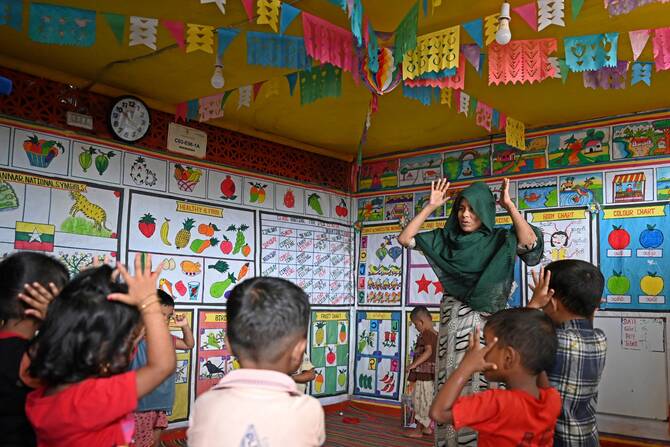
In this photo taken on September 12, 2024, a Rohingya woman teaches at a school in a refugee camp in Cox's Bazar, Bangladesh. (AFP/File)
Short Url
Updated 04 February 2026
Follow

Bangladesh to fund Rohingya education for first time as foreign donors pull back

  • Funding shortfalls forced UNICEF to close thousands of schools in Rohingya refugee camps
  • Rohingya are excluded from public schools in Bangladesh to prevent long-term integration

DHAKA: The Bangladeshi government will fund the primary education of Rohingya children living in refugee camps following the closure of thousands of UN-supported facilities due to budget shortages, authorities said on Wednesday.

Hundreds of thousands of Rohingya were forced to flee a military crackdown in Myanmar and take shelter in neighboring Bangladesh in 2017. Today, more than 1 million of them are cramped inside 33 camps in Cox’s Bazar district on the country’s southeast coast. About half are children.

The Bangladeshi government does not allow Rohingya children to enroll in regular public schools outside the camps under its longstanding policy to prevent long‑term integration. Since the beginning of the crisis, Bangladesh, which is not a signatory to the UN refugee convention, has made it clear that the Rohingya settlement is temporary.

Education has largely been organized by NGOs and UN agencies, providing basic literacy without recognized certificates. But many of these schools were forced to close last year, as foreign aid plunged — especially after the US, which contributed 55 percent of it, suspended most of its humanitarian operations.

To prevent the collapse of educational facilities, the Bangladeshi government on Tuesday for the first time approved state funding to keep them operational, with more than $16 million designated for primary education for Rohingya children under a World Bank grant.

“This World Bank funding will be used by UNICEF to operate learning centers in the Rohingya camps. As UNICEF is currently facing a severe funding shortage, the Bangladesh government has stepped in to provide support, with assistance from World Bank loans,” Mizanur Rahman, refugee relief and repatriation commissioner in Cox’s Bazar, told Arab News.

“Due to the funding crisis, most learning centers in the camps have suspended operations. With this new funding, many of these centers will be able to resume activities. There are around 8,000 learning centers in the camps, of which only about 4,000 are currently operating, while the other half remain closed.”

There are more than 400,000 school-age Rohingya children in the Bangladesh refugee camps. The Bangladeshi government’s support will reach 200,000 of them, with the teaching program based on the national curriculum of their home country, Myanmar.

About 1,100 teachers will be employed and trained to work with the children, Rahman said.

“The government has approved the funding primarily for one year, but the program will continue until 2027. Revised negotiations may take place later to consider a further extension.”


Kyiv under ‘massive’ missile attack, Russian village evacuated after drone strike

Updated 12 February 2026
Follow

Kyiv under ‘massive’ missile attack, Russian village evacuated after drone strike

  • "A mass attack on the capital is still underway," Kyiv Mayor Vitali Klitschko announced on Telegram early Thursday
  • Simultaneously, a Ukrainian drone attack deep inside Russia ignited a fire at a Ministry of Defense facility in the Volgograd region

KYIV/MOSCOW: The conflict between Russia and Ukraine escalated sharply early Thursday as both sides launched significant aerial assaults, targeting critical infrastructure and residential areas.

The Ukrainian capital, Kyiv, came under a “massive” attack from Russian missiles, officials said, while Russian authorities ordered the evacuation of a village in the Volgograd region following a drone strike on a military facility.

"A mass attack on the capital is still underway," Kyiv Mayor Vitali Klitschko announced on Telegram early Thursday. He reported hits on both residential and non-residential buildings on both sides of the Dnipro River, which bisects the city.

According to preliminary reports, falling fragments struck near two residential buildings in one district. While no fires broke out and no immediate casualties were reported, emergency medical teams were dispatched to the affected areas.

Tymur Tkachenko, head of the capital’s military administration, confirmed at least one hit in an eastern suburb, as witnesses reported explosions resounding across the city.

The southeastern city of Dnipro was also targeted. Regional governor Oleksandr Ganzha stated that while some private homes and cars sustained damage, there were no indications of casualties. Air raid alerts remained in effect in both Kyiv and Dnipro well after midnight.

Drone Strike in Russia 

Simultaneously, a Ukrainian drone attack deep inside Russia ignited a fire at a Ministry of Defense facility in the Volgograd region.

"Falling debris caused a fire on the grounds of a Ministry of Defense facility near the village of Kotluban," Governor Andrey Bocharov posted on Telegram.

Authorities declared an immediate evacuation of the nearby village "to ensure civilian safety from the threat of detonation during firefighting," Bocharov added.

The exchange of strikes follows a deadly day in eastern Ukraine. On Wednesday, a Russian strike on the city of Bogodukhiv in the Kharkiv region killed four people, including three young children.

Regional military head Oleg Synegubov reported that two one-year-old boys and a two-year-old girl were killed, along with a 34-year-old man. A 74-year-old woman and a 35-year-old pregnant woman were also wounded in the attack. The Kharkiv region has seen intensified Russian attacks on transport and energy infrastructure in recent weeks.

The ongoing violence stands in stark contrast to diplomatic efforts. Ukrainian and Russian officials have been holding US-mediated talks in Abu Dhabi aimed at ending the four-year invasion. While the two sides successfully conducted a prisoner swap last week, a comprehensive agreement to end the conflict remains elusive.

The human toll continues to mount. According to the UN Human Rights Monitoring Mission in Ukraine (HRMMU), approximately 15,000 Ukrainian civilians have been killed since Russia invaded in February 2022. The agency noted that 2025 was the deadliest year of the conflict so far, with more than 2,500 civilians killed.