WASHINGTON: A US-led air attack against jihadists in Syria targeted Al-Qaeda’s Khorasan group because it was on the verge of carrying out “major attacks” against the West, the US military said Tuesday.
The Americans pounded Khorasan targets in Syria with Tomahawk cruise missiles to counter the mounting threat posed by the group, said Lt. Gen. William Mayville, director of operations for the US Joint Chiefs of Staff.
“Intelligence reports indicated that the group was in the final stages of plans to execute major attacks against Western targets and potentially the US homeland,” Mayville told reporters.
The strikes against the Khorasan militants early Tuesday were separate from a wave of bombing raids led by the United States and joined by several Arab countries that targeted the Islamic State group.
Earlier, the Pentagon had said that US air strikes killed Khorasan members hatching plots against Western targets.
US Central Command, which oversees American forces in the Middle East, had announced that American forces carried out eight air strikes against Khorasan group targets west of Aleppo.
Mayville said more than 40 Tomahawk missiles were launched from naval ships in the Gulf and the Red Sea, and that “the majority of the Tomahawk strikes were against Khorasan.”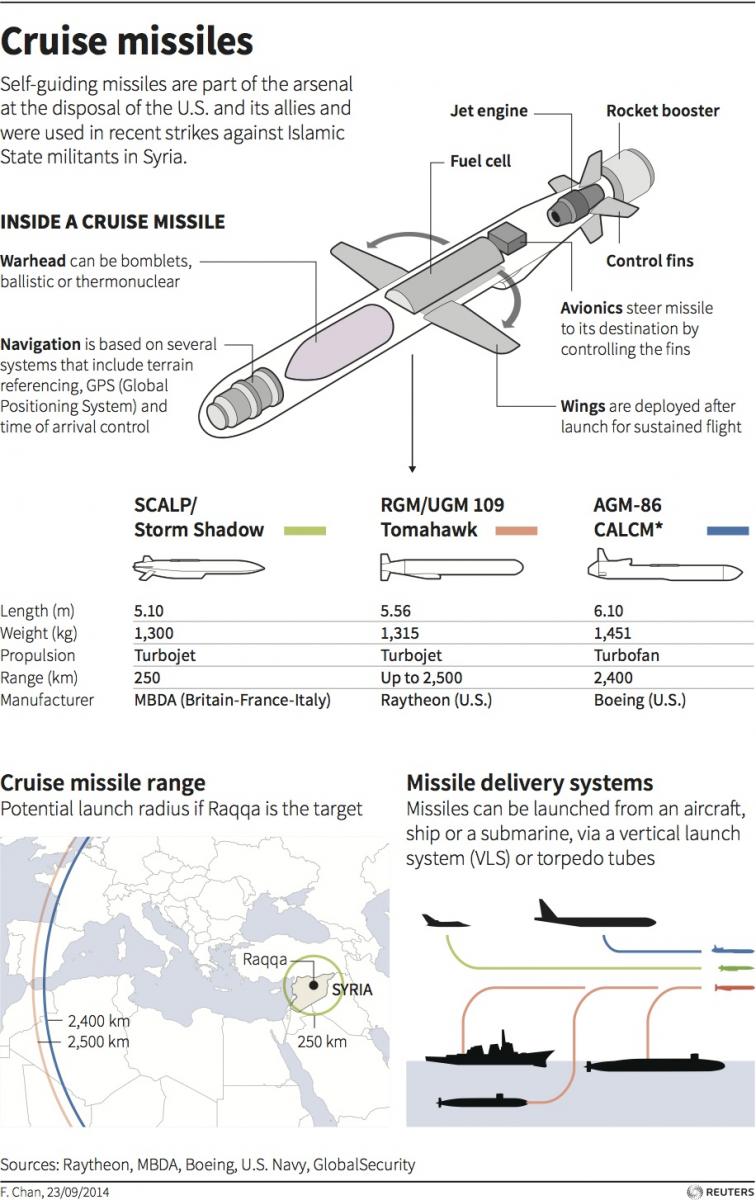
The Khorasan group was not focused on battling the Syrian regime or aiding the Syrian people but instead is “establishing roots in Syria in order to advance attacks against the West and the homeland,” he said.
Speaking of the broader air campaign that included Arab states, Pentagon spokesman Rear Admiral John Kirby said “our initial indication is that these strikes were very successful.”
And he signaled that more bombing raids in Syria were to come.
“I can tell you that last night’s strikes were only the beginning,” Kirby said.
President Barack Obama ordered the bombing raids in Syria last Thursday, a day after conferring with commanders at Central Command headquarters in Tampa, Florida, the White House said.
The US military was “unaware of any civilian casualties” from the strikes and the air attack was planned to minimize the risk to civilians in the area, Mayville said.
The general acknowledged there was evidence IS fighters were already dispersing and moving toward population centers to hide from the sights of US attack aircraft.
But he said there was no need at the moment to bring in tactical air controllers on the ground to direct bombing raids to avoid civilian casualties.
The first wave of strikes Tuesday featured mainly Tomahawk cruise missiles, the second wave had US fighter planes and B-1 bombers hitting targets and then the third wave included Arab warplanes and American F/A-18 jets flying from an aircraft carrier, the George H.W. Bush, in the Gulf, Mayville said.
IS group leaders were not specifically targeted in the raids but US and Arab aircraft aimed at “command and control” centers, he said.
The operation broke new ground with four Arab countries sending in aircraft to take part, which US officials said demonstrated regional states were committed to fighting the IS extremists.
Bahrain, Jordan, Saudi Arabia and the United Arab Emirates played direct roles in the operation while Qatar played a supporting role, officials said, without providing details.
The “preponderance” of bombs dropped were from US aircraft, Mayville said.
The Damascus regime views the IS group as an adversary, and the White House said President Bashar Assad’s government was told in advance about the plan to attack — but in general terms.
The US ambassador to the United Nations, Samantha Power, passed the word to her Syrian counterpart, said Ben Rhodes, deputy national security adviser.
But he and other officials insisted the air strikes were not coordinated in any way with Assad’s army.
Asked if Syrian regime air defense radar locked onto to US or allied aircraft, Mayville suggested the regime did not target the incoming warplanes.
The general said “radar acquisition on the part of Syria, I would characterize as passive.”
The overnight operation was the first in which the US military’s costly, new F-22 Raptor fighter jet was used in combat.
The general showed reporters aerial photos of targets bombed by the stealthy F-22s, with the planes unleashing precision-guided bombs on an IS command and control site in a building.
“This strike was the first time the F-22 was used in a combat role,” Mayville said. He said the F-22s “destroyed” the intended target.


![]()

Khorasan group was planning ‘major’ attacks in Europe: US
Khorasan group was planning ‘major’ attacks in Europe: US
Latest updates


© 2026 SAUDI RESEARCH & PUBLISHING COMPANY, All Rights Reserved And subject to Terms of Use Agreement.