Saudi-Egypt air traffic grows 22% in July

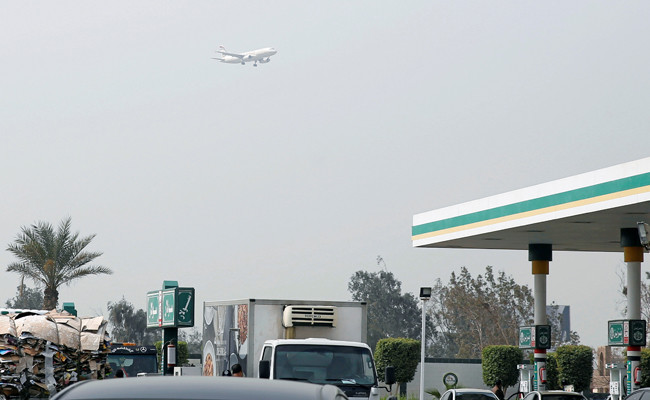
A passenger plane makes its final landing approach to Cairo Airport in Egypt on February 19, 2018. Air traffic between Saudi Arabia and Egypt grew by 22 percent in July and poised to register higher levels in the next few months, officials say. (REUTERS/Amr Abdallah Dalsh)
Updated 05 March 2018
Follow

Saudi-Egypt air traffic grows 22% in July

Air traffic between Saudi Arabia and Egypt grew by 22 percent in July and poised to register higher levels in the next few months, local media said quoting an expert.
In remarks to Al-Eqtisadiah daily, CEO of Egypt Air Hasan Aziz ascribed air traffic grew because of the influx of thousands of Egyptians to Makkah to perform Umrah. Saudi nationals choosing Egypt as their favorite tourist destination also contributed to the increase.
Egypt has been reportedly witnessing a growing movement of Saudi investors since the victory of Abdulfattah El-Sisi of the presidential elections and a visit made by Custodian of the Two Holy Mosques King Abdullah bin Abdulaziz.
In this context, some 20 Saudi firms plan to invest SR1.57 billion (3 billion Egyptian pounds) in agro projects in areas ranging 100,000 — 200,000 feddans, the paper said.
According to the CEO of Egypt Air, private aviation companies in the two countries, such as “the Nile”, “Nasma” and “Flynas” began to operate direct flights between Jeddah and Cairo which were earlier denied to do so between major airports.
They are operating 15 flights per month whereas Egypt Air alone has 15 flights per month between Cairo and Jeddah, he said.
He expected that air traffic between Egypt and other Arab countries will register a growth rate of 150 percent compared to figures in pre-June era, based on a number of developmental indicators, notably restoration of stability and strong come-back of foreign investments in Egypt.
“The (growing) number of flights between Egypt and Saudi Arabia represents a quantum leap and will be a good news for the liberation of airlines between Egypt and other countries in the next period, in a manner that will also activate airlines, on the one hand, and increase inter-trade between these countries, on the other hand,” he was quoted as saying.


Closing Bell: Saudi main index extends gains as market opens wider to foreign investment

Updated 02 February 2026
Follow

Closing Bell: Saudi main index extends gains as market opens wider to foreign investment

RIYADH: Saudi Arabia’s Tadawul All Share Index rose on Monday, gaining 153.61 points, or 1.38 percent, to close at 11,321.09.

The total trading turnover of the benchmark index was SR5.85 billion ($1.56 billion), as 207 of the listed stocks advanced, while 55 retreated.

The MSCI Tadawul Index increased, up 21.20 points or 1.41 percent, to close at 1,524.18.

The Kingdom’s parallel market Nomu gained 278.13 points, or 1.17 percent, to close at 24,013.03. This comes as 43 of the listed stocks advanced, while 29 retreated.

The best-performing stock was Saudi Pharmaceutical Industries and Medical Appliances Corp., with its share price surging by 7.26 percent to SR28.94.

Other top performers included Rasan Information Technology Co., which saw its share price rise by 6.51 percent to SR144, and Knowledge Economic City, which saw a 6.25 percent increase to SR13.09.

On the downside, the worst performer of the day was Najran Cement Co., whose share price fell by 2.11 percent to SR6.49.

Almasane Alkobra Mining Co. and Saudi Cable Co. also saw declines, with their shares dropping by 2 percent and 1.88 percent to SR103.10 and SR166.80, respectively.

On the announcement front, Riyad Bank has announced its annual financial results for 2025, with the total income from special commission of financing reaching SR24.1 billion, while net income from special commission of financing amounted to SR12 billion.

In a statement on Tadawul, the bank said: “Net income increased by 11.7 percent mainly due to an increase in total operating income and a decrease in total operating expenses.”

The bank further noted that the rise in total operating income was primarily driven by increased revenue from fees and commissions, trading activities, special commissions, gains on non-trading investments, and other operating sources. This growth was partially tempered by declines in exchange and dividend income.

“Net provision of expected credit losses and other losses decreased by 15.8 percent due to a decrease in impairment charge of credit losses and impairment charge for other financial assets, partially offset by an increase in impairment charge for investments,” it added.

RIBL’s share price closed at SR18.18 on the main market, marking a 1.43 percent increase.