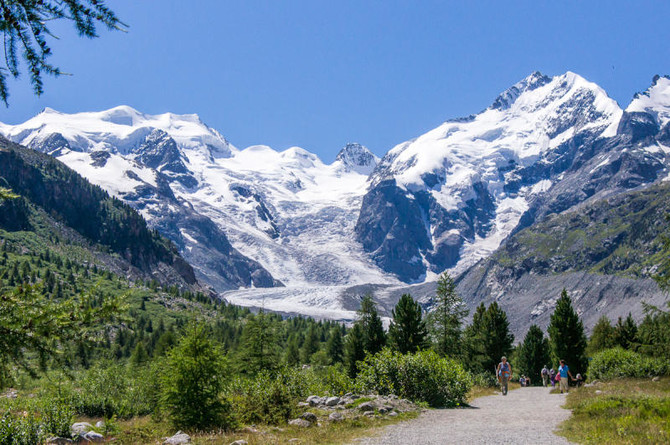
The hour-long walk from the local railway station to the Morteratsch glacier is a winding trek through a valley littered with rocks that the retreating ice left behind.
The walk was not always this long. In the mid-19th century, the Morteratsch glacier stretched all the way to the station in this hamlet in southeastern Switzerland.
By 1900, people had to walk about a kilometer to touch its shimmering blue surface.
In the past century, the ice has shrunk around 2.4 kilometers, and signposts marking the glacier’s “tongue” over the past century point to a decline that in recent years has accelerated dramatically.
“Each year we come here, we have to walk further to get to the glacier,” said Joerg Wyss, a 43-year-old tourist from Lucerne, who said he had been visiting Morteratsch for 25 years.
Ursula Reis, a 73-year-old from Zurich, said she had been coming for even longer, visiting almost every year since 1953.
“I have seen the shrinkage. It’s amazing and frightening at the same time,” she said.
As closely studied by scientists as it is loved by the Swiss, the Morteratsch glacier provides one of the clearest examples of climate change in action, experts say.
Like almost all documented Alpine glaciers, it has been steadily shrinking for decades, and only its highest points are expected to see the turn of the next century.
“The glaciers are kind of a direct signal of climate change,” said Samuel Nussbaumer, a scientist with the World Glacier Monitoring Service at the University of Zurich.
Since 1950, the glacier has shrunk by about 1.6 kilometers. Its tip today is hidden in a forest of high trees, and even the 2010 signpost is separated by a good 200 meters (yards) of rocks from the glacier mouth, which emits gushing meltwater into an icy river.
“This is one part of the Morteratsch glacier where you can really see how fast the ice is melting away,” said glacier guide Gian Luck, standing in a rock-strewn area that only three years ago was still covered with a system of ice caves, before they suddenly collapsed and disappeared.
A 2011 report from the European Topic Center on Air Pollution and Climate Change Mitigation, a consortium of institutes known by its acronym of ETC/ACM, found that more than half of the ice-covered areas and probably two-thirds of the ice volume in the Alps had disappeared since 1850.
From 2000 to 2010, the Alpine glaciers on average lost more than a meter of thickness each year, according to the study.
“They are shrinking, and the rate of shrinkage is increasing,” Nussbaumer said, adding that while factors like precipitation and wind played a part, rising temperatures were the main explanation.
Glaciers cover some 2,900 square kilometers in the Alps, including 1,342 square kilometers in Switzerland alone.
Scientists have warned that a summer temperature increase of around four degrees Celsius from today’s levels would leave Europe’s biggest mountain range almost ice-less by 2100.
The Alps, like the Arctic and the Antarctica Peninsula, are considered a hot-spot where warming can be two or three times greater than the global average.
“These ice giants could disappear literally in the space of a human lifetime, or even less,” said Sergio Savoia, who heads conservation group WWF’s Alpine office in Switzerland, stressing the need to “prepare for the serious consequences.”
Globally, glaciers are one of the main contributors to sea level rise, and their contribution to shrinking shore lines is believed to have doubled in recent decades.
An eagerly-awaited UN report on global warming, set to be released in Stockholm next Friday, will for the first time include detailed estimates for melting ice from glaciers and ice sheets in its calculation of sea level rise.
The issue of rising sea levels is not as relevant to the Alps though. If all of the region’s glaciers melted, this would add only about one millimeter to ocean levels, scientists say.
Locally, though, the effects would be dramatic.
The thick ice cover functions as a water tower that stores water, releasing it when it is most needed — in the hot and dry summer months.
The Alpine glaciers feed into some of Europe’s biggest river systems, including the Rhone, Po and Danube, and if this source disappeared, the effects would be felt across Europe, said Savoia.
“It’s very hard to predict what will happen when the temperatures rise even more and we no longer have the compensating function of the glaciers,” he said.
Melting glaciers can also cause natural hazards, ripping open crevasses, creating glacier lakes that can burst suddenly and increasing the risk of flash floods, landslides and mudslides.
While the effects of the vanishing Alpine glaciers will mainly be felt locally, only global action to reduce emissions of carbon dioxide can truly slow down the trend, Savoia said.
Swiss attempts to cover parts of glaciers with canvas to slow the melting are “a very visual way of declaring our powerlessness,” he said.
Guenther Baldauf, a 45-year-old German visiting Morteratsch for the first time, expressed awe when he finally reached the glacier tongue.
“You walk and you walk, past sign after sign saying ‘Here was the glacier. I was here,’ but everything is green,” he said. “Then suddenly, it is there, and it is really big. It’s ice and water, but it’s alive. It’s like a dinosaur, dying.”


![]()
Shrinking Swiss glacier shows climate change in action
Shrinking Swiss glacier shows climate change in action
Latest updates


© 2026 SAUDI RESEARCH & PUBLISHING COMPANY, All Rights Reserved And subject to Terms of Use Agreement.