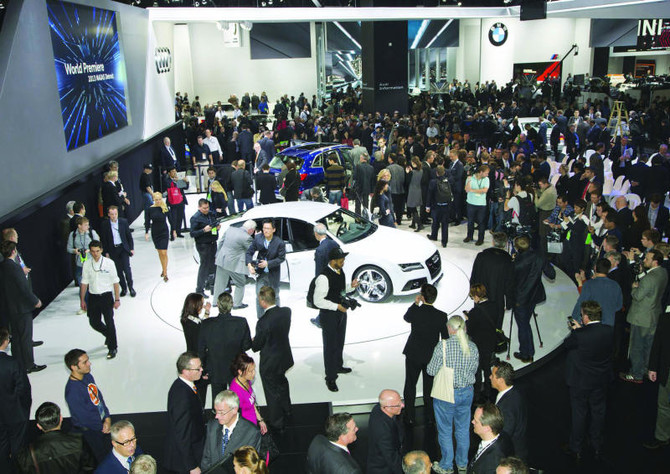
The Audi RS 7 Sportback made its debut at the ongoing week long North American International Auto Show 2013 in Detroit.
The RS 7 Sportback, the large five-door coupe from Audi, combines many strengths to produce a fascinating character. A market launch in the Middle East has been confirmed for 2014.
Its strong heart is the 4.0 TFSI, which takes Audi’s downsizing strategy to the high-end category. The twin-turbo V8 displaces 3,993 cc and develops awesome power, with 560 hp available between 5,700 and 6,700 rpm. A constant 700 Nm of torque are available between 1,750 and 5,500 rpm.
The RS 7 Sportback sprints from 0 to 100 km/h in just 3.9 seconds. Audi limits the top speed in the standard configuration to 250 km/h. Top speed with the optional dynamic package is 280 km/h and 305 km/h with the dynamic package plus. Yet the new top model of the model series consumes on average just 9.8 liters of fuel per 100 km. This top value is due in part to the standard start-stop system and innovative thermal management. The standard eight-speed tiptronic is specially tuned to the sporty character of the Audi RS 7 Sportback.
The most innovative efficiency technology in the new Audi RS 7 Sportback is the cylinder on demand (COD) system. To increase efficiency the 4.0 TFSI runs as a four-cylinder engine at low to medium loads and engine speeds.
The Audi RS 7 Sportback comes standard with quattro permanent all-wheel drive for its decisive advantage in traction and driving safety compared with its two-wheel drive competitors. Audi also offers the optional sport differential for the rear axle, which uses two superposition gears to actively distribute the power between the wheels.
The character of the Audi RS 7 Sportback is immediately obvious. A series of specific design details give a sporty edge to its flowing coupe design. These include the distinctive bumpers and high-gloss black protective grille with honeycomb structure at the front of the car as well as add-on parts in matt aluminum. At the rear of the car, which features a power extending spoiler, the diffuser and the two large, elliptical tailpipe trims of the exhaust system catch the eye. The elegant dynamics carry over to the cockpit of the Audi RS 7 Sportback displays for boost pressure and oil temperature plus a lap timer round out the RS 7-specific menu.
The body of the Audi RS 7 Sportback includes up to 20 percent aluminum and includes many parts of high-strength and ultra high-strength steels. Its high rigidity is the foundation for the precise handling, excellent workmanship and quiet cabin free of intrusive noise.
The Audi RS 7 Sportback comes with a generous list of equipment, including LED headlights, a tire pressure monitoring system, the parking system plus, three-zone automatic air conditioning, cruise control and the Audi sound system in addition to features mentioned previously. high-end options include a head-up display, a comfort package, the dynamic package and the dynamic package plus

Audi RS 7 Sportback debuts at Detroit auto show
St. Francis relics go on public show for first time in Italy
Assisi, Italy: Saint Francis of Assisi’s skeleton is going on public display from Sunday for the first time for the 800th anniversary of his death, drawing hundreds of thousands of visitors.
Inside a nitrogen-filled plexiglass case with the Latin inscription “Corpus Sancti Francisci” (The Body of St. Francis), the remains are being shown in the Italian hill town’s Basilica of St. Francis of Assisi.
St. Francis, who died on October 3, 1226, founded the Franciscan order after renouncing his wealth and devoting his life to the poor.
Giulio Cesareo, director of communications for the Franciscan convent in Assisi said he hoped the display could be “a meaningful experience” for believers and non-believers alike.
Cesareo, a Franciscan friar, said the “damaged” and “consumed” state of the bones showed that St. Francis “gave himself completely” to his life’s work.
His remains, which will be on display until March 22, were transferred to the basilica built in the saint’s honor in 1230.
But it was only in 1818, after excavations carried out in utmost secrecy, that his tomb was rediscovered.
Apart from previous exhumations for inspection and scientific examination, the bones of Saint Francis have only been displayed once, in 1978, to a very limited public and for just one day.
Usually hidden from view, the transparent case containing the relics since 1978 was brought out on Saturday from the metal coffer in which it is kept, inside his stone tomb in the crypt of the basilica.
The case is itself inside another bullet-proof and anti-burglary glass case.
Surveillance cameras will operate 24 hours a day for added protection of the remains.
St. Francis is Italy’s patron saint and the 800th anniversary commemorations of his death will also see the restoration of an October 4 public holiday in his honor.
The holiday had been scrapped nearly 50 years ago for budget reasons.
Its revival is also a tribute to late pope Francis who took on the saint’s name.
Pope Francis died last year at the age of 88.
‘Not a movie set’
Reservations to see the saint’s remains already amount to “almost 400,000 (people) coming from all parts of the world, with of course a clear predominance from Italy,” said Marco Moroni, guardian of the Franciscan convent.
“But we also have Brazilians, North Americans, Africans,” he added.
During this rather quiet time of year, the basilica usually sees 1,000 visitors per day on weekdays, rising to 4,000 on weekends.
The Franciscans said they were expecting 15,000 visitors per day on weekdays and up to 19,000 on Saturdays and Sundays for the month-long display of the remains.
“From the very beginning, since the time of the catacombs, Christians have venerated the bones of martyrs, the relics of martyrs, and they have never really experienced it as something macabre,” Cesareo said.
What “Christians still venerate today, in 2026, in the relics of a saint is the presence of the Holy Spirit,” he said.
Another church in Assisi holds the remains of Carlo Acutis, an Italian teenager who died in 2006 and who was canonized in September by Pope Leo XIV.
Experts said the extended display of St. Francis’s remains should not affect their state of preservation.
“The display case is sealed, so there is no contact with the outside air. In reality, it remains in the same conditions as when it was in the tomb,” Cesareo said.
The light, which will remain subdued in the church, should also not have an effect.
“The basilica will not be lit up like a stadium,” Cesareo said. “This is not a movie set.”


